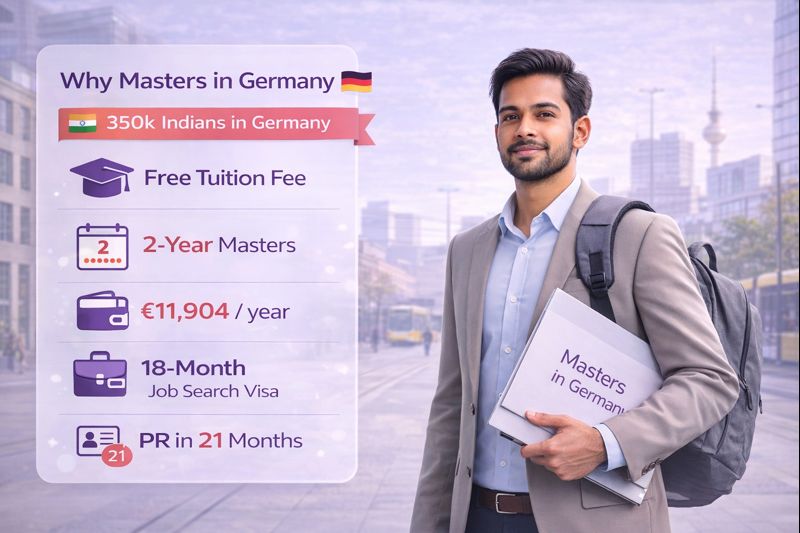
Germany offers Indian students one of the best value propositions for higher education anywhere in the world. Public universities charge no tuition fees—even for international students—while providing globally recognized degrees in engineering, computer science, business, and natural sciences. With over 43,000 Indian students already studying in Germany and a 350,000-strong Indian community, you’ll find familiar support networks in every major city. This comprehensive guide covers everything from choosing universities and understanding eligibility requirements to navigating German bureaucracy, funding your studies, and building a career that leads to Permanent Residence in as little as 21 months after employment.
| Aspect | Details |
|---|---|
| Tuition (Public Universities) | €0 (Free) |
| Tuition (Private Universities) | €10,000–30,000/year |
| Tuition (MBA Programs) | €15,000–40,000/year |
| Semester Admin Fee | €150–400/semester (includes public transport) |
| Living Expenses (Blocked Account) | €11,904/year (€992/month) |
| Total Cost – Public Uni (2 years) | €24,000–28,000 (~₹22–26 lakhs) |
| Program Duration | 2 years (most Masters) |
| Post-Study Work Visa | 18 months (any job allowed) |
| PR Timeline (Blue Card + B1) | 21 months after employment |
| PR Timeline (German Graduate) | 2 years after employment |
| Citizenship Timeline | 5 years total residence |
| Student Work Limit | 120 full days OR 240 half days/year |
| Indian Students in Germany | 43,000+ (largest international group) |
| Indians Living in Germany | 350,000+ |
Currency note: INR values at approximately 1 EUR ≈ ₹92. Exchange rates fluctuate.
This guide will walk you through everything — from choosing your university to landing your first job. No fluff. No sugar-coating. Just the real information you need to make this happen.
Why Study Masters in Germany?
Let’s address the question that brought you here: Is Germany really worth it?
The short answer: Yes—if you’re willing to invest in learning German and navigate bureaucracy. Here’s why Germany increasingly beats UK, USA, and Canada for Indian students thinking long-term.
The “Free Education” Reality
Public universities in Germany charge no tuition fees—even for international students. You’ll pay only a semester contribution (€150–400), which typically includes a public transport pass for the entire semester.
But “free tuition” doesn’t mean “zero cost.” Here’s the real math:
| Cost Component | Per Year | 2-Year Total |
|---|---|---|
| Semester fees | €300–800 | €600–1,600 |
| Living expenses (blocked account) | €11,904 | €23,808 |
| Health insurance | ~€1,200 | ~€2,400 |
| Books, misc | ~€500 | ~€1,000 |
| Total | ~€14,000 | ~€28,000 |
That’s roughly ₹22–26 lakhs for a complete Masters degree. Compare this to UK (₹50–80 lakhs) or USA (₹80–150 lakhs). The ROI is unmatched.
High-Quality Education & Global Recognition
German universities aren’t just cheap—they’re genuinely excellent:
- TU9 Alliance (Technical Universities) — Comparable to IITs in reputation for engineering
- Strong research focus (U15) — Direct connections to Max Planck, Fraunhofer institutes
- Industry integration — Thesis projects, internships with BMW, Siemens, Bosch, SAP
- “Made in Germany” brand — German engineering degrees open doors worldwide
A Masters from TU Munich, RWTH Aachen, or KIT carries significant weight with global employers. Even lesser-known German universities provide rigorous education that employers respect.
English-Taught Programs Available
Worried about German? Over 1,800 Masters programs are taught entirely in English at German universities. You can study in English while learning German on the side—the smart strategy for career success.
Popular English-taught fields include Computer Science, Data Science, Business, International Management, and increasingly, Engineering programs.
Career Opportunities After Graduation
This is where Germany truly shines:
| What You Get | Details |
|---|---|
| Post-study work visa | 18 months to find any job |
| Job market access | Germany has skilled worker shortage |
| Blue Card eligibility | Salary threshold €45,300 (shortage) / €50,700 (standard) |
| PR fast-track | 21 months with Blue Card + B1 German |
| Citizenship path | 5 years total residence |
Germany wants skilled graduates to stay. The 18-month job search visa lets you work any job while finding qualified employment. Once you land a skilled job, the path to permanent residency is clearer than in UK, USA, or Canada.
Germany’s Position in the World
This isn’t just about cheap education. It’s about where you’re positioning yourself for the next 20-30 years of your career.
| Fact | Why It Matters |
|---|---|
| #1 economy in the EU | Jobs everywhere, stable economy |
| #4 economy globally | Global companies, international opportunities |
| Borders 9 countries | France, Austria, Switzerland, Netherlands, Belgium, Luxembourg, Poland, Czech Republic, Denmark |
| Heart of Europe | European Central Bank in Frankfurt, major EU decisions flow through Berlin |
| “Made in Germany” | Global gold standard for engineering, automotive, precision technology |
German Inventions That Changed the World
Innovation is literally in the culture here:
- 🚗 The Automobile (Karl Benz, 1886)
- 🖨️ The Printing Press (Gutenberg)
- 💊 Aspirin (Bayer)
- 🎵 MP3 technology
- 🔬 X-rays (Wilhelm Röntgen)
- 🚂 The Diesel engine (Rudolf Diesel)
- 🥤 Fanta (yes, really — invented in Germany in 1940!)
When you study in Germany, you’re joining a legacy of innovation that shaped the modern world.
The Travel Bonus
Here’s something the official university websites won’t tell you: Germany’s location is incredible for travel.
From Frankfurt:
- 🇨🇭 Switzerland: 4 hours by train
- 🇫🇷 Paris: 4 hours by train
- 🇳🇱 Amsterdam: 4 hours by train
- 🇧🇪 Brussels: 3 hours by train
Weekend trips to Paris, Amsterdam, Prague, Vienna? That’s just normal life for students in Germany. Ryanair flights for €20-50, FlixBus tickets for even cheaper. Your Instagram is going to look incredible.
🏎️ And then there’s the Autobahn…
Germany’s famous highway system has sections with no speed limits. Yes, you can legally drive at 200+ km/h. Rent a car with friends, hit the Autobahn, and experience what driving is supposed to feel like. Road trips to Austria, Switzerland, or the Netherlands become an adventure, not just transport.
With Germany as your base, you can realistically visit 15-20 European countries during your 2-year Masters. Try doing that from the USA.
Strong Indian Community
You won’t be alone:
- 43,000+ Indian students currently studying in Germany
- 350,000+ Indians living in Germany
- Indian grocery stores, temples, restaurants in every major city
- Diwali, Holi, cricket screenings, Bollywood events everywhere
- Seniors from your college likely already there to guide you
Popular Fields of Study for Indian Students
Germany excels in specific fields that align with Indian students’ backgrounds and career goals. Here’s where German universities truly shine:
Engineering (Mechanical, Electrical, Automotive, Aerospace)
Germany is the global leader in engineering education. The country that invented the automobile, diesel engine, and modern manufacturing processes offers unmatched opportunities.
| Specialization | Language | Top Universities | Job Prospects |
|---|---|---|---|
| Mechanical Engineering | English/German | TU Munich, RWTH Aachen, TU Berlin | Excellent — automotive, manufacturing |
| Electrical Engineering | English/German | TU Munich, KIT, TU Darmstadt | Excellent — Siemens, Bosch, Infineon |
| Automotive Engineering | Mostly German | TU Munich, Stuttgart, RWTH Aachen | Outstanding — BMW, Mercedes, VW, Porsche |
| Automotive Software | English available | TU Munich, Stuttgart, Chemnitz | Outstanding — ADAS, autonomous driving |
| Aerospace Engineering | English/German | TU Munich, Stuttgart, TU Berlin | Strong — Airbus, DLR, MTU |
Why Germany for Engineering:
- “Made in Germany” is the global gold standard for engineering
- TU9 universities (think “IITs of Germany”) have direct industry pipelines
- Thesis and internship opportunities with world-leading companies
- German engineering degrees are recognized and respected worldwide
Computer Science & IT
Germany’s tech sector is booming, with strong demand for software engineers, data scientists, and AI specialists.
| Specialization | Demand | Entry Salary | German Needed |
|---|---|---|---|
| Software Engineering | Very High | €48,000–58,000 | A2-B1 (startups often less) |
| Data Science | Very High | €50,000–60,000 | B1-B2 |
| AI/Machine Learning | Very High | €55,000–70,000 | B1 often sufficient |
| Cyber Security | High | €50,000–65,000 | B1-B2 |
| Cloud/DevOps | High | €50,000–62,000 | A2-B1 |
Top universities for CS: TU Munich, RWTH Aachen, KIT, TU Berlin, Saarland (for AI)
Business & Economics
For MBA aspirants and business-focused students, Germany offers solid options—though with important caveats.
| Program Type | Typical Cost | Language | Career Path |
|---|---|---|---|
| MBA (Public Uni) | €2,000–15,000 total | English | Consulting, management |
| MBA (Private/Top) | €30,000–80,000 | English | Strategy, leadership |
| International Business | €0–500/year (public) | English | Marketing, operations |
| Finance | €0–500/year (public) | English/German | Banking (Frankfurt) |
| Economics | €0–500/year (public) | English/German | Research, policy, consulting |
Top business schools: Mannheim Business School, WHU, ESMT Berlin, Frankfurt School (all private/expensive), plus public options at LMU Munich, Goethe University Frankfurt.
Natural Sciences & Mathematics
Germany has an exceptional research infrastructure, with four Nobel Prize-winning research networks actively recruiting international talent.
| Field | Research Opportunities | Funding | Career Paths |
|---|---|---|---|
| Physics | Excellent (Max Planck Institutes) | Strong PhD funding | Research, tech industry, finance |
| Chemistry | Excellent (BASF, Bayer connections) | Industry-sponsored | Pharma, chemicals, materials |
| Mathematics | Strong | Academic focus | Finance (quant), tech, academia |
| Biology/Biotech | Good | EU research grants | Biotech, pharma, research |
Top research universities: LMU Munich, Heidelberg, Göttingen, Bonn, TU Munich
Many natural science Masters programs naturally lead to funded PhD positions in Germany’s research institutes—an excellent path for those interested in research careers.
Global Recognition of German Masters Degrees
Will employers outside Germany value your degree? Absolutely.
Why German Degrees Command Respect
| Factor | Reality |
|---|---|
| Engineering reputation | German engineering degrees are considered among the best globally |
| Research intensity | Emphasis on practical research and industry collaboration |
| Quality assurance | All programs accredited by German government standards |
| Industry connections | TU9 universities have direct pipelines to BMW, Siemens, SAP, Bosch |
| Global employer recognition | HR departments worldwide recognize German university quality |
University Tiers That Matter
TU9 — Technical Universities (Elite for Engineering/Tech) TU Munich, RWTH Aachen, TU Berlin, TU Darmstadt, TU Dresden, TU Braunschweig, TU Kaiserslautern, KIT (Karlsruhe), University of Stuttgart
These are the “IITs of Germany”—extremely competitive admissions, highly respected globally. For detailed comparison, see our How to Choose a University guide.
U15 Research Universities Top research-intensive universities including LMU Munich, Heidelberg, Göttingen. Strong for natural sciences, medicine, humanities.
Universities of Applied Sciences (Fachhochschulen/HAW) More practical, industry-focused education. Don’t underestimate these—German employers often prefer FH graduates for their hands-on skills. Smaller class sizes, more internship integration.
Career Impact by Background
| Your Background | German Masters Impact |
|---|---|
| Tier 2/3 Indian College | Massive upgrade — German degree significantly overshadows undergrad brand |
| IIT/NIT Graduate | Lateral move in prestige, but adds European market access |
| Working Professional | Career reset opportunity — German Masters + work experience = powerful combination |
| Non-traditional Background | Fresh start — German universities evaluate holistically |
The insider truth: Your German university name matters less than you think. What matters more: your thesis topic, Werkstudent experience, German language skills, and networking during studies.
The Hard Truths (Read This Before Deciding)
Germany is excellent, but it’s not for everyone. Let me be honest about the challenges:
Truth #1: German Language is Non-Negotiable for Career Success
Yes, you can study in English. Yes, you can survive in Berlin or Munich with English. But here’s what the glossy brochures don’t tell you:
80-90% of jobs in Germany require German language skills.
Even in “international” companies, even in tech:
- Informal conversations switch to German
- Career advancement requires German
- Client communication often requires German
- Networking events, industry conferences—German
The consequence: I’ve seen brilliant Indian engineers stuck in junior positions for years because they never learned German. And I’ve seen average students leapfrog ahead because they invested in the language.
The solution: Start learning German NOW. Aim for A2 before arrival, B1 by end of first year, B2 by graduation. This investment pays massive dividends. See our upcoming [Learn German: A1 to B2 Guide] for a complete strategy.
Truth #2: German Bureaucracy is Real
Germans love paperwork. And rules. And processes. You’ll encounter this at every stage:
- APS certificate (mandatory document verification)
- University applications through uni-assist
- Visa application at VFS
- City registration (Anmeldung) after arrival
- Opening a bank account
- Health insurance enrollment
- Residence permit extensions
Each step has specific requirements. Miss one document? Start over.
The good news: This is exactly why we created this guide series. We walk you through each process step-by-step. Start with understanding Eligibility Requirements, APS Certificate and further till you land your job.
Truth #3: Weather and Culture Adjustment
Let’s be realistic:
- German winters are dark and cold (especially challenging for South Indians)
- Germans are initially reserved—not unfriendly, just private
- Sundays are quiet—most shops closed
- Everything requires appointments (even going to a government office)
- The food is very different (though Indian grocery stores help)
Students who thrive:
- Join student associations and sports clubs
- Connect with the Indian community (350,000+ Indians in Germany)
- Learn enough German to break the ice with locals
- Give themselves time to adapt (first 6 months are hardest)
Your Complete Roadmap: 6-18 Months to Germany before Intake
Here’s the journey from “I want to study in Germany” to “I’m working at a German company.” We’ve organized it into 7 phases.
VISUAL TIMELINE
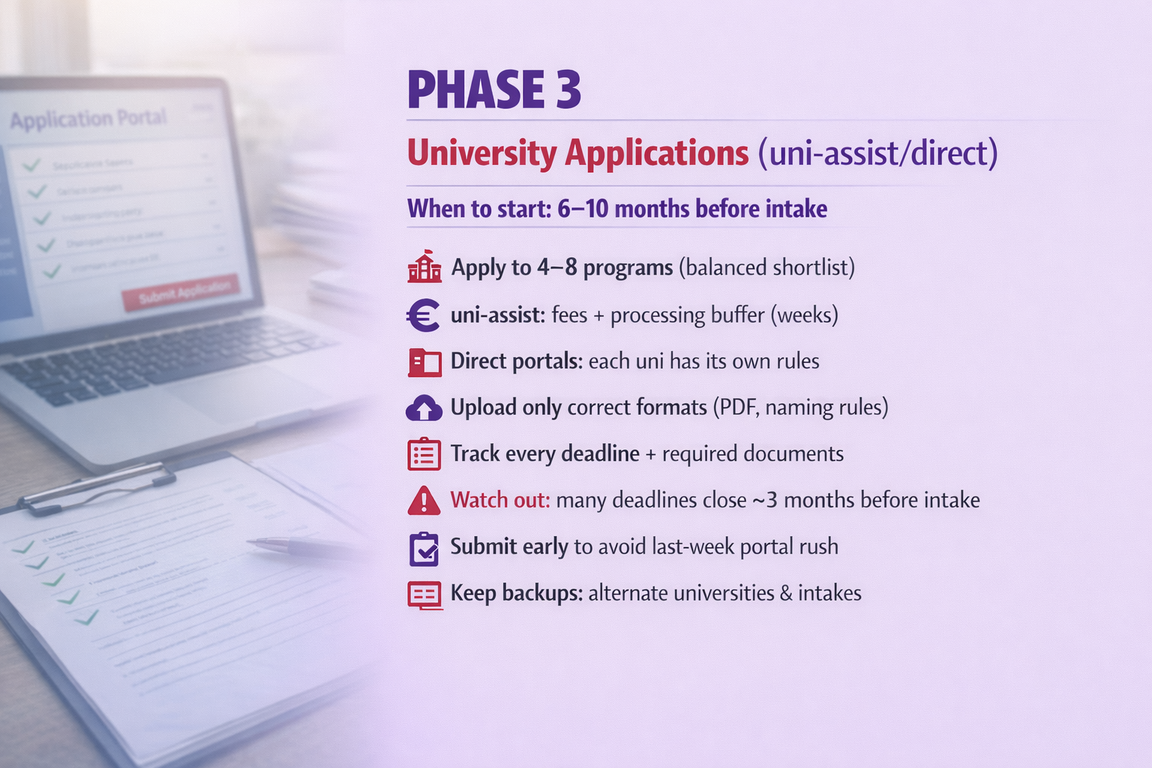
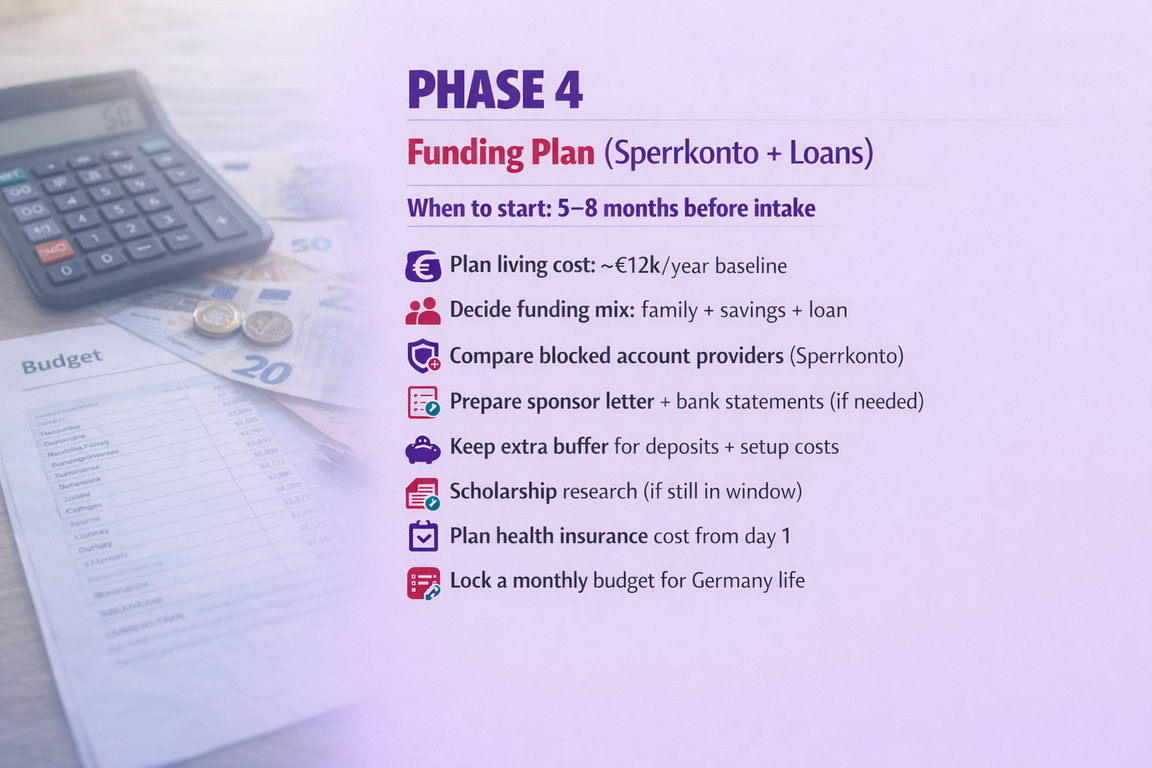
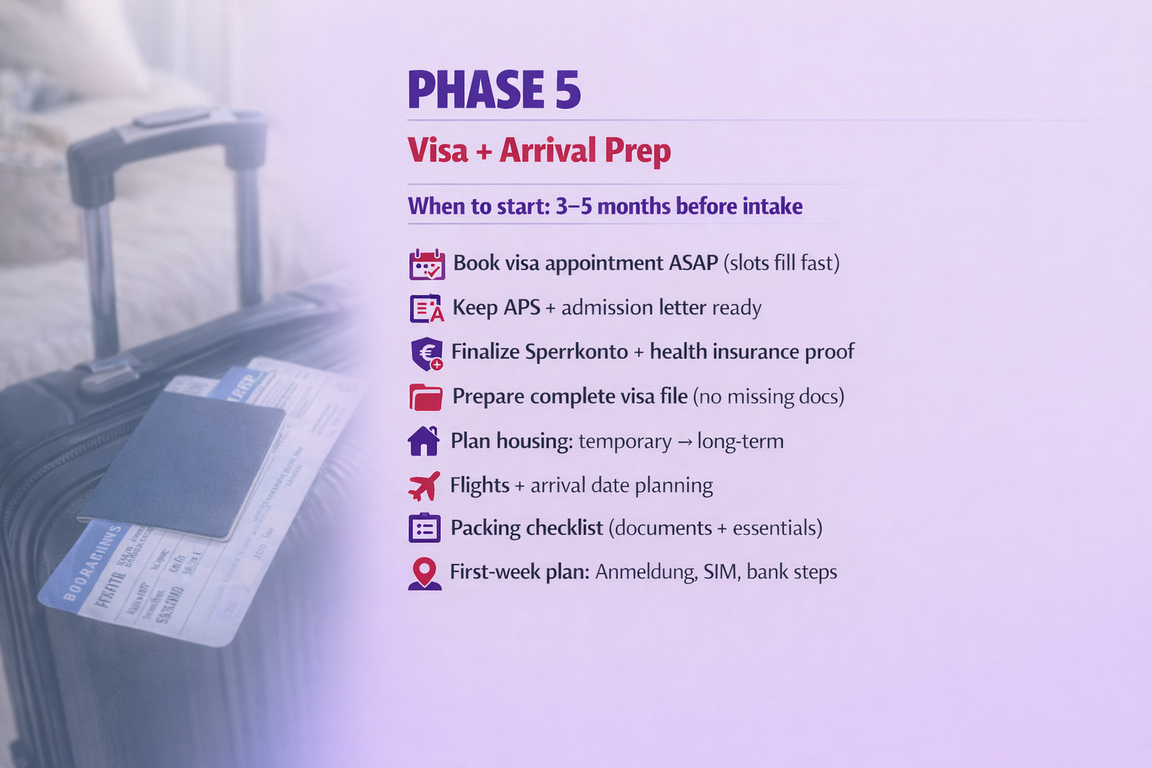
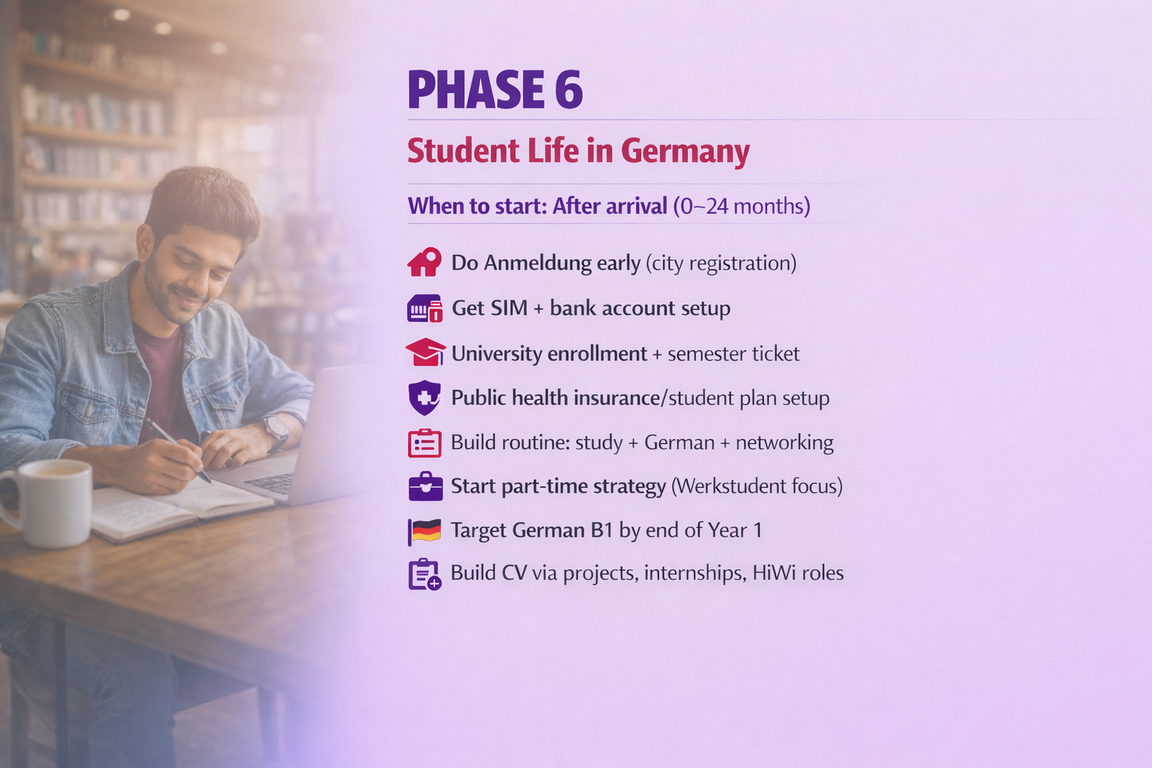
The ideal path gives you time for scholarships (DAAD deadlines are October-November, a full year before intake). But many successful students started with just 6 months—tight, but doable with proper organization.
Phase-by-Phase Breakdown
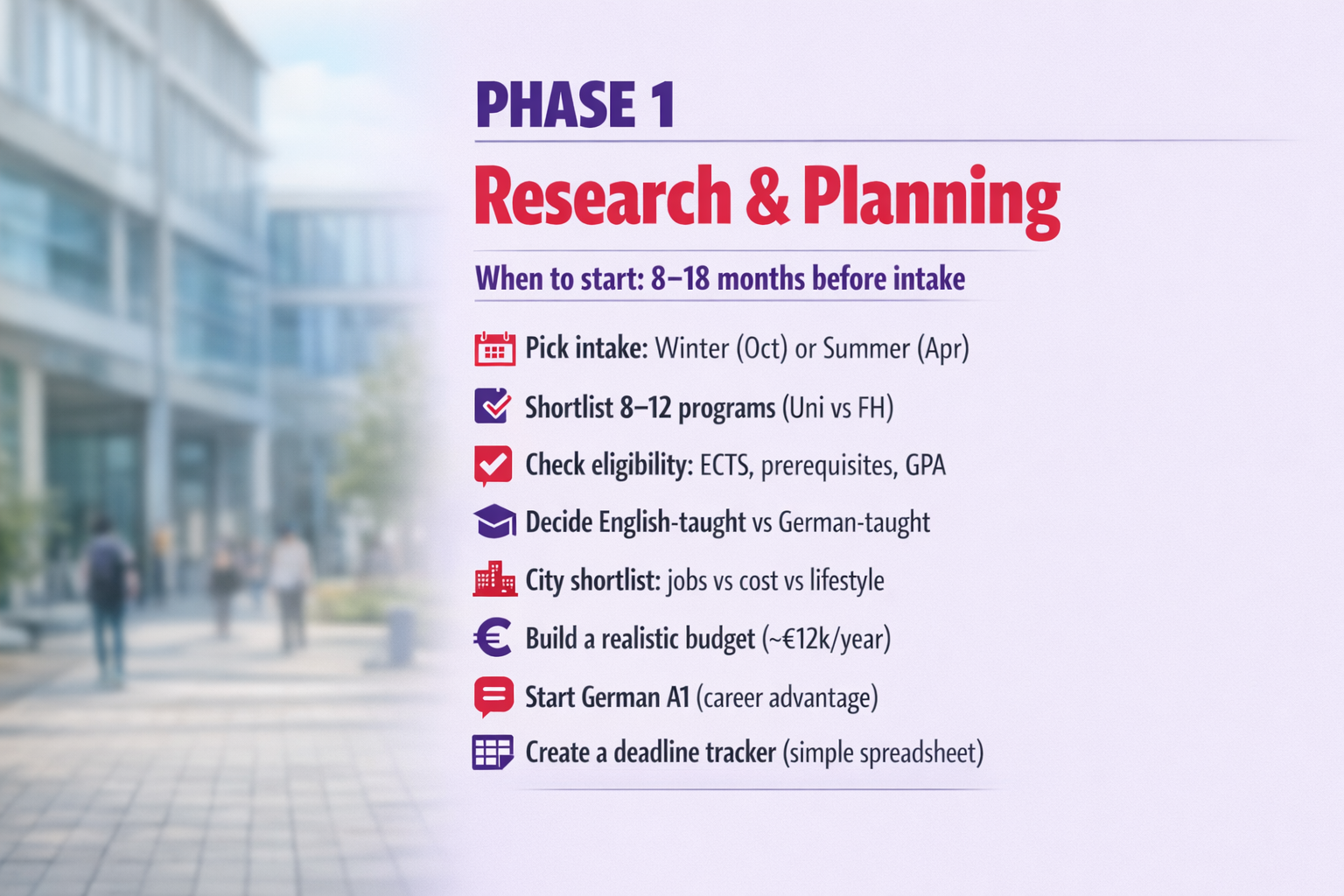
PHASE 1: Research & Planning
Timeline: 12-18 months before (ideal), 6+ months (minimum)
What you’ll decide:
- Which universities match your profile
- Whether Germany is right compared to UK/USA/Canada
- English-taught vs German-taught programs
- City preferences (Munich vs Berlin vs smaller cities)
Key Guides:
- How to Choose a University in Germany — TU9, U15, Fachhochschulen explained
- Germany vs UK, USA, Canada, Ireland, Netherlands Comparison — ROI analysis
- Masters in Germany Eligibility Requirements — Check if you qualify
Resources:
- DAAD Database — Official program search
- Hochschulkompass — All German programs
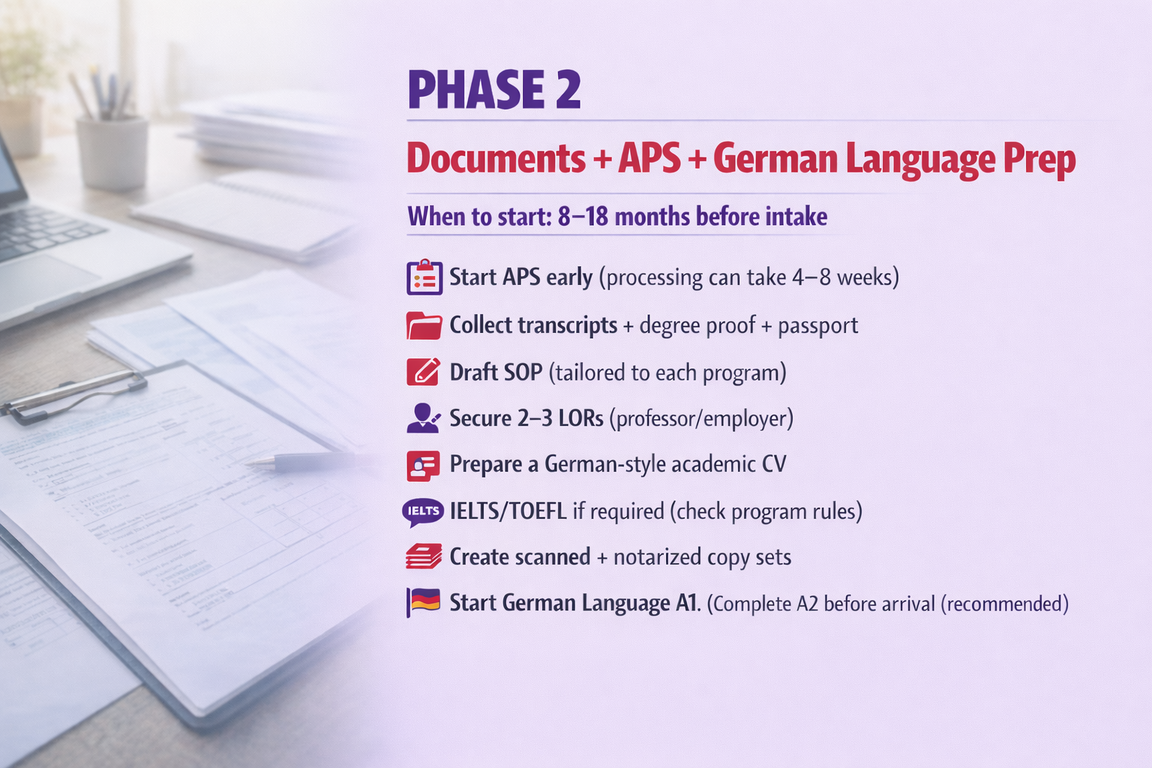
PHASE 2: Documentation
Timeline: 10-14 months before (ideal)
What you’ll prepare:
- APS Certificate (mandatory for Indian students)
- Statement of Purpose (SOP)
- Letters of Recommendation (LOR)
- Academic CV
- Language certificates
Key Guides:
- APS Certificate Germany Complete Guide — Complete step-by-step process
- Masters in Germany Application: SOP, LOR, CV and Documents Guide — Templates and strategies
Critical: APS takes 4-8 weeks to process. You cannot apply to most German universities without it. Start this EARLY.
PHASE 3: Application
Timeline: 6-10 months before intake
What you’ll do:
- Submit university applications
- Navigate uni-assist portal
- Track multiple deadlines
- Wait for decisions
Key Deadlines (Winter Semester 2026 — October intake):
- uni-assist: July 15, 2026
- TU Munich: May 31, 2026
- Direct applications: Varies by university
Coming Soon: Application Timeline 2026/2027 Guide, uni-assist Guide
PHASE 4: Funding
Timeline: Apply for scholarships 12+ months before!
What you’ll arrange:
- Blocked account (€11,904 — mandatory for visa)
- Scholarships (if applicable)
- Education loan (if needed)
- Family support documentation
Key Guides:
- Sperrkonto (Blocked Account) — Provider comparison, step-by-step
Scholarship Deadlines: DAAD applications are October-November of the year BEFORE you start. For October 2026 intake, apply by October-November 2025.
Coming Soon: Scholarships Guide, Education Loans Guide
PHASE 5: Visa & Arrival
Timeline: 2-4 months before departure
What you’ll handle:
- German Student Visa application (VFS)
- Document preparation
- Packing essentials
- First steps after landing
Key Guides:
- Anmeldung (City Registration) — Critical first step after arrival
- German Banking — Opening your first account
- Health Insurance — Mandatory coverage
Coming Soon: Student Visa Guide, First 30 Days Checklist
PHASE 6: Student Life
Timeline: During your studies
What you’ll optimize:
- Part-time work (120 full days / 240 half days per year)
- Werkstudent positions (the golden option)
- German language progression
- Building networks
How students fund their living costs:
| Job Type | Hourly Rate | Monthly Potential |
|---|---|---|
| Werkstudent (corporate) | €15–25 | €800–1,500 |
| Mini-job (retail, restaurant) | €12–15 | €450–600 |
| HiWi (university assistant) | €12–15 | €400–600 |
| Tutoring | €15–30 | Varies |
Werkstudent positions are the best option—corporate work in your field, €15-25/hour, often converts to full-time job after graduation. Start applying from semester 2.
Coming Soon: Werkstudent Jobs Guide, Student Life Hacks
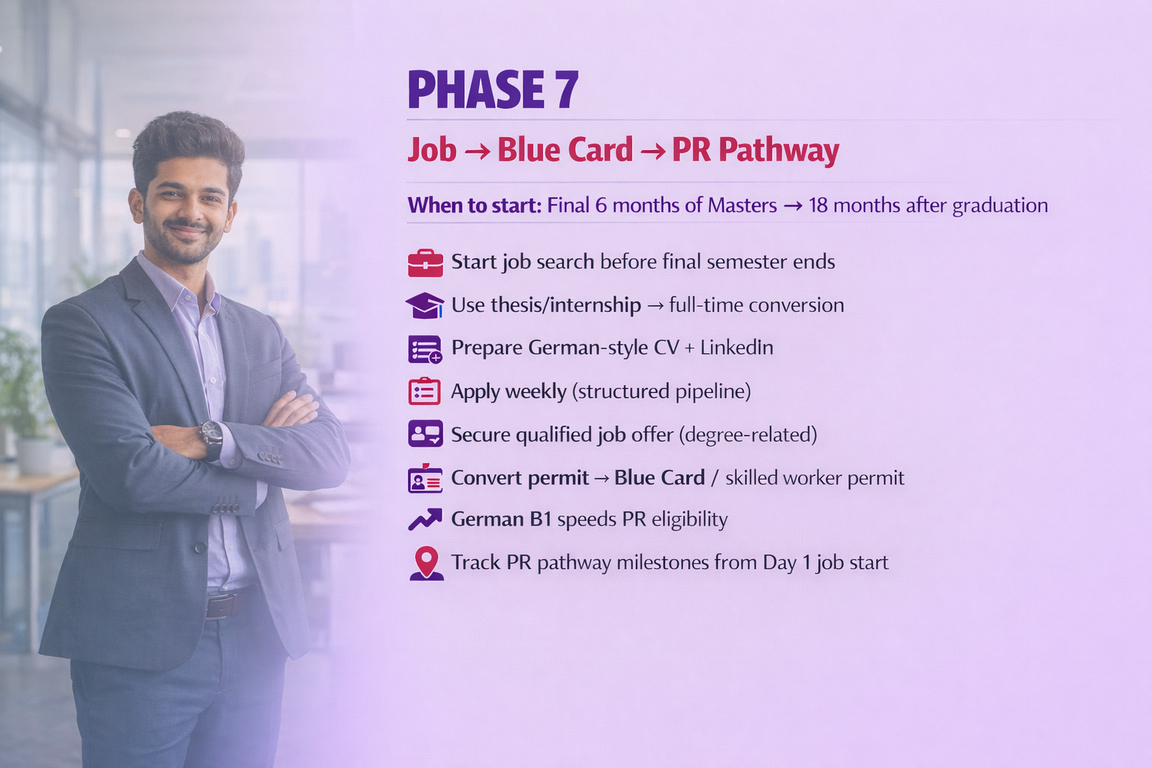
PHASE 7: Career & Beyond
Timeline: Start in semester 3, not after graduation
What you’ll pursue:
- Thesis at a company (Masterarbeit bei Unternehmen)
- Converting Werkstudent to full-time
- Job search strategy
- Visa transition
Key Guides:
- EU Blue Card — The skilled worker visa
- Permanent Residence — Your long-term pathway
- Opportunity Card — Alternative entry route
Coming Soon: Job Search Strategy, Post-Study Visa Guide
Career Opportunities After Graduation
Let’s talk about what happens after you finish your Masters.
The 18-Month Post-Study Advantage
After your 2-year Masters, you receive an 18-month Job Seeker Visa (§20 AufenthG):
- Can work ANY job during this time (even unrelated to your degree)
- No restrictions on hours
- Time to find the right opportunity without visa pressure
- Convert to EU Blue Card once you land qualified employment
Industries Actively Hiring Indian Graduates
| Industry | Key Employers | Hiring Level | German Needed |
|---|---|---|---|
| Automotive | BMW, Mercedes, VW, Bosch, Continental | Very High | B1-B2 |
| IT/Tech | SAP, Siemens, Deutsche Telekom, startups | Very High | A2-B1 |
| Consulting | Big 4, McKinsey, BCG | Medium | B2-C1 |
| Finance | Deutsche Bank, Commerzbank (Frankfurt) | Medium | B2-C1 |
| Pharma | Bayer, BASF, Merck, Boehringer | Medium | B1-B2 |
| Manufacturing | Siemens, ThyssenKrupp, ABB | High | B1-B2 |
Entry-Level Salaries by Field (2026)
| Field | Entry Salary | With 3-5 Years |
|---|---|---|
| Software Engineering | €48,000–58,000 | €65,000–80,000 |
| Data Science | €50,000–60,000 | €70,000–90,000 |
| Mechanical Engineering | €48,000–55,000 | €60,000–75,000 |
| Automotive Engineering | €52,000–62,000 | €70,000–90,000 |
| Business/Consulting | €45,000–55,000 | €65,000–90,000 |
| Finance (Frankfurt) | €50,000–65,000 | €80,000–120,000 |
Gross annual salaries. Net (after tax) is typically 55-65% of gross.
Job Search Success Factors
Students who find jobs within 3-6 months of graduation typically:
- Started job searching in semester 3 (not after graduation)
- Did Werkstudent/internship at their target company
- Wrote their thesis at a company (Masterarbeit bei Unternehmen)
- Reached B1-B2 German by graduation
- Networked actively (Xing, LinkedIn, industry events)
How Student Time Counts Toward PR & Citizenship
This is important for long-term planning:
Permanent Residence (Niederlassungserlaubnis)
General Route (5 years):
- Student time counts at 50% (2 years study = 1 year credit)
- Need 5 years total to qualify
German Graduate Fast-Track (2 years):
- Graduate from German university ✓
- Job related to your qualification ✓
- §18a/§18b/§18d residence permit ✓
- 24 months pension contributions ✓
- B1 German ✓
- = PR eligible after just 2 years of working
EU Blue Card Fast-Track:
- B1 German: PR in 21 months
- A1 German: PR in 27 months
For complete details, see our Permanent Residence Guide.
Citizenship (Einbürgerung)
Current requirement: 5 years total residence
- You CANNOT apply while on student visa (§16b)
- Must first switch to work permit after graduation
- Student time DOES count toward residence period
- 3-year “fast-track” was ABOLISHED in October 2025
Typical timeline:
- 2 years Masters (student visa)
- Graduate → Switch to work permit
- 3 years working = 5 years total
- Apply for citizenship
Other requirements: B1 German, citizenship test, financial self-sufficiency, no criminal record
Quick Comparison: Germany vs Other Countries
| Factor | 🇩🇪 Germany | 🇬🇧 UK | 🇺🇸 USA | 🇨🇦 Canada |
|---|---|---|---|---|
| Tuition (per year) | €0–500 | £18,000–35,000 | $35,000–60,000 | CAD 20,000–45,000 |
| Living Cost (per year) | €12,000–14,000 | £12,000–15,000 | $18,000–25,000 | CAD 15,000–20,000 |
| Total 2-Year Cost | €24,000–30,000 | £60,000–100,000 | $100,000–170,000 | CAD 70,000–130,000 |
| In INR (approx) | ₹22–28 lakhs | ₹65–110 lakhs | ₹90–150 lakhs | ₹50–90 lakhs |
| Post-Study Visa | 18 months | 2 years | OPT (limited) | 3 years (PGWP) |
| PR Timeline | 21 months* | 5+ years | Uncertain | 3-5 years |
| Language Barrier | German needed | English | English | English |
*After starting qualified employment with EU Blue Card + B1 German
Bottom line: Germany offers the best ROI if you’re willing to learn German. For detailed analysis, see Germany vs UK, USA, Canada, Ireland and Netherlands.
🎓 Connect With the Indian Community
Brizz.me is your digital home in Germany:
Find what you need:
- 🎉 Desi events in Germany — Indian festivals, Bollywood nights, student meetups — Find on Brizz Events
- 🏠 Indian flatmates in Germany — verified WG rooms from community — Find on Brizz Rentals
- ✅ Desi services — German tutors, tax consultants, student consulting — Discover on Brizz Services
- 📚 Free student guides — Visa, blocked account, university tips — Read on Brizz Guides
Share with the community:
- 🎤 Organizing a Desi event? — List for free, reach thousands of Indians — Create on Brizz Events
- 💼 Offer tutoring or consulting? — Students & professionals welcome — List on Brizz Services
📍 Join the Desi community — Start at brizz.me
FAQ
Is education in Germany really free for Indian students? Yes, public universities charge no tuition—only semester fees (€150-400). You’ll need €11,904/year for living expenses in a blocked account. Total 2-year cost: ~€24,000-28,000 (₹22-26 lakhs).
Do I need to know German to study in Germany? For admission: No—1,800+ programs are English-taught. For career: Yes—80-90% of jobs require German. Start learning now, aim for B1-B2 by graduation.
What are the best fields to study in Germany? Engineering (especially automotive, mechanical), Computer Science, Data Science, and Natural Sciences. Germany excels in technical education with strong industry connections.
How much can I earn while studying? Working 20 hours/week in a Werkstudent position can earn €800-1,500/month. Legal limit: 120 full days or 240 half days per year.
What is APS and why do I need it? APS (Akademische Prüfstelle) verifies your academic documents. Mandatory for all Indian students since November 2022. Fee: ₹18,000, Processing: 4-8 weeks. Start early—see our APS Guide.
How long can I stay after graduation? 18 months on the Post-Study Job Seeker Visa. You can work any job while searching for qualified employment.
How fast can I get Permanent Residence? German graduates: 2 years of working. Blue Card holders with B1 German: 21 months. See PR Guide for complete pathways.
Which German cities are best for Indian students? Munich (automotive, tech), Frankfurt (finance), Berlin (startups), Stuttgart (automotive). All have strong Indian communities. Smaller cities like Dresden, Leipzig offer lower costs.
Can I bring my family to Germany? Yes, with proof of sufficient funds. Spouse gets dependent visa with work rights. Children can attend free German schools.
What are the job prospects after graduation? Excellent if prepared. Germany has skilled worker shortage in IT, engineering, healthcare. Key: Learn German (B1-B2), start job search in semester 3, do internships.
About This Guide Series
This Guide #1 is part of “Study Masters in Germany: From Application to Employment” — a 20-part series by Brizz.me for Indian students.
| # | Guide |
|---|---|
| 1 | Masters in Germany — Complete Guide |
| 2 | Germany vs UK, USA, Canada, Ireland, Netherlands |
| 3 | How to Choose a University in Germany |
| 4 | Masters in Germany Eligibility Requirements |
| 5 | APS Certificate Germany Guide |
| 6 | Masters in Germany Application: SOP, LOR, CV & Documents |
| 7 | Learn German for Germany: A1 to B2 |
| 8 | Germany Application Timelines 2026 and 2027 |
| 9 | Germany uni-assist Guide |
| 10 | Germany Scholarships Guide |
| 11 | Germany Sperrkonto (Blocked Account) |
| 12 | Education Loans from India for Germany |
| 13 | Germany Student Visa Application |
| 14 | First 30 Days in Germany Checklist |
| 15 | Germany Werkstudent Jobs Guide |
| 16 | Germany Student Life Hacks |
| 17 | Germany Job Search Strategy |
| 18 | Germany Job Seeker Visa (§20) |
| 19 | Student to Blue Card Germany |
| 20 | Germany Permanent Residence (PR) |
Next →: Germany vs UK, USA, Canada, Ireland, Netherlands
Final Thoughts
Germany is genuinely one of the best destinations for Indian students thinking long-term. Free tuition, strong industry connections, clear PR pathway, and a thriving Indian community make it an exceptional choice.
But success requires preparation:
- Start German early — This is the #1 factor for career success
- Plan 12-18 months ahead — Especially for scholarships
- Use this guide series — We’ve documented every step
The path is clear. The opportunity is real. Now it’s up to you.
You’ve got this — Germany rewards those who prepare.
⚠️ Disclaimer: This is educational content, not legal or immigration advice. University requirements, visa rules, and costs change frequently. Always verify current requirements with official sources (German Embassy, DAAD, Make-it-in-Germany.com) before making decisions. Information accurate as of January 2026.
Last Updated: January 2026 Author: Brizz.me Editorial Team
Keywords: Study Masters in Germany for Indian students, Masters in Germany free tuition, Germany student visa India, German universities for Indians, study abroad Germany cost, Germany PR for students, post-study work visa Germany, DAAD scholarship India, APS certificate Germany Indian students, blocked account Germany, uni-assist Germany Indian students, English taught masters Germany, public universities Germany masters