You land in Germany with one suitcase, a phone full of screenshots, and the blunt realization that a “student room” is not waiting for you at the airport. If you're an international student, especially from India, the housing search starts feeling serious the moment you hear the word semester. The people who get decent rooms are usually not the luckiest, they're the ones who started early, worked the timeline, and stopped treating housing like a last-minute admin task.
- The Three Doors Into Student Housing in Germany
- How the Public Dorm System Works
- WG Rooms, Private Studios and Shared Flats Compared
- Contracts, Deposits and What Landlords Really Check
- The Timeline That Actually Gets You a Room
- City-Specific Housing Realities Across Germany
- Common Mistakes International Students Make
- Your Next Steps and Where to Find Listings Today
The Three Doors Into Student Housing in Germany
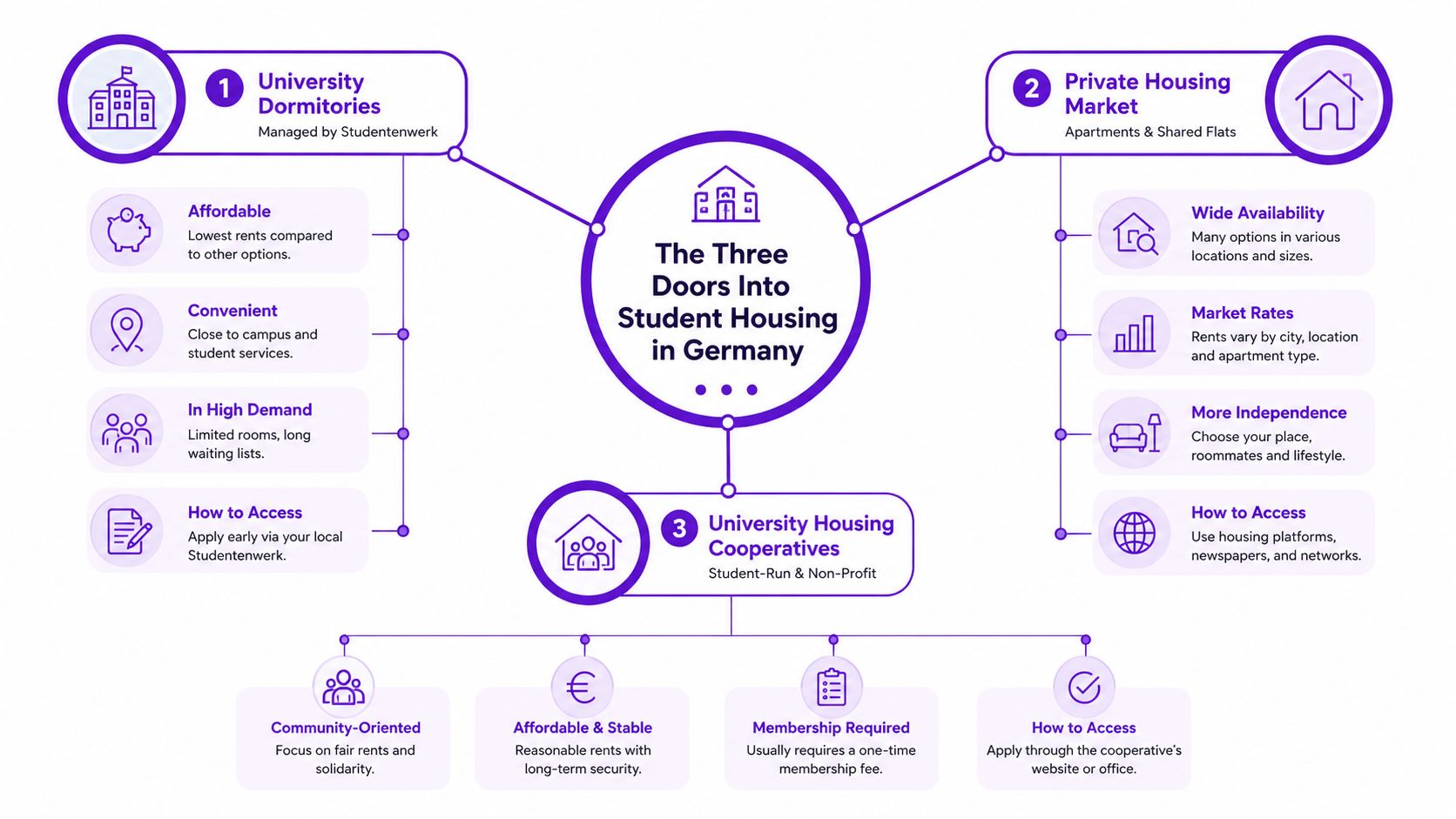
Your first week in Germany can go two ways. Either you step out of the train with a confirmed key in your pocket, or you spend the first nights refreshing housing portals in a hostel lobby. The difference usually comes down to understanding that student accommodation Germany is not one market, it's three overlapping ones.
Public dorms, private student halls, and the open rental market
The first door is the public dorm system run by Studierendenwerke. This is the cheapest and most subsidized route, but it's also the most crowded, which is exactly why you should treat it like a lottery with rules, not a sure thing. In 2025, publicly funded student residence places stood at 241,732, with Studierendenwerke operating about 196,749 of them, roughly 81% of the total, while coverage remained far below total student demand (source).
The second door is private student housing, run by companies and funds that build furnished studios or cluster flats for students. This option usually gives you more polish, more predictable furnishings, and less bureaucracy than the public system, but you pay for it. It's the lane for students who want convenience and can tolerate a higher monthly cost in exchange for less stress.
The third door is the open rental market, which is where WG rooms and small flats live. This is the most flexible route, and in many cities it's also the most realistic one when dorms are full. If you want a stronger map of the process and what to compare before you start writing messages, the practical housing overview at Brizz guides is worth keeping open in another tab.
Practical rule: apply to all three doors at once. Dorms for price, private halls for certainty, WGs for availability.
Why the timeline matters more than the label
Students love asking, “Which option is best?” Wrong question. The better question is, “Which option will still be available when I arrive?” A dorm room is great if you apply early enough. A WG room is great if you can move fast and speak like a real person, not a template. A private studio is great if you can pay for the convenience.
That's the actual structure of housing here. The label matters less than the lead time. Start late, and even the “cheap” option becomes unavailable. Start early, and the whole market opens up a little.
How the Public Dorm System Works
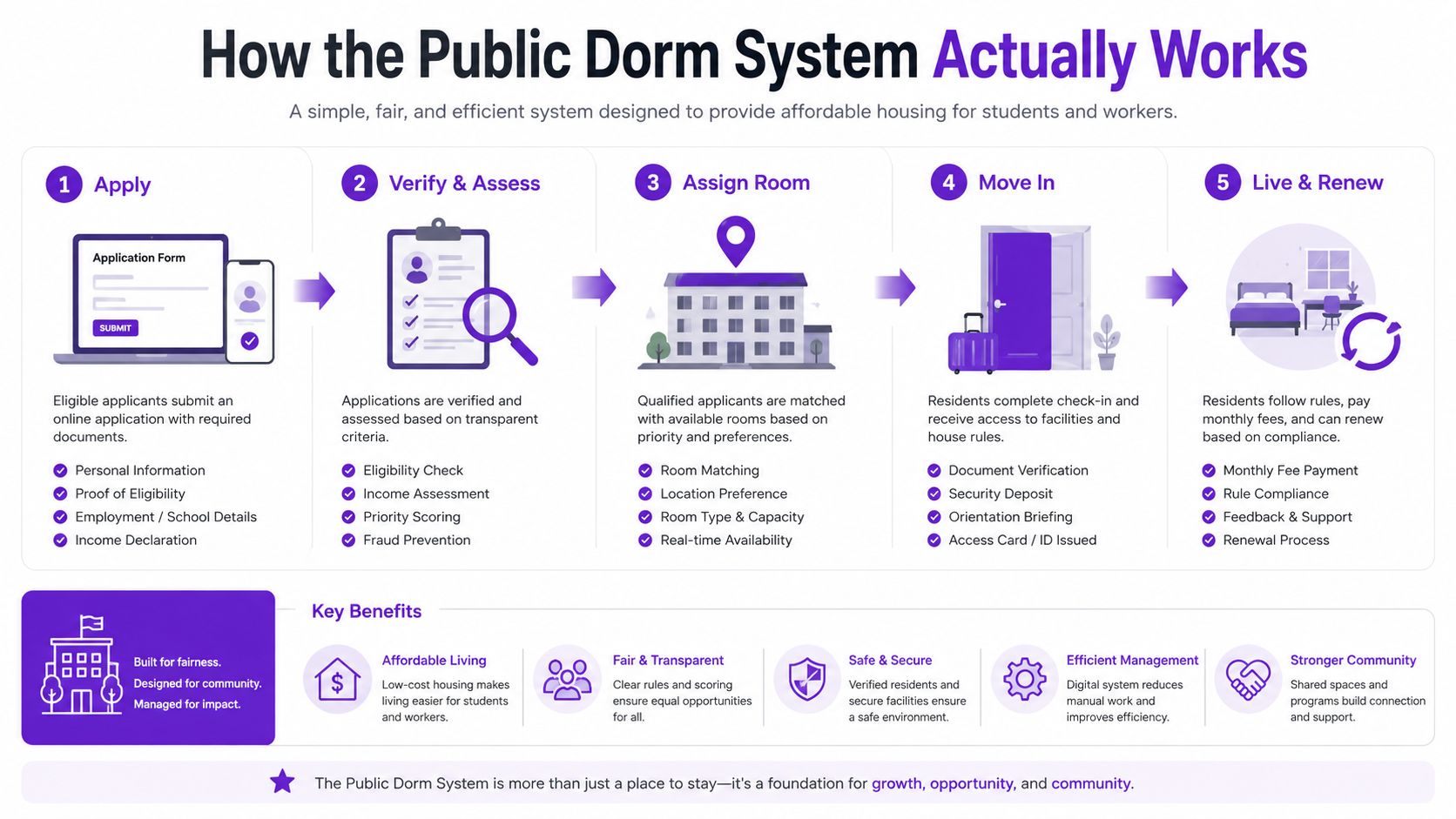
Public dorms are the closest thing Germany has to a student housing safety net, but the net has holes. The attraction is simple. Rent is still one of the lowest parts of the student market, with dorm-room rents averaging about 267 to 306 euros per month, well below the national student rent average (source). That gap is exactly why demand crushes supply.
What the numbers tell you
The shortage is severe. In 2022, Germany had only 237,626 student dormitory places for about 2.9 million students, meaning just 8% of students had access to a publicly funded dormitory place (source). That is not a normal market. It is a structural bottleneck.
For you, the lesson is blunt. Apply anyway, but do not build your arrival plan around getting a dorm room. A dorm application is smart because the price is good and the paperwork is usually centralized through a Studierendenwerk portal, not because the odds are on your side. If your course starts in October, your housing search should already be in motion months earlier, not after your visa lands.
What you should prepare before the portal opens
The dorm system rewards speed and complete paperwork. Keep your admission letter, passport scan, enrolment status if you already have it, and any proof of finances in one folder before you click submit. Some portals move quickly, others move like government software from another century, but the winning pattern stays the same, complete application first, questions later.
If the dorm queue is closed or painfully long, a temporary fallback can keep you from arriving homeless. A short-term sublet in Erlangen is the kind of bridge many students use while they wait for a proper room.
Cheap does not mean easy to get. Public student housing is affordable because it is scarce.
You leave the dorm queue and the choice starts: WG rooms, private studios, or shared flats with friends. On paper they sound close. In daily life they are very different bets. One gives you more social contact and a better shot at moving fast. One gives you quiet, but you pay for it. One gives you control, if the people involved are people you trust.
Comparing the trade-offs
| Option | Typical rent (EUR/mo) | Contract length | Availability | Best for |
|---|---|---|---|---|
| WG room | Usually mid-range, often cheaper than studios | Flexible to medium-term | Better than dorms in most cities | First-year international students, social movers |
| Private studio | Higher than WG rooms | Often longer and stricter | Limited in tight cities | Master's students, couples, privacy seekers |
| Shared flat with friends | Depends on city and size | Negotiated case by case | Harder to secure together | Small groups who already know each other |
A WG room is the default for a reason. It is not always the absolute cheapest option in every city, but it is usually the easiest to find and the least isolating. You share a kitchen, deal with someone else's cleaning habits, and pick up German faster than you planned.
A private studio is the opposite deal. You get quiet, your own bathroom in many cases, and less daily friction, but the monthly cost is usually higher and landlords tend to be stricter about the paperwork. If you need space to work, sleep, and reset without other people in the apartment, this is the cleaner choice.
A shared flat with friends sounds safer than it often is. It works only when the group already knows how to split rent, chores, and bills without drama. Renting together with strangers turns friendship into a housing experiment, and that usually ends badly.
How to decide without overthinking it
Pick a WG if speed matters, if you want flexibility, and if you need something before arrival. Pick a studio if you want quiet, hate shared bathrooms, and can handle a higher monthly hit for privacy. Pick a shared flat with friends only if you already trust the people involved and have talked through money, cleaning, and exit plans.
That is where many international students get it wrong. They chase the “perfect” housing type instead of the one that fits the actual timeline. Eight months out, you can aim high. Three months out, you should be ready to compromise. Two weeks before semester start, the best room is the first decent room you can secure legally and on time.
If your housing choice is also tied to registration, start reading about student stay options that support Anmeldung before you sign anything. If the lease is in German and you are not fully sure what you are signing, a tool like rental contract extraction with Matil helps you pull out the core terms before you commit.
Contracts, Deposits and What Landlords Really Check
German housing paperwork is not glamorous, but it's where a lot of first-time renters get caught. The landlord doesn't care that you're smart, organized, or coming from a top university. They care whether your documents look complete and whether your payment trail makes sense.
What they usually expect from you
Start with a clean folder. You'll usually need your passport, proof of enrolment or admission, proof of funds, and a basic rental profile that doesn't read like a desperate essay. A SCHUFA check is often part of the process for longer-term rentals, and if you don't have one yet, expect to be asked for alternatives or a guarantor. If the lease is in German and you're not fully sure what you're signing, a tool like rental contract extraction with Matil can help you pull out the core terms before you commit.
The other obvious pain point is the deposit. In Germany, landlords commonly ask for a security deposit, and they usually don't negotiate it just because you're a student. Budget for it early, because a good room can disappear while you're still waiting for money to move between accounts.
Anmeldung and utility costs are not side issues
Your Anmeldung at the city Bürgeramt depends on having an address, which means housing is not just about sleep, it's about legal residence. If you land first and try to figure it out later, you're making every other admin task harder. The same goes for Nebenkosten, the utility and service charges that sit outside base rent. Heat, water, and electricity can change the actual cost of a room more than the headline rent does.
If you're renting your first place in Germany and want a basic reality check on the process, the practical notes on student stay and Anmeldung are useful before you sign anything.
Rule of thumb: never pay a deposit into a private account without a written confirmation, a real lease draft, and a way to verify the person offering the room.
The Timeline That Actually Gets You a Room
Housing in Germany is a timeline problem, not a taste problem. The students who win are the ones who stop asking “What do I prefer?” and start asking “What will still be possible by the time I arrive?” That mindset saves money, panic, and bad decisions.
Eight months out
Start with the city, not the room. If your university is in a major market, assume the demand will be ugly and the cheap options will move slowly. Open Studierendenwerk portals, private housing sites, and WG boards early, because public and private systems don't obey the same calendar. This is when you build your shortlist and decide whether you can tolerate a commute in exchange for lower rent.
Three months out
This is the serious phase. If you haven't applied to dorms, you're already behind. If your WG search hasn't started, now is the time to send messages daily, not casually. At this stage, students who wait for perfect listings usually lose to students who respond fast, write clearly, and attach their documents immediately.
Two weeks before arrival
This is not the time to “see what happens.” Book a temporary bed, a hostel, a youth hostel, or a short sublet if your permanent room isn't locked. Use those first days to attend viewings, meet people, and close the last gap between arrival and move-in. If your inbox is still quiet, switch from polite browsing to high-volume outreach.
Hard advice: arriving in October with no housing booked is a self-inflicted crisis. The market doesn't care that your flight is confirmed.
That late-stage scramble is exactly why some students end up in temporary accommodation longer than planned, or in the wrong neighborhood because they ran out of time. If the list of fallback choices feels abstract, the emergency accommodation guidance from German student welfare organizations shows how often students depend on last-minute rooms and temporary stays when halls are full (source).
City-Specific Housing Realities Across Germany
Germany is one housing market only on paper. Berlin, Munich, and a smaller university town do not behave the same way, and that mistake blows up budgets fast. The core problem is timing plus city pressure. If you start late in a tight market, even a decent budget turns into a weak set of options.
Berlin and Munich sit at the hardest end of the search. Savills market research on the 30 largest German university cities shows that private supply expanded over time, with private providers reaching around 66,100 beds by 2021 and an average provision rate of 14.2% across those cities (source). That does not mean rooms are easy to get. It means more private beds exist, while demand stays stubborn and the cheap options disappear quickly.
The price gap is the part students feel immediately. In the same research, students were paying around 410 euros per month nationally in 2021, while room rents in Berlin averaged 650 euros and Munich student apartments went beyond 800 euros per month (source). If your budget is tight, those differences are not minor. They should change the city you target, the commute you accept, and how early you start searching.
Smaller university cities usually give you a better shot at finding something, but they are not automatically easy. Dresden or Göttingen can feel far less brutal than Munich, yet rooms still tighten near semester start, especially for international students who arrive late. The search method changes by city. In smaller places, local portals, university noticeboards, and direct contact with student services often work better than broad national listings, because the good rooms get claimed through local channels first.
For a practical example of how a city-specific room listing is framed for quicker decisions, the furnished single room student dormitory in Frankfurt shows the kind of listing students tend to move on faster, because the basics are clear and the offer is easy to compare.
Common Mistakes International Students Make
The biggest mistake is treating student housing like a backup plan. It is the main bottleneck, and it punishes slow searchers, especially international students who arrive late and expect the room to appear after landing. German landlords and housing offices do not care that your flight was stressful.
The second mistake is assuming a friendly message or a good story will carry the application. It won't. What gets responses is timing, documents, and a message that makes you easy to approve.
The three habits that waste time
- Waiting for the “right” room too long: if the room is decent, legal, and affordable enough, take it seriously instead of holding out for a perfect match that never comes.
- Paying before confirming everything in writing: scams depend on urgency, and students who rush are the easiest targets.
- Ignoring the culture of the WG: some flatmates care more about quiet hours, kitchen cleanliness, and notice periods than rent alone.
One more mistake shows up again and again in Indian student groups. People assume that being in Germany means housing will sort itself out fast. Arrival helps, but only if you arrive with an address plan, your documents ready, and a message strategy that gets replies instead of silence. A decent viewing or application starts before you land, not after.
The timeline matters more than optimism. Eight months out, you should already be watching public dorm portals and private listings. Three months out, you need to be sending applications every day and following up quickly. Two weeks before semester start, you are in rescue mode, which is when Brizz rentals becomes useful for finding live options without wasting time on random listings.
If you want to avoid signing the wrong thing, the plain-language checklist from first time renter advice is a useful sanity check before you commit.
The broader research picture says the same thing. Housing shortage is structural, and international students get hit harder when information is patchy and language or cultural barriers slow the search down (source).
Your Next Steps and Where to Find Listings Today
Stop overthinking the category and start building the shortlist. Save your documents in one folder, keep your admission proof handy, and prepare a short message in German and English that says who you are, when you arrive, and what kind of room you need. That alone puts you ahead of the students who start searching only after landing.
What to bookmark right now
- WG-Gesucht: the first stop for WG rooms and sublets.
- Immobilienscout24: useful for private rentals and studios.
- Studierendenwerke portals: the place to track public dorm applications.
- Brizz rentals: helpful when you want culturally compatible flatmates and listings in Indian community hubs, without wasting time on irrelevant results.
If you're new to renting in Germany, the plain-language checklist from first time renter advice is a useful sanity check before you sign anything.
The single biggest risk is still timing. Pick the right timeline first, then the right housing type. If you want a faster path into rooms, flatshares, and practical listings built around the Indian community in Germany, start with Brizz rentals and work from there.
If you want a less chaotic search and a better shot at rooms that fit real student life, Brizz is built for that kind of browsing. Use Brizz to find rentals, community-relevant listings, and practical local options without starting from zero every time.
Made with Outrank app