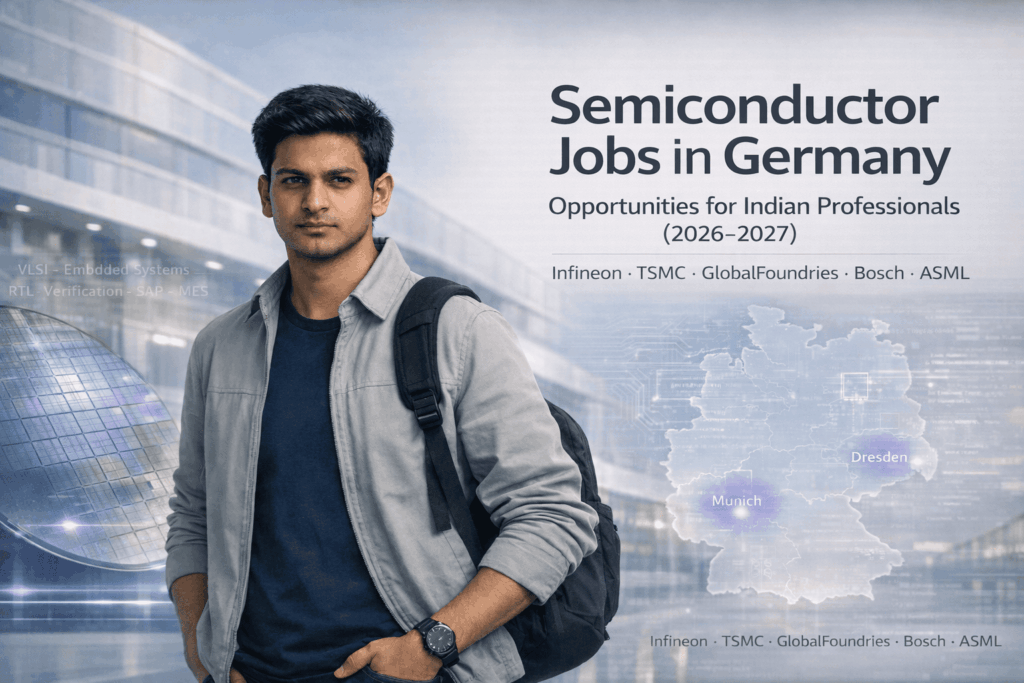
The global chip war is reshaping everything. When COVID-19 froze supply chains and car factories sat idle waiting for $2 chips, the world woke up to an uncomfortable truth: semiconductors aren’t just components — they’re the foundation of modern civilization. Your smartphone, your car’s braking system, hospital ventilators, military drones, AI data centers — all helpless without chips. And 90% of the world’s most advanced chips come from one island: Taiwan. One geopolitical crisis away from catastrophe.
Europe got the message. Germany got the checkbook — €20 billion+ flowing into TSMC’s first European fab, Infineon’s €5B Smart Power Fab, and GlobalFoundries’ expansion. Dresden is becoming Europe’s semiconductor capital.
Why this matters for your career: Unlike IT services that can be offshored or cyclical industries that boom and bust, semiconductor manufacturing is physical infrastructure tied to the ground. Chip fabs can’t be moved to cheaper labor markets — a single facility costs €5-10 billion and takes 3-5 years to build. That’s precisely why governments are investing. Semiconductors are now classified as critical infrastructure, essential to European security, defense, and economic sovereignty. The EU Chips Act isn’t a temporary stimulus; it’s a permanent strategic shift backed by the same urgency that drives military spending. These jobs are here to stay. They will expand, not shrink. When governments invest billions not for quarterly profits but for national security, you’re looking at career stability that few industries can match.
This guide breaks down Germany’s semiconductor opportunity for Indian professionals — covering 40+ employers from fabs to design houses to IT services, the specific skills each role requires, which German Masters programs feed directly into the industry, and practical entry strategies whether you’re a student, already in Germany on a Blue Card, or holding a Chancenkarte.
📌 Related Guide: If you’re interested in another high-investment sector with strong government backing, see our Defense IT Jobs Germany Guide — covering €108 billion in defense spending and IT opportunities at Rheinmetall, HENSOLDT, and more.
| Data Point | Value |
|---|---|
| Government Investment | €20B+ through 2030 |
| EU Chips Act Target | 20% global production by 2030 (from ~0% advanced) |
| Major Fab Projects | 3 (TSMC 2027, Infineon 2026, GlobalFoundries 2028) |
| Estimated New Jobs | 10,000+ direct, 30,000+ indirect |
| Current Open Positions | 2,500+ |
| Salary Premium | +5-15% vs Standard IT |
| Blue Card Threshold (IT, 2026) | €45,934.20 |
| Primary Hub | Dresden (“Silicon Saxony“) |
Why Semiconductors, Why Now?
The Global Chip Race
The semiconductor industry has transformed from a technical backwater into the most strategically important sector on earth. Consider what chips control: every smartphone, every modern vehicle (2,000+ chips per car), every military system, every AI model, every medical device. When TSMC’s Taiwan fabs sneeze, the global economy catches pneumonia.
COVID-19 exposed this fragility brutally. Automakers lost $210 billion in revenue waiting for chips. Hospital equipment faced delays. Consumer electronics vanished from shelves. And governments realized a terrifying truth: the technology underpinning their economies and militaries depends entirely on a few facilities in East Asia.
The response has been a global scramble for semiconductor sovereignty. The US passed the CHIPS Act ($52 billion). China is investing $150 billion+. And Europe — which manufactures essentially 0% of the world’s advanced chips — launched the European Chips Act with €43 billion to reach 20% of global production by 2030.
Europe’s Response: The European Chips Act
The European Chips Act isn’t just money — it’s a strategic pivot. Europe excels at automotive semiconductors, power electronics, and sensors (mature nodes). But it manufactures zero leading-edge logic chips. Every AI accelerator, every advanced processor comes from Taiwan or South Korea.
The Act aims to:
- Quadruple Europe’s global market share (from ~10% to 20%)
- Build sovereign capacity in advanced nodes
- Secure supply chains for automotive, defense, and industrial sectors
Germany, as Europe’s industrial powerhouse, anchors this strategy. The country is receiving the largest share of EU semiconductor investment, building on existing strengths in automotive chips and power electronics.
Germany’s €20 Billion Bet
Three mega-projects define Germany’s semiconductor future:
TSMC/ESMC Dresden (€10B+): Taiwan Semiconductor Manufacturing Company — the world’s most advanced chipmaker — chose Dresden for its first European fab. The European Semiconductor Manufacturing Company (ESMC), a joint venture with Bosch, Infineon, and NXP, will produce 28nm to 12nm chips starting 2027. This isn’t leading-edge, but it’s exactly what European automakers desperately need.
Infineon Smart Power Fab Dresden (€5B): Infineon Technologies, Germany’s semiconductor champion, is expanding its Dresden facility into Europe’s largest power semiconductor fab. Production begins 2026, creating thousands of jobs in chips for electric vehicles, renewable energy, and industrial automation.
GlobalFoundries Expansion (€1.1B): The GlobalFoundries Dresden site — already Europe’s largest semiconductor foundry — is scaling to over one million wafers annually by 2028, focusing on automotive and IoT chips.
Combined with existing facilities from Bosch, X-FAB, and dozens of suppliers, Dresden is cementing its position as Europe’s semiconductor capital.
Dresden: Silicon Saxony
Dresden’s semiconductor cluster didn’t appear overnight. The region has built chip-making capability since reunification, leveraging East German technical expertise and massive federal investment. Today, “Silicon Saxony” comprises:
- 2,500+ companies in the semiconductor ecosystem
- 75,000+ employees in microelectronics
- Complete supply chain: fabs, equipment, materials, design, testing
- Direct university pipeline (TU Dresden’s microelectronics programs)
- Established infrastructure and workforce
When TSMC evaluated European locations, Dresden won decisively. The cluster effect is real: suppliers, talent, and expertise concentrate, making each new investment more viable.
[IMAGE PLACEHOLDER: Map of Germany semiconductor hubs — Dresden, Munich, Regensburg, Stuttgart]Companies by Tier
Tier 1: IDMs & Foundries (Chip Manufacturers)
These companies manufacture chips in their own fabs. Highest job creation, most roles, largest hiring volume.
Deep Dive: TSMC/ESMC Training Program — What You Need to Know
TSMC Dresden (officially ESMC — European Semiconductor Manufacturing Company) represents one of the most significant semiconductor investments in European history. For Indian professionals, understanding how TSMC hires and trains is crucial — because most engineering roles require extended training in Taiwan before you start work in Germany.
The Reality: Most Fab Roles Require Taiwan Training
This isn’t optional. TSMC’s proprietary processes, equipment handling, and safety protocols are so specialized that they can only be taught at TSMC’s facilities in Taiwan. The Newcomer Training Center (NTC) in Taichung — opened in 2021 — has trained 42,000+ personnel and is now the gateway to ESMC Dresden careers.
What the training includes:
- 4-8 weeks classroom/hands-on for newcomers (varies by role)
- Process-specific modules: lithography, etching, deposition, CMP
- Equipment operation and troubleshooting
- Cleanroom protocols and safety
- TSMC’s manufacturing execution systems (MES)
- Quality control and yield management methodologies
Training Duration by Role Category
Roles with Shorter or No Extended Taiwan Training
Not all ESMC roles require months in Taiwan. These are more accessible for Indian professionals who cannot relocate for extended periods:
Fresh Graduates vs Experienced Professionals
Good news for fresh graduates: TSMC explicitly hires newcomers. The NTC has separate training tracks:
- Newcomer Track: 4-8 weeks foundational training + role-specific modules
- Senior Engineer Track: Advanced courses for experienced hires
Experience requirements by role:
- Process/Equipment/Facility Engineer: 0-2 years acceptable (fresh grads welcome)
- Yield Engineer: 0-3 years acceptable
- Quality/Reliability Engineer: 5+ years typically required
- Chemical Analysis Engineer: 8+ years required
- Module Engineer (Trilingual): Experienced preferred
Student Pipeline: STIPT Program
If you’re a student at a German university, the Semiconductor Talent Incubation Program Taiwan (STIPT) offers a direct path:
- Eligibility: 3rd year Bachelor’s or Master’s students at Saxon universities (TU Dresden, etc.)
- Duration: 6 months (4 months university courses + 2 months TSMC internship)
- Funding: Living allowance (€700/month) + travel subsidy (€1,500) + tuition covered
- Pathway: Strong performers receive full-time job offers at ESMC
This program is a golden ticket — you get TSMC training, Taiwan experience, and potential job offer while still a student.
What This Means for Your Planning
If you’re applying to ESMC fab roles:
- Visa implications: You’ll need a German work permit that allows 6-12 months abroad
- Family considerations: Extended Taiwan stays may affect family visa situations
- Compensation: Training period is fully paid + housing/relocation support
- Career value: TSMC training is globally recognized — massive CV boost
- German language: Less critical during Taiwan training, but needed for Dresden operations
Strategic advice for Indian professionals:
- Target IT/Support roles first if you cannot do extended Taiwan training
- Target fab roles if you want maximum career acceleration and can manage 6-12 months in Taiwan
- Consider STIPT if you’re a student in Germany — it’s the smoothest path
- German B1+ helps for fab floor communication once you’re in Dresden
Tier 2: Fabless & Design Houses
These companies design chips but outsource manufacturing. Highly technical roles, English-friendly, competitive salaries.
Tier 3: Equipment, Materials & EDA
These companies build the machines and software that make chip manufacturing possible. Often overlooked, excellent salaries.
Tier 4: IT Services & Enterprise Support
These companies provide IT services, consulting, and enterprise systems to semiconductor manufacturers.
📥 Download: Complete company database with 40+ companies, salary ranges, visa sponsorship status, and direct career portal links → Download Excel Tracker
[DECISION MATRIX PLACEHOLDER: Tier 1 (Fab jobs) vs Tier 2 (Design) vs Tier 4 (IT Services) — which suits your profile?]Role Categories & Skills Required
Chip Design & Verification
What you’ll do: Design digital/analog circuits, verify chip functionality before manufacturing
| Role | Key Skills | German Required? | Entry Salary |
|---|---|---|---|
| RTL Design Engineer | Verilog, VHDL, SystemVerilog, synthesis | No | €55-65K |
| Verification Engineer | UVM, SystemVerilog, formal verification | No | €55-68K |
| FPGA Engineer | VHDL/Verilog, Xilinx/Intel tools, embedded C | Helpful | €52-62K |
| Analog Design Engineer | Cadence Virtuoso, SPICE, transistor-level | No | €58-70K |
| Physical Design Engineer | Innovus, ICC2, timing closure, DFT | No | €55-68K |
Embedded Systems & Firmware
What you’ll do: Write software that runs directly on chips — the bridge between hardware and software
| Role | Key Skills | German Required? | Entry Salary |
|---|---|---|---|
| Embedded Software Engineer | C/C++, RTOS (FreeRTOS, Zephyr), ARM | Helpful | €50-62K |
| Firmware Developer | C, microcontrollers, hardware debugging | Helpful | €50-60K |
| Device Driver Engineer | Linux kernel, hardware interfaces | No | €55-68K |
| Embedded Linux Engineer | Yocto, bootloaders, kernel customization | No | €55-65K |
Process & Manufacturing IT
What you’ll do: Optimize fab operations, improve yield, automate manufacturing processes
| Role | Key Skills | German Required? | Entry Salary |
|---|---|---|---|
| MES Engineer | MES platforms (Camstar, PROMIS), SQL, Python | Helpful | €50-62K |
| Yield Engineer | Data analysis, Python/R, semiconductor physics | Helpful | €55-68K |
| Process Integration Engineer | Semiconductor physics, DOE, data analysis | Yes (often) | €55-70K |
| Equipment Software Engineer | PLC, automation, Python, SECS/GEM | Helpful | €52-65K |
| Industrial Data Scientist | Python, ML, statistical process control | No | €58-72K |
⚠️ Insider Warning: Dresden fab floor jobs often require German B1+ due to shift team communication. Consider starting German language courses early. Munich design roles are more English-friendly.
EDA & CAD Tools
What you’ll do: Develop or support the software tools that chip designers use
| Role | Key Skills | German Required? | Entry Salary |
|---|---|---|---|
| EDA Application Engineer | Cadence/Synopsys tools, customer support | No | €55-68K |
| CAD Engineer | Tcl, Python, automation scripts, tool flows | No | €52-65K |
| EDA Software Developer | C++, algorithms, compiler design | No | €60-75K |
Test & Quality
What you’ll do: Ensure chips work correctly before shipping — from lab validation to production testing
| Role | Key Skills | German Required? | Entry Salary |
|---|---|---|---|
| Test Engineer | ATE platforms (Teradyne, Advantest), Python | Helpful | €48-58K |
| Validation Engineer | Hardware debugging, oscilloscopes, automation | Helpful | €50-62K |
| Quality Engineer | Six Sigma, FMEA, automotive standards (IATF) | Yes (often) | €52-65K |
| Reliability Engineer | Failure analysis, physics of failure | Helpful | €55-68K |
Enterprise IT & Support Functions
What you’ll do: Keep the business running — ERP systems, data infrastructure, cybersecurity
| Role | Key Skills | German Required? | Entry Salary |
|---|---|---|---|
| SAP Consultant (PP/MM) | SAP modules, manufacturing processes | Helpful | €55-70K |
| SAP S/4HANA Consultant | S/4HANA migration, ABAP | No | €60-75K |
| IT Infrastructure Engineer | Cloud (AWS/Azure), networking, virtualization | Helpful | €50-62K |
| Data Engineer | Python, SQL, ETL, Spark, data warehousing | No | €55-68K |
| Cybersecurity Analyst | SIEM, network security, compliance | No | €55-70K |
| Business Intelligence Analyst | Power BI, Tableau, SQL | Helpful | €50-62K |
| PLM Consultant | Siemens Teamcenter, PTC Windchill | Helpful | €55-68K |
Summary: Role Fit by Background
| Your Background | Best-Fit Roles | Transition Difficulty |
|---|---|---|
| ECE / Electronics | Chip Design, Verification, Test, Embedded | 🟢 Direct fit |
| Computer Science | Embedded, EDA Software, Enterprise IT, Data | 🟢 Easy |
| EEE / Electrical | Power electronics, Analog design, Test | 🟢 Direct fit |
| Physics | Process Engineering, Yield, R&D, Materials | 🟡 Moderate |
| Instrumentation | Test, Equipment, Automation | 🟡 Moderate |
| Mechanical | Equipment, Manufacturing IT | 🟡 Moderate |
| IT / Information Science | Enterprise IT, SAP, Data Engineering | 🟢 Easy |
German Masters Programs — Your Entry Ticket
Why a German Masters?
For Indian students, a German Masters in a relevant field is the most reliable path into semiconductor careers. If you’re considering this route, start with our comprehensive Masters in Germany — Complete Guide for the full picture.
Key advantages:
- Direct industry pipeline: Werkstudent → Thesis → Full-time offer is a well-worn path
- Cost-effective: Public universities charge €0-500/semester (compare to $50K+/year in US)
- Work rights: 18-month post-study job seeker visa
- Location advantage: Study in Dresden or Munich, interview at companies next door
- German degree recognition: Highly valued by German employers — check Anabin for credential equivalence
Top Programs for Semiconductor Careers
For detailed guidance on selecting the right program, see our guide on How to Choose a University in Germany.
| University | Program | Duration | Language | Tuition | Best For |
|---|---|---|---|---|---|
| TU Dresden | Nanoelectronic Systems | 2 yrs | English | Free | Chip design, verification |
| TU Dresden | Electrical Engineering | 2 yrs | German | Free | Broad EE, fab roles |
| TU Munich | Electrical & Computer Engineering | 2 yrs | English | ~€150/sem | Design, embedded |
| TU Munich | Communications Engineering | 2 yrs | English | ~€150/sem | RF, analog, signal processing |
| RWTH Aachen | Electrical Engineering | 2 yrs | English/German | Free | Power electronics |
| KIT Karlsruhe | Electrical Engineering & IT | 2 yrs | German | Free | Broad EE |
| FAU Erlangen-Nuremberg | Advanced Signal Processing | 2 yrs | English | Free | Signal processing, ML |
| TU Berlin | Computer Engineering | 2 yrs | English | Free | Embedded, systems |
| Uni Stuttgart | Electrical Engineering | 2 yrs | German | Free | Automotive electronics |
| TU Chemnitz | Micro and Nano Systems | 2 yrs | English | Free | MEMS, sensors |
Eligibility & Application
Before applying, check if you meet the requirements:
- Academic eligibility: See our Masters in Germany Eligibility Requirements guide
- APS Certificate: Required for all Indian students — follow our APS Certificate Germany Guide
- Application documents: SOP, LOR, CV — detailed guidance in our SOP, LOR, CV & Documents Guide
- Application timeline: Plan your deadlines with our Masters in Germany Application Timeline 2026-2027
- uni-assist: Many universities use uni-assist for application processing — check if your target university requires it
Which Bachelor’s Background Works?
| Your B.Tech/B.E. Stream | Fit for Semiconductor? | What to Supplement |
|---|---|---|
| ECE / Electronics & Communication | ✅ Perfect fit | Nothing major |
| EEE / Electrical Engineering | ✅ Excellent fit | Digital design basics |
| Computer Science | ✅ Good fit | Hardware fundamentals, computer architecture |
| Instrumentation & Control | ✅ Good fit | Semiconductor physics basics |
| Physics | ✅ Good fit (process roles) | Programming skills (Python, C) |
| Mechanical Engineering | 🟡 Possible (equipment roles) | Electronics basics, automation |
| Chemical Engineering | 🟡 Possible (materials/process) | Semiconductor manufacturing knowledge |
| IT / Information Science | 🟡 Possible (IT roles) | Embedded systems basics |
Bridging the Gap: What to Learn
Free/Low-cost online courses:
| Platform | Course | Useful For |
|---|---|---|
| Coursera | VLSI CAD (UIUC) | Design flow basics |
| Coursera | Digital VLSI Design (IIT Kharagpur) | RTL, synthesis |
| edX | Embedded Systems (UT Austin) | Embedded fundamentals |
| NPTEL | CMOS Digital VLSI Design | Verification, RTL |
| Udemy | Verilog HDL from Scratch | RTL coding |
| Cadence Learning | Online Learning (free tier) | Tool familiarity |
| Synopsys Training | University Program | EDA tools access |
Certifications that add value:
| Certification | Useful For | Investment |
|---|---|---|
| Cadence Certified Professional | Design/Verification roles | Time + exam fee |
| Siemens Opcenter Certification | MES/Manufacturing IT | Employer-sponsored usually |
| AWS/Azure Cloud Certifications | Enterprise IT, Data | €150-300 per exam |
| Six Sigma Green Belt | Quality, Process roles | €200-500 |
German language preparation:
Many fab roles prefer German B1+. Start early with our Learn German for Germany: A1 to B2 Guide. Even basic German (A2) helps with daily life in Dresden.
Financial Preparation
Before arriving in Germany:
- Blocked Account: You’ll need a Sperrkonto (blocked account) with ~€11,904 for visa application
- Education Loans: For financing options from India, research banks offering Germany-specific education loans
The Werkstudent Strategy
📌 This is the cheat code for students.
Working as a Werkstudent (20 hrs/week during semester, 40 hrs during breaks) at a semiconductor company while studying is the most reliable path to full-time employment. You get:
- Paid work experience (€15-22/hour typical)
- Industry knowledge and networking
- Thesis project opportunity at the company
- Inside track for full-time roles (conversion rate 60-80% at top companies)
Companies with strong Werkstudent programs:
How to find Werkstudent positions:
- Company career portals — filter for “Werkstudent” or “Working Student”
- StepStone.de — search “Werkstudent Semiconductor”
- LinkedIn — set location to Dresden/Munich
- University job boards — TU Dresden Stellenbörse, TUM job portal
- Silicon Saxony Job Board
Paths for Experienced Professionals
Already Working in Germany
If you’re in Germany on a Blue Card or work permit, you’re in the strongest position to transition into semiconductors.
| Your Current Role | Transition Path | Difficulty |
|---|---|---|
| IT Services (TCS, Infosys, Wipro) | Apply to semiconductor IT roles directly | 🟢 Easy |
| SAP Consultant | Semiconductor SAP roles (premium pay) | 🟢 Easy |
| Embedded Developer (Automotive) | Direct lateral move to chip companies | 🟢 Easy |
| Software Developer (General) | Upskill embedded/EDA, then apply | 🟡 Moderate |
| Data Engineer/Scientist | Manufacturing analytics, yield roles | 🟢 Easy |
| Hardware Engineer (Automotive) | Direct move to chip design/test | 🟢 Easy |
| Non-IT roles | Requires significant reskilling | 🔴 Hard |
Changing jobs on Blue Card:
Your Blue Card allows job changes within the same field. For the first two years, you need approval from the Ausländerbehörde (typically granted within 2-4 weeks if the new job meets Blue Card requirements). After two years, you can switch freely within your profession.
While waiting for job change approval, you may receive a Fiktionsbescheinigung — a temporary permit that allows you to continue working.
Strategy for IT services employees:
Many Indians at TCS, Infosys, Wipro, and Capgemini in Germany work on semiconductor client projects (Infineon, Bosch, Continental). If you’re in this situation:
- Request assignment to semiconductor client projects
- Build domain knowledge on the job
- Network with client-side engineers
- After 1-2 years of domain exposure, apply directly to the client
- Your Blue Card allows job changes in the same field — just notify Ausländerbehörde
Chancenkarte (Opportunity Card) Holders
The Chancenkarte gives you 12 months to find qualifying employment in Germany. Semiconductors are an excellent target because:
- High demand for technical talent
- English-friendly roles available (especially Tier 2-3 design houses)
- Salaries easily meet Blue Card threshold (€45,934.20 for IT)
- Companies experienced with international hiring and visa sponsorship
Your 12-month action plan:
| Weeks | Action |
|---|---|
| 1-2 | Anmeldung (address registration), German bank account, German phone number, health insurance, LinkedIn optimization |
| 2-4 | Apply to 50+ positions across Tier 1-4 companies |
| 4-8 | Interview process, consider contract/Werkstudent roles for income |
| 8-12 | Convert to Blue Card upon receiving job offer above threshold |
Finding accommodation:
Dresden and Munich both have competitive rental markets. Use our Rental Houses in Germany Guide to understand WG (shared apartments) vs. studio options. For Dresden, shared apartments near Infineon or GlobalFoundries are more affordable than Munich.
Best cities for semiconductor job hunting:
| City | Why | Living Cost |
|---|---|---|
| Dresden | Highest concentration of fabs, most hiring | 🟢 Affordable |
| Munich | Design houses, EDA companies, startups | 🔴 Expensive |
| Stuttgart / Reutlingen | Bosch, automotive semiconductors | 🟡 Moderate |
| Berlin | Growing (ASML office, startups) | 🟡 Moderate |
| Nuremberg / Erlangen | Qualcomm, automotive suppliers | 🟡 Moderate |
Realistic expectations:
- Entry-level (0-2 yrs relevant experience): €48-55K
- Mid-level (3-5 yrs): €58-72K
- All above Blue Card IT threshold: ✅ Yes
Applying from India (Direct Hire)
This is the hardest path but possible for:
- 5+ years semiconductor-specific experience
- Niche skills in demand (specific EDA tools, verification methodologies, RF design)
- PhD holders in relevant fields
Companies known to sponsor from India:
- Intel Munich (design center)
- Qualcomm Munich/Nuremberg
- Synopsys Munich
- Cadence Munich
- Infineon (selective, usually senior roles)
- Apple Munich (very selective)
Typical process:
- Apply via company career portals (not recruiters)
- Remote interviews (4-6 rounds typical)
- Company initiates visa sponsorship upon offer
- Timeline: 3-6 months from application to Germany arrival
- Check Make it in Germany for official visa information
⚠️ Insider Warning: Generic software profiles rarely get direct-hire sponsorship from semiconductor companies. You need either semiconductor-specific experience OR a Masters from a German/European university. If you’re a generalist, plan to do a Masters or move to Germany via Chancenkarte/IT services first.
How to Get Hired — Application Strategy
Where to Find Jobs
| Platform | Best For | Link |
|---|---|---|
| All levels, especially Tier 2-3 | linkedin.com/jobs | |
| StepStone | German market, broad listings | stepstone.de |
| Indeed.de | Volume of listings | indeed.de |
| Company Career Portals | Direct applications (always check) | See company list |
| Silicon Saxony Job Board | Dresden cluster | silicon-saxony.de/jobs |
| Get in Engineering | Engineering roles | get-in-engineering.de |
| German professional network | xing.com |
Application Best Practices
- Direct applications > Recruiters — Semiconductor companies prefer direct applicants
- Tailor your CV to each role — German employers expect specificity, not generic applications
- Use EU CV format — Europass or similar German-style CV
- Include thesis/project details — Especially relevant for fresh graduates
- Keywords matter — ATS systems filter heavily; mirror the job description language
- Cover letter still matters — In Germany, a tailored Anschreiben is expected
For detailed guidance on CV and cover letter preparation, see our SOP, LOR, CV & Documents Guide — while written for university applications, the CV advice applies to job applications too.
CV tools:
| Tool | Why Use It |
|---|---|
| Europass | EU standard format, widely accepted |
| Lebenslauf.de | German-style templates |
| CVmaker | Clean modern templates |
| Novoresume | ATS-optimized |
Interview Process
Typical flow at major semiconductor companies:
| Round | Format | Focus | Duration |
|---|---|---|---|
| 1. HR Screen | Phone/Video | Motivation, visa, salary expectations | 30 min |
| 2. Technical | Video/Onsite | Domain knowledge, problem-solving | 60-90 min |
| 3. Hiring Manager | Video/Onsite | Team fit, specific projects | 45-60 min |
| 4. Panel (sometimes) | Onsite | Multiple interviewers, presentation | Half day |
Technical interview topics by role:
- Chip Design: RTL coding exercises, timing analysis, synthesis constraints
- Verification: UVM architecture, coverage strategies, debugging scenarios
- Embedded: C programming, RTOS concepts, hardware interface questions
- Test: ATE concepts, test coverage metrics, yield analysis
- Enterprise IT: System architecture, SAP module knowledge, SQL queries
Salary Negotiation
- Research ranges on Glassdoor.de, Kununu, levels.fyi
- Semiconductor typically pays 5-15% above general IT
- German negotiation culture is modest — one reasonable counteroffer is acceptable
- Consider total compensation: base + bonus (10-15% typical) + benefits
Salary Benchmarks
| Role Category | Entry (0-2 yrs) | Mid (3-5 yrs) | Senior (6+ yrs) |
|---|---|---|---|
| Chip Design / Verification | €55-65K | €70-85K | €90-120K |
| Embedded Systems | €50-62K | €65-80K | €85-105K |
| Process / Manufacturing IT | €50-62K | €62-78K | €80-100K |
| EDA / CAD Tools | €55-68K | €70-88K | €90-115K |
| Test Engineering | €48-58K | €58-72K | €75-95K |
| Enterprise IT / SAP | €55-70K | €70-85K | €90-110K |
- Munich typically 5-10% higher than Dresden (but higher cost of living)
- Tier 1 companies (Infineon, TSMC) pay top of range
- 13th month salary (Weihnachtsgeld) common at German companies — effectively +8% annually
- Bonus typically 10-15% of base at target
- Blue Card IT shortage threshold (2026): €45,934.20 — all semiconductor roles exceed this
Resources & Next Steps
Job Portals
- Silicon Saxony Jobs — Dresden cluster
- Chip-Jobs.de — Semiconductor-specific
- Get in Engineering — Technical roles
- LinkedIn Jobs — Set “semiconductor Germany” alerts
- StepStone.de — Broad German market
- Make it in Germany Job Board — Official government portal
Networking
LinkedIn Groups:
- “Semiconductor Professionals Germany”
- “Silicon Saxony Network”
- “VLSI Professionals Europe”
Events & Conferences:
- SEMICON Europa (Munich) — November annually
- electronica (Munich) — Major electronics trade fair
- Silicon Saxony Day — Dresden cluster event
Meetups:
- Dresden Semiconductor Meetup
- Munich Tech Events
- Embedded Systems meetups
Official Resources
- Make it in Germany — Official government portal for skilled workers
- DAAD — German Academic Exchange Service
- Anabin — Credential recognition database
- Federal Employment Agency — Job market information
- European Chips Act — EU policy background
Related Brizz Guides
Immigration & Visa:
- Blue Card Germany — Complete Guide
- Chancenkarte (Opportunity Card) Guide
- Fiktionsbescheinigung Guide
- Germany Permanent Residence Guide
Brizz: Your Community in Germany
Finding your footing in Germany’s semiconductor hubs?
Looking for: Networking events in Dresden/Munich, WG rooms near fab locations, Indian community services, relocation support
Want to share: Your expertise with newcomers, sublet listings, event recommendations
🎯 Explore Events · 🏠 Find Rentals · 🛠️ Discover Services · 📚 Read More Guides
Frequently Asked Questions
Do I need to speak German for semiconductor jobs in Germany?
It depends on the role and company. Design houses (Intel, Qualcomm, Synopsys) and EDA companies operate almost entirely in English. Fab floor roles at Infineon or GlobalFoundries Dresden often require German B1+ for shift communication and safety. Enterprise IT roles vary — international teams work in English, but client-facing roles may need German. Start applying to English-friendly roles while learning German for long-term career growth.
Can I get a semiconductor job in Germany without a Masters degree?
Yes, but it’s harder. Companies like Intel, Qualcomm, and Synopsys hire based on skills and experience regardless of degree. However, for entry-level positions, a Masters in Germany provides structured entry via Werkstudent → thesis → full-time pipeline. Experienced professionals (5+ years in semiconductor domain) can get hired directly. For career changers without domain experience, a German Masters is the most reliable path.
Which city is better for semiconductor careers — Dresden or Munich?
Dresden for manufacturing and volume hiring; Munich for design and EDA. Dresden hosts the major fabs (TSMC, Infineon, GlobalFoundries, Bosch, X-FAB) with thousands of roles across all levels. Munich hosts design centers (Intel, Qualcomm, AMD, Nvidia) and EDA companies (Synopsys, Cadence, Siemens). Both are excellent — choose based on your target role type. Dresden has lower cost of living; Munich has more diverse tech scene beyond semiconductors.
Is TSMC really hiring in Germany? When do they start?
Yes, TSMC’s Dresden fab (ESMC) is actively hiring. Construction began in 2024, with equipment installation through 2026 and production starting 2027. They’re currently hiring engineers, technicians, and support staff for training (including stints at TSMC Taiwan facilities). Check tsmc.com/careers and filter for Germany/Dresden. Early hires get the advantage of foundational roles and rapid advancement as the fab scales.
What salary can I expect as a fresher in semiconductor companies?
€48-65K depending on role and company. Entry-level salaries: Test/Manufacturing IT roles start around €48-55K; Embedded/EDA roles €50-62K; Chip Design/Verification roles €55-65K. All exceed the Blue Card IT shortage threshold (€45,934.20 for 2026). Add 10-15% bonus at target and potentially a 13th month salary. Total compensation is typically €55-75K for fresh graduates.
How do I transition from IT services (TCS/Infosys/Wipro) to semiconductor companies?
Leverage client exposure and domain knowledge. Many IT services professionals in Germany work on semiconductor client projects. Strategy: (1) Request assignments to semiconductor clients (Infineon, Bosch, Continental), (2) Learn the domain deeply while on project, (3) Build relationships with client-side colleagues, (4) After 1-2 years, apply directly to the client company citing your project experience, (5) Your insider knowledge makes you stronger than external applicants. Your Blue Card allows job changes in the same field. Alternatively, target Tier 4 companies’ semiconductor practice as an intermediate step.
What’s the first thing I should do after arriving in Germany?
Complete your Anmeldung (address registration) within 14 days. This is mandatory and required for everything else — opening a bank account, getting health insurance, signing an employment contract. Book your appointment at the Bürgeramt (citizen’s office) as soon as you have a rental contract.
Last Updated: January 2026