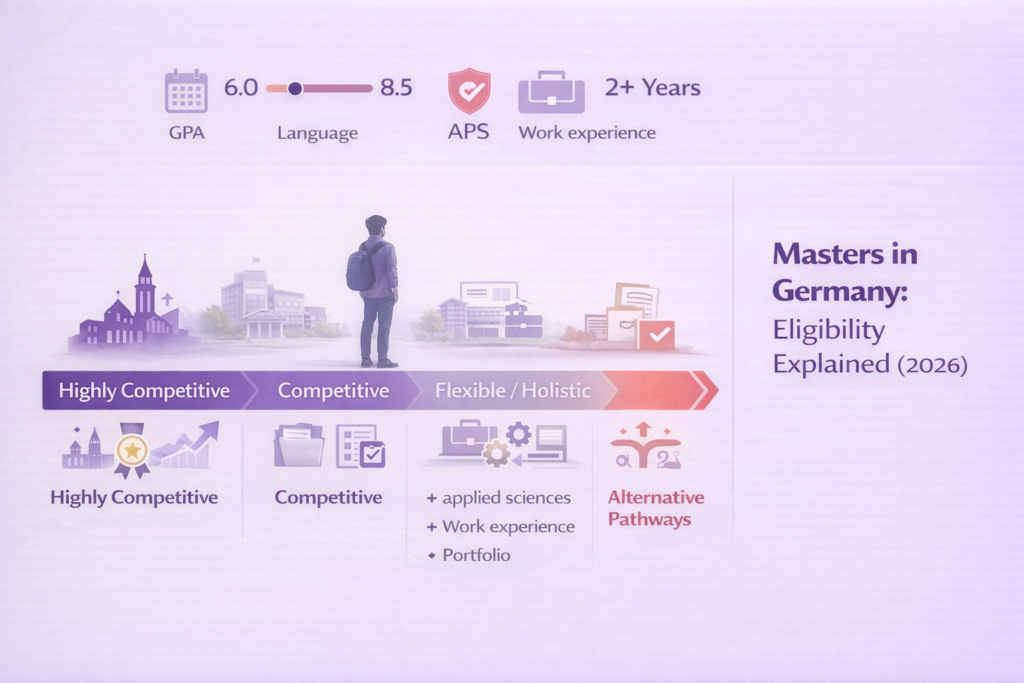
Masters in Germany Eligibility Requirements – Quick Glance
Core Requirements:
- ✅ Recognized bachelor’s degree (verify via Anabin database)
- ✅ APS certificate
- ✅ Language proficiency (IELTS 6.5+ for English programs / TestDaF TDN 4 for German programs)
- ✅ Program-specific requirements (CGPA, credits, work experience)
CGPA Expectations by University Type:
- TU9 universities: 8.0+ (75%+)
- U15 universities: 7.5+ (70%+)
- Other Public universities: 6.5+ (60%+)
- Fachhochschulen (UAS): 6.0+ (55%+) — value work experience highly
Note: Some programs apply German grade conversion formulas (Bavarian / Modified Bavarian), which may shift your effective grade slightly up or down.
How to Use This Guide
This guide helps you understand Masters in Germany eligibility requirements and find the right pathway based on your profile. Whether you have a stellar CGPA or need alternative strategies, you’ll find actionable steps here.
Your CGPA is:
- 8.0+ (75%+)? → Target TU9 and U15 universities
- 7.0–8.0 (65–75%)? → Target U15 and Other Public Universities
- 6.0–7.0 (55–65%)? → Target Fachhochschulen and smaller city universities
- Below 6.0? → Read the “Low CGPA Alternatives” section carefully
Step 1: Verify Your Basic Eligibility
Before anything else, check if your Indian degree is recognized in Germany.
Official Verification Tools
1. DAAD Admission Database
- URL: daad.de/en/studying-in-germany/requirements/admission-database
- What it does: Non-binding check for 140+ countries
- Use it for: Quick eligibility snapshot based on your country and qualification
2. Anabin Database
- URL: anabin.kmk.org
- What it does: Official database of recognized institutions and degrees
- Check for:
- H+ status: University/degree fully recognized
- H+/- status: Case-by-case evaluation
- H- status: Not recognized — may need Studienkolleg
3. uni-assist
- URL: uni-assist.de
- What it does: Processes applications for 180+ German universities
- Cost: €75 (first application), €30 (each additional)
Step 2: Understand Degree Recognition Rules
For Indian Bachelor’s Degrees
| Your Degree | Admission Type | What It Means |
|---|---|---|
| 3-year Bachelor’s | Subject-restricted | Can only apply to Masters in same/related field |
| 4-year Bachelor’s (BE/BTech/Integrated) | General admission | Can apply to Masters in any field |
| Diploma | Case-by-case | Evaluated individually by university |
The 3-Year vs 4-Year Reality
Many Indian students have 3-year degrees (BA, BSc, BCom). Here’s what you need to know:
3-Year Degree Holders:
- ✅ CAN apply to German Masters programs
- ⚠️ Must be in the same or closely related field
- ⚠️ Some programs require additional credits or bridge courses
- 💡 Strategy: Target programs explicitly welcoming 3-year degree holders
Note: Some universities explicitly state “minimum 180 ECTS equivalent required” — always check module-level credit mapping.
4-Year Degree Holders (BE/BTech/Integrated Masters):
- ✅ Full flexibility to switch fields
- ✅ More program options available
- ✅ Generally stronger applications
Step 3: Know CGPA Expectations by University Type
This is where most confusion happens. German universities don’t publish strict cutoffs, but patterns emerge from admission data.
Eligibility by University Type
| Factor | TU9 | U15 | Other Public Universities | Fachhochschule (UAS) |
|---|---|---|---|---|
| Examples | TU Munich, RWTH Aachen, TU Berlin, KIT | LMU Munich, Heidelberg, Göttingen, FU Berlin | Marburg, Magdeburg, Kassel, Chemnitz, Ilmenau | HAW Hamburg, HS Darmstadt, Offenburg, Deggendorf |
| Focus | Technical/Engineering | Research/Medicine/Humanities | Varies by university | Applied/Practical |
| CGPA Expected (Indian) | 8.0+ (75%+) | 7.5+ (70%+) | 6.5–7.5 (60–70%) | 6.0+ (55%+) |
| German Grade Equivalent | 1.0–2.0 | 1.5–2.5 | 2.5–3.0 | 3.0–3.5 |
| Competition Level | Very High | High | Moderate | Moderate–Lower |
| English Programs | Limited | More available | Varies | Many available |
| Work Experience Value | Low weight | Moderate | High weight | Very High weight |
| GRE/GMAT | Sometimes required | Rarely required | Rarely | Rarely |
| Holistic Review | Rare | Some programs | More common | Common |
| Acceptance Rate | 10–25% | 20–35% | 30–50% | 40–60% |
📚 Deep Dive: Learn more about each university type in our Guide to Choosing a University in Germany.
Quick Links by University Type:
- TU9 Universities — Germany’s Technical Elite
- U15 Universities — Germany’s Research Powerhouses
- Universität vs Fachhochschule
- Top Fachhochschulen — Germany’s Best Applied Universities
Step 4: Low CGPA? Here Are Your Alternatives
A low CGPA doesn’t close doors — it just means you need a smarter strategy.
8 Ways to Compensate for Low CGPA
| Compensating Factor | How It Helps | Best For |
|---|---|---|
| 1. Relevant Work Experience | 2+ years shows practical capability | FH, EPOS scholarships, MBA programs |
| 2. Strong GRE/GMAT Scores | Demonstrates academic potential beyond GPA | Competitive programs, US-style admissions |
| 3. Compelling SOP | Explains GPA context, shows growth and passion | All universities |
| 4. Strong LORs | Third-party validation of your potential | All universities |
| 5. High Language Scores | IELTS 7.5+ or TestDaF 5 shows academic readiness | All universities |
| 6. Relevant Certifications | Online courses, technical certs in your field | Tech programs, FH |
| 7. Portfolio/Projects | Demonstrates hands-on skills | CS, Engineering, Design |
| 8. Strong Subject Grades | High marks in major subjects despite low overall | Technical programs |
Universities Known for Holistic Admissions
These universities look at your complete profile, not just grades:
| University | Known For | What They Value |
|---|---|---|
| Otto von Guericke University Magdeburg | Engineering, Economics | Projects, research, leadership qualities |
| Chemnitz University of Technology | Engineering, Sciences | Work experience, purpose of study |
| University of Kassel | Sustainability, Engineering | Diverse backgrounds, ecological focus |
| Freie Universität Berlin | Interdisciplinary Studies | Research experience, diverse backgrounds |
| Goethe University Frankfurt | Various programs | Strong overall profile |
| HAW Hamburg | Applied Sciences | Motivation, community engagement, work experience |
| Hochschule Darmstadt | Technical programs | Practical skills, industry experience |
| Offenburg University | English-taught Masters | Work experience, technical skills |
| Deggendorf Institute of Technology | Innovation programs | Practical exposure, creative thinking |
The Location Strategy
Big Cities (Berlin, Munich, Hamburg, Frankfurt):
- Higher competition
- More international applicants
- Stricter requirements in practice
Smaller Cities (Magdeburg, Chemnitz, Ilmenau, Siegen, Greifswald):
- Lower competition
- More flexible admissions
- Lower cost of living
- Equally valid degrees
Step 5: Course Switching Strategies
Can’t get into your dream program? Consider related alternatives.
Example: Marburg Data Science Eligibility
Philipps-Universität Marburg uses a point-based system for their Data Science Masters:
| Component | Max Points | How It Works |
|---|---|---|
| Grade | 55 points | 1.4 GPA = 55 pts, 2.3 GPA = 45 pts, 3.2 GPA = 35 pts |
| Thesis | 10 points | If 10+ CP thesis completed or registered |
| Subject Competencies | 35 points | 9 CP each in 7 relevant modules |
| Total Required | 65 points | Out of 100 possible |
Strategy: Even with low grades (35 points), you can qualify with a thesis (10 points) + strong subject background (20+ points from relevant courses).
Related Course Alternatives
| Original Field | Alternative Programs | Why It Works |
|---|---|---|
| Computer Science | Data Science, Information Systems, Computational Engineering | Interdisciplinary, different eligibility criteria |
| Mechanical Engineering | Mechatronics, Automotive Engineering, Production Engineering | Applied focus, FH-friendly |
| Electrical Engineering | Embedded Systems, Automation, Renewable Energy | Growing demand, more seats |
| Business | International Management, Supply Chain, Digital Business | Different applicant pools |
Step 6: When Private Universities Make Sense
Private universities aren’t automatically bad — but choose wisely.
Legitimate Use Cases for Private Universities
| Scenario | Private University Option | Why It Makes Sense |
|---|---|---|
| Elite MBA/Business | WHU, ESMT Berlin, Frankfurt School | Global rankings, strong ROI, industry connections |
| Low CGPA + Strong Profile | SRH, Hochschule Fresenius | Holistic admissions, value experience |
| English-Taught Programs | Various private options | More variety than public universities |
| Career Changers | Some private specialized programs | More flexible on field switching |
| Backup After Public Rejections | Apply simultaneously | Safety net strategy |
Cost-Benefit Reality
| University Type | Annual Tuition | Employer Recognition | ROI |
|---|---|---|---|
| Public (TU / Universität / FH) | €0–€500/semester | High in Germany | Excellent |
| Elite Private (WHU, ESMT) | €15,000–€40,000/year | High globally | Good for target careers |
| Budget Private | €10,000–€15,000/year | Varies | Verify carefully |
| “Easy Admission” Private | €10,000–€20,000/year | Often lower | ⚠️ Questionable |
Note: Public universities include TU9, U15, other Universitäten, and Fachhochschulen (FH/HAW). All are tuition-free except Baden-Württemberg (€1,500/semester for non-EU students).
⚠️ Red Flag: If a university accepts almost everyone, question the value and verify visa compliance.
Red Flags to Watch
Verify Before You Enroll
| Issue | What Happened | What to Check |
|---|---|---|
| Hybrid/Online Programs | 500+ Indian students at IU Berlin faced visa issues (Dec 2024) — LEA rejected hybrid programs as not meeting “full-time, in-person” requirements under §16b | Ask: “Is this 100% Präsenzstudium (in-person)?” Verify with German embassy |
| Consultant Pressure | Some agents push private universities for commissions (public = zero commission) | Ask: “Do you receive commission from this university?” |
| Guaranteed Admissions | No one can guarantee admission | If it sounds too easy, investigate further |
| Hidden Costs | Some programs have unexpected fees | Read the complete fee structure in your contract |
📰 Source: Euronews: 500+ Indian students in Germany facing deportation (December 2024)
Verification Checklist Before Enrolling
- ☐ Is the program truly Präsenzstudium (in-person) for visa purposes?
- ☐ Are ALL exams held in-person in Germany?
- ☐ Check contract for automatic online/hybrid switches
- ☐ Ask German embassy: Does this specific program qualify for student visa?
- ☐ Cross-reference with current students (critically evaluate their experience)
🎓 Connect With the Indian Community in Germany
Frequently Asked Questions
What is the minimum CGPA required for Masters in Germany?
There’s no universal minimum. TU9 universities typically expect 8.0+ CGPA (75%+), while Fachhochschulen may accept 6.0+ (55%+) with strong compensating factors. Each university and program sets its own requirements.
Can I study in Germany with a 3-year bachelor’s degree?
Yes, but with restrictions. 3-year degree holders get “subject-restricted” admission — you can only apply to Masters programs in the same or closely related field. 4-year degree holders have general admission flexibility.
Is APS certificate mandatory for Indian students?
Yes. Since November 2022, all Indian students must obtain an APS certificate before applying to German universities. Apply early — processing takes 4–8 weeks.
Can I get admission with low CGPA (below 7.0)?
Yes, especially at Fachhochschulen, smaller city universities, and programs with holistic admissions. Compensate with work experience, strong SOP, GRE scores, and relevant certifications.
How do I verify if my university is recognized in Germany?
Use the Anabin database (anabin.kmk.org). Check for H+ status (fully recognized) or H+/- status (case-by-case). Also verify your specific degree, not just the institution.
Are private universities worth the cost?
Elite private universities (WHU, ESMT, Frankfurt School) offer strong ROI for specific careers. Budget private universities vary widely — verify visa compliance, employer recognition, and graduate outcomes before enrolling.
What language scores are required?
For English-taught programs: IELTS 6.5+ or TOEFL 90+. For German-taught programs: TestDaF TDN 4 or DSH-2. Some universities accept Duolingo for admission, but German student visas do NOT accept Duolingo — verify separately with the German embassy.
How many universities should I apply to?
With low-to-moderate CGPA, apply to 15–20 universities across different tiers. Mix TU9/U15 (reach schools), Other Public (match schools), and FH/smaller cities (safety schools).
About This Guide Series
This Guide #4 is part of Brizz’s 20-part series — helping Indian students check Masters in Germany eligibility requirements.
| # | Guide |
|---|---|
| 1 | Masters in Germany — Complete Guide |
| 2 | Germany vs UK, USA, Canada, Ireland, Netherlands |
| 3 | How to Choose a University in Germany |
| 4 | Eligibility Requirements & Alternative Pathways |
| 5 | APS Certificate Guide |
| 6 | SOP, LOR & Documents |
| 7 | Learn German: A1 to B2 |
| 8 | Application Timelines 2026 and 2027 |
| 9 | uni-assist Guide |
| 10 | Germany Scholarships Guide |
| 11 | Sperrkonto (Blocked Account) |
| 12 | Education Loans from India |
| 13 | Germany Student Visa Application |
| 14 | First 30 Days Checklist |
| 15 | Germany Werkstudent Jobs Guide |
| 16 | Germany Student Life Hacks |
| 17 | Germany Job Search Strategy |
| 18 | Germany Job Seeker Visa (§20) |
| 19 | Student to Blue Card |
| 20 | Permanent Residence (PR) |
← Previous: How to Choose a University
Next →: APS Certificate Guide
Disclaimer
⚠️ Disclaimer: This is educational content, not legal advice. Eligibility requirements change frequently. Always verify current regulations with official sources (DAAD, Anabin, uni-assist, German embassy) or consult an immigration lawyer for your specific situation. Information current as of January 2026.