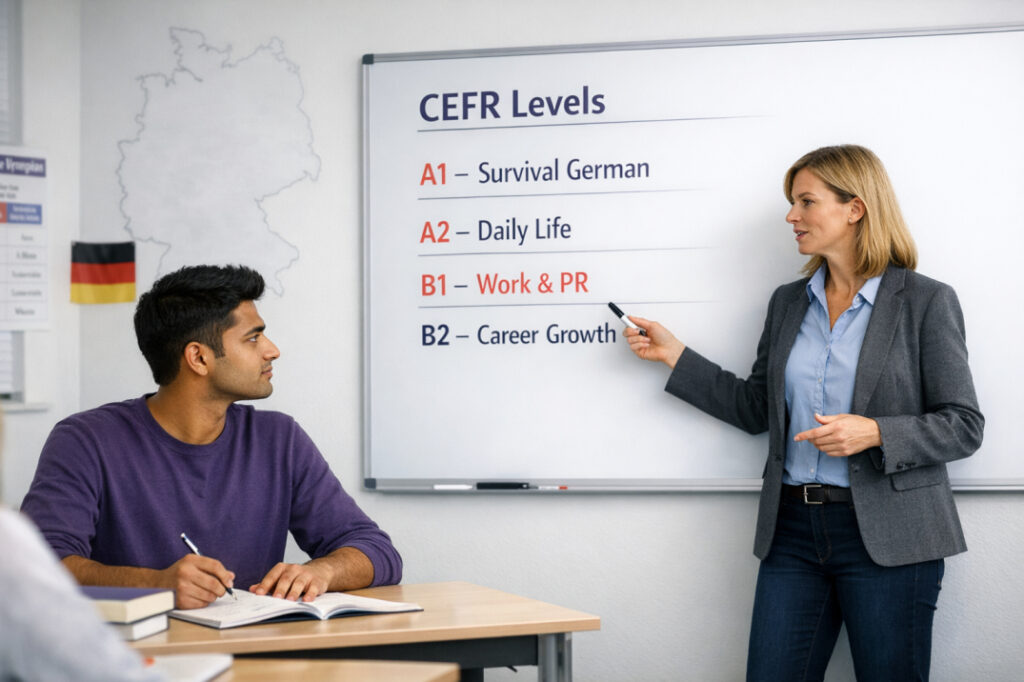
This guide covers everything Indians need to know about learning German for Germany—from understanding CEFR levels (A1 to C2) and choosing between Goethe Institut, VHS, and university courses, to building a realistic two-phase learning strategy. Whether you’re a student preparing for Masters, an Opportunity Card holder, a Blue Card professional, or a job seeker, German proficiency is the single most important factor for career growth, workplace integration, and faster pathways to Permanent Residence (PR) and citizenship. This guide provides honest advice based on real job market data—including the uncomfortable truth that the vast majority (~90%+) of German jobs require German proficiency.
| Data Point | Value |
|---|---|
| Jobs requiring German | ~90%+ (vast majority) |
| English-only jobs | <5% (explicitly stated) |
| Salary premium with German | +13–20% (studies indicate) |
| Hours to reach B2 (from zero) | 500–750 hours |
| Days to reach B2 (at 3 hrs/day) | 170–250 days (~6–8 months) |
| Goethe Institut India (per level) | ₹23,000–₹30,500 |
| Online tutors India (per level) | ₹8,000–₹14,000 |
| Goethe Exam Fee A1 | ₹9,400 |
| Goethe Exam Fee B1 | ₹18,800 |
| VHS Integration Course | €229/module (with BAMF) |
| Blue Card PR with B1 | 21 months |
| Blue Card PR with A1 | 27 months |
| Citizenship requirement | B1 German (mandatory) |
| Opportunity Card minimum | A1 German OR B2 English |
| Student part-time earning potential | €10,000–€12,000/year |
How to Use This Guide
This guide is designed for multiple audiences:
- Students: Planning Masters in Germany or already enrolled
- Opportunity Card holders: Preparing for job search in Germany
- Blue Card professionals: Seeking career advancement and PR
- Job seekers: Looking to improve employability in Germany
Navigate to sections relevant to your situation, but I recommend reading the “Why German Matters” and “Real Story” sections first—they may change how you prioritize language learning.
Why You Must Learn German for Germany (Job Market Reality)
The short answer: The vast majority (~90%+) of German jobs require German proficiency. Without it, you’re competing for less than 5% of the job market—against thousands of other international candidates.
Let me be direct with you: German proficiency is the single most important factor determining your success in Germany—more than your degree, more than your technical skills, more than your English fluency.
Here’s what the data shows (2025):
The Job Market Reality
- The vast majority (~90%+) of jobs in Germany require German proficiency
- Less than 5% of job listings explicitly state German is not required
- Even in “English-friendly” companies, informal settings (meetings, coffee breaks, lunch) happen in German
- Customer-facing roles (sales, HR, management, healthcare) require B2-C1 minimum
💡 Insider Reality: Job portals like StepStone and Indeed show “English-friendly” roles, but here’s what they don’t tell you—hiring managers often filter out candidates without German even when the posting says “German nice to have.” I’ve seen Indians with perfect technical qualifications rejected because the team lead wanted someone who could join lunch conversations.
The Salary Impact
- Studies indicate German proficiency increases earnings by 13–20%
- Higher German levels correlate with higher salaries across all industries
- Career advancement (promotions, management roles) requires German
The Integration Reality
Many Indians arrive thinking: “I’ll work in English and learn German later.”
Here’s what actually happens:
- Internal work (coding, documentation, reports) often happens in English
- Coffee breaks, lunch, team outings happen in German
- Meetings, presentations, client calls happen in German
- Performance reviews, salary negotiations happen in German
- Friendships, networking, community happen in German
Without German, you become isolated. With German, you become integrated.
English Proficiency in Germany—The Reality
Yes, 56% of Germans speak English. But here’s the nuance:
- English speakers are concentrated among university-educated, under-40, metropolitan residents
- Many Germans lack confidence speaking English even if they understand it
- Berlin and Frankfurt are exceptions; smaller cities have limited English
- The grocery store, doctor’s office, Ausländerbehörde, landlord—they speak German
Bottom line: English gets you in the door. German keeps you in the room.
Real Story: How A2 German Changed Everything
Let me share a real example that illustrates why starting German early matters.
Rahul from Hyderabad arrived in Munich for his Masters with A2 German (completed at Goethe Institut Hyderabad before departure). Within 4 weeks of arriving, he landed a part-time cashier job at REWE supermarket paying €13.50/hour.
Working his allowed student hours (240 half-days of 4-hour shifts), Rahul earned approximately €10,000 in his first year—money that covered his living expenses beyond his blocked account.
Meanwhile, his classmates without German spent 3-4 months applying to the same handful of “English-only” warehouse and kitchen helper jobs that hundreds of international students were fighting over. Some didn’t find part-time work until their second semester.
The Part-Time Jobs That Open Up With A2-B1 German
| Job Type | Typical Hourly Rate | German Level Needed |
|---|---|---|
| Supermarket cashier (REWE, EDEKA, Lidl) | €12.50–€14.00 | A2-B1 |
| Retail assistant (H&M, Decathlon, MediaMarkt) | €12.50–€14.00 | A2-B1 |
| Restaurant service | €12.00–€15.00 + tips | A2-B1 |
| Hotel reception | €13.00–€15.00 | B1 |
| Call center (German support) | €14.00–€17.00 | B1-B2 |
| Pharmacy assistant | €13.00–€15.00 | B1-B2 |
| Tutoring (German students in Math/Science) | €15.00–€25.00 | B1-B2 |
The Math: Student Earning Potential
- Current minimum wage: €12.82/hour (2025 rate)
- Student work limit: 120 full days OR 240 half-days per year
- 240 half-days × 4 hours = 960 hours/year
- 960 × €12.82 = €12,307/year potential
With better-paying jobs (cashier, retail, tutoring): €13,000–€15,000/year is realistic.
Without German? You’re competing with hundreds of international students for the handful of English-only warehouse positions paying minimum wage—and even those often go to students with at least basic German.
The Hidden Advantage
Beyond earnings, Rahul’s German helped him:
- Negotiate better rent with his landlord
- Understand his health insurance and university paperwork
- Make German friends (not just other international students)
- Get a Werkstudent job in his field by semester 3 (because he could communicate with the team)
The lesson: A2 German before arrival isn’t just about language—it’s about unlocking opportunities from day one.
German A1 to B2 Course Levels Explained (CEFR Framework)
Quick answer: B1 is the minimum for citizenship and PR fast-track. B2 is the sweet spot for career growth. Most Indians should target B1 before or shortly after arrival, then build to B2 over time.
The Common European Framework of Reference for Languages (CEFR)—known in German as Gemeinsamer Europäischer Referenzrahmen (GER)—defines six levels. This standardized framework is used by all German institutions: Goethe Institut, VHS, telc, TestDaF, and DSH exams all map to CEFR levels.
Here’s what each means practically, including realistic time investments:
A1 (Beginner)
| Metric | Value |
|---|---|
| Total hours required | 80–100 hours |
| At 3 hours/day | 27–33 days (~5–6 weeks) |
| Goethe Institut India duration | 7 weeks (intensive) |
| VHS Germany duration | 1 module (100 teaching units) |
What you can do:
- Introduce yourself and ask basic questions
- Order food and drinks
- Understand simple signs and announcements
- Handle basic survival situations
Real-world example:
- “Ich komme aus Indien.” (I come from India.)
- “Ein Kaffee, bitte.” (A coffee, please.)
- “Wo ist der Bahnhof?” (Where is the train station?)
Enough for: Tourist situations, basic Anmeldung, minimal daily survival, Opportunity Card minimum requirement
A2 (Elementary)
| Metric | Value |
|---|---|
| Total hours required | 180–200 hours (cumulative from zero) |
| Hours from A1 to A2 | 80–100 additional hours |
| At 3 hours/day (A1→A2) | 27–33 days (~5–6 weeks) |
| Goethe Institut India duration | 7 weeks (intensive) per level |
| VHS Germany duration | 2 modules total (200 teaching units) |
What you can do:
- Handle routine tasks (shopping, banking, public transport)
- Describe your background and immediate environment
- Understand frequently used expressions
- Have simple conversations about familiar topics
Real-world example:
- “Ich suche eine Wohnung in München.” (I’m looking for an apartment in Munich.)
- “Können Sie das bitte wiederholen?” (Can you please repeat that?)
- “Ich arbeite als Softwareentwickler.” (I work as a software developer.)
Enough for: Daily life basics, simple job tasks, part-time jobs (cashier, retail, gastro), understanding instructions
This is the recommended minimum level before arriving in Germany.
B1 (Intermediate)
| Metric | Value |
|---|---|
| Total hours required | 350–400 hours (cumulative from zero) |
| Hours from A2 to B1 | 150–200 additional hours |
| At 3 hours/day (A2→B1) | 50–67 days (~8–10 weeks) |
| Goethe Institut duration | 7–16 weeks per level |
| VHS Integration Course | 6 modules total (600 teaching units) for A1→B1 |
What you can do:
- Understand main points of clear standard speech
- Handle most travel and work situations
- Produce coherent text on familiar topics
- Describe experiences, events, dreams, and ambitions
- Give reasons and explanations for opinions
Real-world example:
- “Obwohl das Wetter schlecht ist, möchte ich spazieren gehen.” (Although the weather is bad, I want to go for a walk.)
- Participating in team meetings with prepared contributions
- Writing emails to colleagues and landlords
Enough for:
- Citizenship application (mandatory)
- Permanent Residence (most routes)
- Blue Card PR fast-track (21 months instead of 27)
- Basic professional communication
- Werkstudent jobs in your field
B2 (Upper-Intermediate)
| Metric | Value |
|---|---|
| Total hours required | 500–750 hours (cumulative from zero) |
| Hours from B1 to B2 | 150–350 additional hours |
| At 3 hours/day (B1→B2) | 50–117 days (~2–4 months) |
| Total time from zero (3 hrs/day) | 170–250 days (~6–8 months) |
What you can do:
- Understand complex text on concrete and abstract topics
- Interact fluently and spontaneously with native speakers
- Produce clear, detailed text on wide range of subjects
- Explain viewpoints on topical issues
- Understand news, podcasts, and TV shows
Real-world example:
- Leading team meetings in German
- Writing professional reports and emails
- Negotiating with landlords and service providers
- Presenting project updates to stakeholders
Enough for:
- Most professional roles
- Client-facing positions (with practice)
- Full workplace integration
- Comfortable daily life
- German-taught Master’s programs (with DSH/TestDaF)
C1 (Advanced) — 600–900 hours cumulative
What you can do:
- Understand demanding, longer texts with implicit meanings
- Express ideas fluently and spontaneously without searching for words
- Use language flexibly for social, academic, and professional purposes
Enough for: Management and leadership roles, complex negotiations, regulated professions (law, medicine, teaching)
C2 (Mastery) — 1000+ hours cumulative
Near-native proficiency. Rarely required except for specific professions (interpreters, university professors, journalists).
Timeline Summary: Zero to B2
Here’s the complete picture for someone starting from scratch:
Realistic scenario:
- Studying 3 hours/day, 5 days/week (15 hrs/week): A1→B1 in ~6 months, B2 in ~10–12 months
- Intensive course (4 hours/day, 5 days/week): A1→B1 in ~4 months, B2 in ~7–8 months
- Part-time (1.5 hours/day): Double all timelines above
The Two-Phase Learning Strategy
Based on extensive experience with Indian expats, here’s the most effective approach:
Phase 1: Learn German in India (A1–A2)
Why learn German in India before departure?
- Courses are significantly cheaper (₹8,000–28,000 vs €400+ in Germany)
- You have more time before visa/job pressure
- Foundation makes German learning in Germany exponentially easier
- Many Opportunity Card applicants fail job searches because they skipped this step
- Part-time job opportunities open up immediately upon arrival
💡 Insider Reality: Goethe Institut centers in India have 3-6 month waiting lists for popular batches (especially evening/weekend slots in Bangalore and Delhi). Don’t wait until your visa is approved—register the moment you decide Germany is your destination. Many students lose 3-4 months just waiting for a batch to start.
Recommended provider: Goethe Institut India (Gold standard)
Exam fees (Goethe Institut India):
- A1: ₹9,400
- A2: ₹10,600
- B1 (full): ₹18,800
- B1 (per module): ₹4,700
Alternative: Learn German Online (Budget Option)
If Goethe Institut fees are out of budget or classroom schedules don’t work for you, learning German online offers a more affordable alternative:
| Option | Cost per Level | Format | Best For |
|---|---|---|---|
| Online tutors (C1/C2 certified) | ₹8,000–₹14,000 | 1-on-1 or small groups | Working professionals, budget-conscious learners |
| Goethe Institut classroom | ₹23,000–₹30,500 | Classroom (15-20 students) | Structured learning, exam preparation |
| Goethe Institut online (self-paced) | ₹10,620 | Self-study with materials | Self-motivated learners |
Many online tutors are C1 or C2 certified Germans or Indians who’ve lived in Germany. They offer flexible scheduling—helpful if you’re working 8-hour days and can’t attend fixed classroom batches.
⚠️ Our Recommendation: Online learning is acceptable for A1 and A2, but we strongly recommend classroom learning for B1 and B2. Here’s why:
- B1-B2 grammar is complex—you need real-time teacher feedback
- Speaking fluency requires live interaction, not async video calls
- Classroom peer pressure keeps you accountable
- Group discussions simulate real German conversations
- You pick up the language 2-3x faster with immersion-style classroom learning
The comfort trap: Many learners prefer online for the convenience of studying at home. But convenience often comes at the cost of effectiveness. If you do A1-A2 online, make the switch to classroom for B1—your future self will thank you.
Our Recommendation Hierarchy:
- Best: University German courses in Germany (free for enrolled students)
- Recommended: Classroom courses (Goethe Institut, VHS, private schools)
- Acceptable for A1-A2: Online tutors (budget-friendly, flexible)
- Not recommended alone: Apps like Duolingo (supplement only)
Recommended Timeline:
- 12 months before departure: Start A1
- 9 months before departure: Complete A1, start A2
- 6 months before departure: Complete A2, take exam
- 3 months before departure: Start B1 (or continue after arrival)
- Arrival in Germany: Continue B1, have A2 certificate in hand
Phase 2: Accelerate in Germany (B1–B2+)
Why Germany accelerates learning:
- Immersion accelerates learning dramatically
- Daily practice opportunities everywhere
- University courses often free or subsidized
- VHS (Volkshochschule) courses affordable for residents
- Motivation is higher when you need German for daily life
Options in Germany:
University German Courses (Best Option for Students)
If you’re enrolled in a German university, this is hands-down the best option:
- Free or heavily subsidized for enrolled students
- Typically A1–B2 levels available
- Small class sizes with qualified instructors
- Designed specifically for international students
- DSH preparation courses for German-taught programs
- DSH exam fee: €50–€150 (university-specific)
- TestDaF exam fee: ~€195 (standardized, can take internationally)
💡 Insider Reality: University German courses fill up fast—especially A1 and B1 levels. Register during the enrollment period, not after semester starts. Some universities have placement tests; if you already have A1/A2, you can skip to higher levels and save time.
VHS (Volkshochschule)
VHS is Germany’s network of adult education centers—the largest provider of Integration Courses (Integrationskurse) authorized by BAMF (Bundesamt für Migration und Flüchtlinge). These courses are specifically designed for immigrants and follow a standardized curriculum.
| Course Type | Cost | Notes |
|---|---|---|
| Integration Course (with BAMF authorization) | €229/module | 100 Unterrichtseinheiten (teaching units) per module |
| Integration Course (benefit recipients) | FREE | Arbeitslosengeld II, Sozialhilfe, BAföG recipients |
| Integration Course (self-paying) | €458/module | Without BAMF Berechtigungsschein |
| Regular German courses | €1.20–€3.00/lesson | Standard Volkshochschule rates |
- Full Integration Course: 600 lessons (A1→B1) + 100 Orientierungskurs = 700 total units
- Ends with DTZ (Deutsch Test für Zuwanderer) B1 exam + “Leben in Deutschland” test
- Must register in person after arrival (cannot enroll from abroad)
- BAMF issues a Berechtigungsschein (authorization certificate) for subsidized rates
💡 Insider Reality: VHS course quality varies dramatically by location. Munich and Hamburg VHS centers are excellent with professional teachers and small classes. Some smaller city VHS courses have 25+ students and overwhelmed instructors. Ask in local Indian Facebook/WhatsApp groups which specific VHS location has good reviews before enrolling.
VHS Bewerbungstraining (Job Application Training)
Once you reach B1, VHS offers specialized Bewerbungstraining workshops that teach you how to apply for jobs in German—a completely different process than in India or English-speaking countries.
| Workshop Type | Duration | Cost | What You Learn |
|---|---|---|---|
| Bewerbungstraining Grundkurs | 1-2 weeks | €50–€150 | German CV (Lebenslauf), cover letter (Anschreiben), interview basics |
| Bewerbungscoaching | 4-8 sessions | €100–€200 | 1-on-1 application review, mock interviews |
| Arbeitsagentur workshops | 1-3 days | FREE | For registered job seekers (Arbeitssuchend) |
Why this matters:
- German CVs use a specific format (photo, personal details, reverse chronological)
- Cover letters (Anschreiben) follow strict formal conventions
- Interview questions and expected answers differ from Anglo-Saxon style
- “Tell me about yourself” (Erzählen Sie mir von sich) has a German formula
Private Language Schools
- Faster but more expensive: €400–€1,000/level
- Intensive options: 20–25 hours/week
- Good for those with work schedule constraints
- Examples: Goethe Institut Germany, Berlitz, inlingua
Already in Germany? How to Start Learning German Now
If you’re already in Germany without German skills, don’t panic—but act fast. Every week you delay is a week of missed opportunities. Here’s your action plan:
Week 1: Immediate Steps
1. Complete Anmeldung first — You cannot enroll in VHS or get BAMF authorization without a registered address.
2. Check your eligibility for Integration Course (Integrationskurs):
| Status | BAMF Authorization | Cost |
|---|---|---|
| EU citizens | Not eligible | Must self-pay |
| Non-EU with residence permit | Eligible (apply via Ausländerbehörde) | €229/module |
| Asylum seekers / refugees | Automatically eligible | FREE |
| Receiving Bürgergeld / social benefits | Eligible | FREE |
| Self-paying (no authorization) | N/A | €458/module |
3. Register at your local VHS — Walk in, don’t wait for online slots. Bring:
- Meldebescheinigung (registration certificate)
- Passport + residence permit
- BAMF Berechtigungsschein (if you have one)
💡 Insider Reality: VHS courses have waiting lists of 2-4 weeks in major cities. The moment you complete Anmeldung, visit VHS in person and get on the list. Don’t wait until you “settle in”—that’s how people lose months.
Week 2-4: While Waiting for Course
Don’t waste the waiting period. Start with free resources:
Daily routine (2-3 hours):
- Morning (30 min): Duolingo for vocabulary
- Afternoon (1 hour): Deutsche Welle free A1 course (dw.com/learn-german)
- Evening (1 hour): YouTube — Easy German street interviews with subtitles
Speaking practice (free):
- Tandem app — Find language exchange partners (you teach Hindi/English, they teach German)
- Meetup.com — Search “German language exchange” in your city
- Facebook groups — “Germans and Internationals in [City]” often have weekly Stammtisch
City-Specific Resources
| City | Best VHS | Free Meetups | Notes |
|---|---|---|---|
| Berlin | VHS Mitte, VHS Neukölln | Weltcafé, Café Babel | Most English-friendly, but German still essential |
| Munich | MVHS (Münchner VHS) | Café Netzwerk | Bavarian dialect—learn Hochdeutsch first |
| Frankfurt | VHS Frankfurt | Internationales Familienzentrum | Finance sector = more English jobs, but German for career growth |
| Hamburg | VHS Hamburg | Bücherhallen language cafés | Strong VHS network |
| Cologne | VHS Köln | Café Kölsch | Kölsch dialect exists but Hochdeutsch widely spoken |
Intensive Options (Faster but Paid)
If you need German fast (job search pressure, Opportunity Card timeline), consider intensive courses:
| Provider | Duration | Cost | Best For |
|---|---|---|---|
| Goethe Institut Germany | 8 weeks/level (intensive) | €1,200–€1,500/level | Gold standard certificate |
| Berlitz | 4-8 weeks (super-intensive) | €1,500–€2,500/level | Corporate-focused, flexible schedules |
| Private tutors (italki, Preply) | Self-paced | €15–€30/hour | 1-on-1 attention, flexible |
| Crash courses (various) | 2-4 weeks intensive | €500–€1,000 | Quick basics before job interviews |
The 90-Day Challenge
If you arrived with zero German, here’s a realistic 90-day plan:
Days 1-30: A1
- Intensive course or daily self-study (3+ hours)
- Focus: survival German (shopping, transport, appointments)
- Goal: Handle basic daily situations
Days 31-60: A2
- Continue structured course
- Add speaking practice (tandem, meetups)
- Goal: Simple conversations, basic job tasks
Days 61-90: A2+ / Early B1
- Push toward B1 vocabulary
- Practice job interview phrases
- Goal: Ready for German-required part-time jobs
This timeline is aggressive and requires 3-4 hours/day of focused study. Most people take 4-6 months to reach A2, 8-12 months for B1. But if your visa clock is ticking (Opportunity Card holders), intensity matters.
Key Mindset Shift
Stop thinking “I’ll learn German when I have time.”
You’ll never “have time” in Germany. Between job hunting, bureaucracy, housing search, and daily life—there’s always something. The people who succeed treat German like a non-negotiable appointment:
- Block 2-3 hours daily in your calendar
- Tell yourself: “German class is my job right now”
- Track your hours (aim for 15+ hours/week)
- Celebrate small wins (first conversation with a shopkeeper, first joke understood)
The uncomfortable truth: Every month without German is a month of limited opportunities, smaller social circles, and slower integration. Start today.
Common Mistakes When You Learn German for Germany
Mistake #1: Relying Only on Duolingo
Let me be honest: Duolingo alone will not make you conversational in German.
What Duolingo does well:
- Vocabulary building (reaches ~A2 level reading after full tree, ~2000 words)
- Daily habit formation
- Basic grammar exposure through pattern recognition
What Duolingo doesn’t do:
- Speaking practice (voice recognition is very lenient, accepts wrong pronunciation)
- Real conversation skills
- Proper pronunciation training
- Complex grammar explanations
- Professional or academic German
- Writing practice beyond single sentences
💡 Insider Reality: I’ve met students who completed the entire Duolingo German tree (600+ day streaks) and couldn’t hold a basic conversation at the bakery. They understood written German but froze when the Bäckerin asked “Sonst noch etwas?” (Anything else?). Duolingo builds recognition, not production. You need both.
Less than 5% of users report achieving C1 through Duolingo alone.
The verdict: Use Duolingo as a supplement (15–20 min/day for vocabulary), not a replacement for structured courses with speaking practice.
Mistake #2: Waiting Until You Arrive
Many Indians think: “I’ll learn German after I reach Germany.”
Reality check:
- First weeks are consumed by Anmeldung, housing search, bank account, health insurance
- University/work pressure leaves little energy for intensive language learning
- Social isolation without German makes everything harder
- Opportunity Card holders need jobs fast—no time to build language foundation
- Part-time jobs require German from day one
💡 Insider Reality: I’ve seen Opportunity Card holders burn through their 12-month visa without finding a job—not because they lacked skills, but because they arrived with zero German and spent 6 months just reaching A2. By then, desperation showed in interviews. The ones who succeed? They arrive with A2-B1 and hit the ground running.
The real cost of waiting:
- 3–4 months without part-time job income = €3,000–€4,000 lost
- Slower integration, smaller social circle
- Missed Werkstudent opportunities
- Longer time to PR (because you delay reaching B1)
Start now. Not after your visa. Not after you arrive. Now.
Mistake #3: Underestimating Time Investment
German is a Category II language for English speakers (FSI classification). It requires significant effort:
These are minimum estimates with effective study methods (structured courses + practice).
Mistake #4: Thinking “English Jobs” Don’t Require German
Even in “English-friendly” roles:
- Internal documentation may be in German
- Colleagues default to German for casual chat
- Career advancement requires German
- Client communication often requires German
- Company events, training sessions in German
The job posting said English; the promotion requires German.
Mistake #5: Skipping Speaking Practice
Many students focus on grammar and reading but avoid speaking. Result:
- Can read B1-level texts
- Can’t order coffee without panicking
- Freeze in job interviews
- Understand but can’t respond
Fix: From day one, practice speaking. Language tandems, conversation groups, speaking with yourself, anything. Grammar without speaking is incomplete learning.
German for PR and Citizenship Pathways
Short answer: B1 German is mandatory for both citizenship and most PR routes. For Blue Card holders, B1 saves you 6 months on your PR timeline (21 vs 27 months).
German proficiency directly impacts your immigration timeline.
Permanent Residence (Niederlassungserlaubnis)
General Route (5 years):
- B1 German required
- Student time counts at 50% (4 years study = 2 years credit)
German Graduate Fast-Track (2 years):
- Must hold §18a, §18b, or §18d residence permit
- Degree-appropriate job required
- 24 months pension contributions
- B1 German required
Blue Card Fast-Track:
| German Level | PR Timeline |
|---|---|
| B1 German | 21 months |
| A1 German | 27 months |
The math is clear: B1 saves you 6 months on your PR timeline.
Citizenship (Einbürgerung)
- B1 German mandatory—no exceptions
- Citizenship test (Einbürgerungstest): 33 questions, 17 correct to pass (covers German history, law, values)
- Standard: 5 years residence
- 3-year fast-track: Removed in late 2025 under revised nationality law
- Cannot apply while on student visa (§16b)—must switch to work permit first
- Fee: €255 per adult
💡 Insider Reality: The Einbürgerungstest is easier than most people fear—you can practice all 310 possible questions online at bamf.de. The real challenge is the B1 certificate. Some Ausländerbehörden are stricter about which certificates they accept. Goethe-Zertifikat B1 and telc Deutsch B1 are universally accepted. If you have an unusual certificate, call your local Einbürgerungsbehörde before applying.
Accepted B1 certificates for citizenship:
- Goethe-Zertifikat B1
- telc Deutsch B1
- TestDaF (TDN 3+)
- DTZ (Deutsch Test für Zuwanderer)
- German school certificate (Hauptschulabschluss or higher)
German for Opportunity Card (Chancenkarte) Holders
Short answer: You can enter with just B2 English, but finding a job without German is nearly impossible. The vast majority of German jobs require German—this doesn’t change just because you have a Chancenkarte.
⚠️ Critical Warning: Opportunity Card holders arriving with zero German often fail not due to skills, but due to access. The 12-month clock starts immediately, and without German, you’re locked out of 90%+ of job opportunities.
If you’re coming on the Opportunity Card (§20a AufenthG), German is critical:
Minimum requirement: A1 German OR B2 English
Points system (need 6+ points total):
| Criterion | Points |
|---|---|
| German A2 | 1 point |
| German B1 | 2 points |
| German B2+ | 3 points |
| English C1+ | 1 additional point |
💡 Insider Reality: The Opportunity Card’s 12-month clock starts ticking the moment you enter Germany. I’ve watched technically brilliant Indians spend months applying to the same 50 “English-only” job postings that 10,000 other Chancenkarte holders are also targeting. Meanwhile, those with B1 German applied to 500+ jobs and landed offers within 3-4 months. The math is brutal but simple: more German = more job options = faster success.
Recommendation: Complete at least A2, preferably B1, before arrival. This dramatically improves your job search success and opens part-time work opportunities while you search.
Industry-Specific Language Requirements
Short answer: IT/Tech is the most forgiving (B1, sometimes A2 in startups). Healthcare and Sales are the strictest (B2-C1 mandatory). Even “English-friendly” industries expect German for career advancement.
Not all industries have the same expectations:
| Industry | Typical Requirement | Notes |
|---|---|---|
| IT/Tech | B1–B2 (A2 possible in startups) | English common internally, German for advancement |
| Engineering | B1–B2 | Documentation often in German |
| Research/R&D | B1 (sometimes A2) | 50%+ roles accept English |
| Finance/Banking | B2–C1 | Client-facing requires German |
| Healthcare | B2+ (regulated) | Patient communication mandatory |
| Sales/Marketing | B2–C1 | Customer interaction in German |
| HR | B2–C1 | Labor law, contracts in German |
| Management | B2–C1 | Leadership requires German |
| Teaching | C1–C2 | Regulated profession |
| Consulting | B2–C1 | Client presentations in German |
💡 Insider Reality: “English-friendly” IT companies like Zalando, Delivery Hero, and N26 hire in English—but promotions stall without German. I know senior developers at major Berlin tech companies who’ve been stuck at the same level for 3+ years because they can’t lead German-speaking teams or present to German clients. The glass ceiling is real.
Cities with most English opportunities:
- Hamburg: 38% of roles mention English
- Berlin: 30% of roles mention English
- Frankfurt/Hesse: 30% of roles mention English
Even in these cities, German opens 70%+ more opportunities.
Learn German Online: Free & Supplementary Resources
Whether you’re in India or Germany, online resources can accelerate your learning. However, use them strategically:
⚠️ Our Recommendation: Online learning works well for A1 and A2 levels where you’re building vocabulary and basic grammar. For B1 and above, we strongly recommend classroom learning — speaking fluency, complex grammar, and real-time feedback require live interaction. The convenience of online learning often comes at the cost of effectiveness at higher levels.
Structured Online Courses (A1–A2 Recommended)
These platforms offer complete courses — suitable for A1-A2 foundation:
About Individual Tutors:
Many C1/C2 certified Indians who’ve lived in Germany or native German speakers offer private classes via WhatsApp groups, Instagram, or platforms like Superprof. At ₹8,000–₹14,000 per level, they’re significantly cheaper than Goethe Institut (₹26,000+). Look for:
- C1/C2 certification proof
- Teaching experience (not just language knowledge)
- Structured curriculum (not just conversation practice)
- Student reviews/testimonials
💡 Tip: Search “German classes online India” on Instagram or Facebook groups like “Indians in Germany” — many verified tutors advertise there. Ask for a free demo class before committing.
Links:
- Deutsche Welle: dw.com/learn-german
- VHS Lernportal: vhs-lernportal.de
- Goethe Institut Online: goethe.de/en/spr/kur/online
Free Resources (Supplements, Not Replacements)
Use these alongside structured courses — not as your primary learning method:
Apps (15-20 min/day max):
- Duolingo — Vocabulary building, gamified learning
- Anki — Flashcard app with German decks (der/die/das practice)
- Tandem/HelloTalk — Language exchange with native speakers
YouTube Channels:
- Easy German — Street interviews with subtitles (excellent for listening)
- Deutsch mit Marija — Grammar explanations in simple German
- Learn German with Anja — Fun, energetic lessons
- Lingster Academy — Structured lessons, exam prep
Podcasts:
- Slow German — News in slow, clear German (A2-B1)
- Coffee Break German — Structured lessons for beginners
- Deutsch Warum Nicht? — Deutsche Welle’s classic audio course
💡 Insider Reality: The secret weapon most Indians miss is Tandem—the language exchange app. You teach someone Hindi/English, they teach you German. It’s free, it’s real conversation practice, and you make friends. I know students who went from A2 to B1 in 3 months just by doing 30-minute Tandem calls every day.
When to Switch from Online to Classroom
The trap: Many learners stay in the “comfort zone” of online learning because it’s convenient. They reach A2 online, then plateau for months because they avoid speaking. Don’t let convenience cost you fluency.
German Language A1 to B2 Course Costs and Exam Comparison
Total Investment: Zero to B2
Learn German in India (A1–A2):
| Item | Cost (INR) |
|---|---|
| Goethe A1 course | ₹26,000–₹28,500 |
| Goethe A2 course | ₹26,000–₹28,500 |
| A1 exam | ₹9,400 |
| A2 exam | ₹10,600 |
| Textbooks (2 levels) | ₹4,000–₹6,000 |
| Total A1–A2 | ₹76,000–₹82,000 (~€850–€920) |
Learn German in Germany (B1–B2):
| Item | Cost (EUR) |
|---|---|
| VHS B1 (3 modules with BAMF) | €687 |
| VHS B2 (if available) | €400–€600 |
| OR University courses | Often FREE |
| B1 exam (Goethe/telc) | €150–€250 |
| B2 exam (if needed) | €200–€250 |
| Total B1–B2 | €400–€1,500 |
Grand Total Zero to B2: Approximately €1,250–€2,400 (₹1.1–2.1 lakh)
Compare this to the €10,000+ you can earn with part-time jobs that German unlocks. The ROI is clear.
Exam Comparison: Which Certificate?
Germany recognizes several German language certifications. Each has different purposes and acceptance:
| Exam | Provider | Cost | Validity | Best For |
|---|---|---|---|---|
| Goethe-Zertifikat | Goethe Institut (worldwide) | ₹9,400–₹18,800 (India) | Lifetime | Visa applications, universal recognition |
| telc Deutsch | telc GmbH (Germany mainly) | €150–€200 | Lifetime | Citizenship, PR applications |
| TestDaF | TestDaF-Institut (worldwide) | ~€195 | Lifetime | University admission (German programs) |
| DSH | Individual universities (Germany only) | €50–€150 | Lifetime | University admission (specific university) |
| DTZ | BAMF-authorized providers (Germany) | Included in Integrationskurs | Lifetime | Integration course completion, citizenship |
Recommendation:
- For visa/general purpose: Goethe-Zertifikat (gold standard, accepted everywhere)
- For university admission: TestDaF (flexible, take anywhere) or DSH (if you know your university)
- For citizenship/PR in Germany: DTZ or telc Deutsch is sufficient
Connect With the Indian Community
Brizz.me is your digital home in Germany:
Find what you need:
- 🎉 Desi events in Germany — Indian festivals, Bollywood nights, student meetups — Find on Brizz Events
- 🏠 Indian flatmates in Germany — verified WG rooms from community — Find on Brizz Rentals
- ✅ German language classes — online tutors, language exchange, conversation practice — Discover on Brizz Services
- 📚 Free student guides — Visa, blocked account, university tips — Read on Brizz Guides
Share with the community:
- 🎤 Teach German or offer tutoring? — Students & professionals welcome — List on Brizz Services
- 🏠 Have a spare room? — Find an Indian flatmate easily — List on Brizz Rentals
📍 Join the Desi community — Start at brizz.me
FAQ
How to learn German for living in Germany? Start with A1-A2 in India (Goethe Institut or online tutors), then continue B1-B2 in Germany via VHS or university courses. Immersion accelerates learning dramatically.
What is the best way to learn German before moving to Germany? Goethe Institut classroom courses are the gold standard. Budget alternative: online tutors for A1-A2, then switch to classroom for B1-B2.
How long does it take to learn German to B1? Approximately 350–400 hours of study. At 3 hours/day, that’s about 4–5 months. At 10 hours/week, expect 8–10 months.
Can I learn German online effectively? Yes, for A1-A2 levels. Online tutors and platforms work well for basics. However, we strongly recommend classroom learning for B1-B2 where speaking fluency matters.
Is Duolingo enough for German? No. Duolingo builds vocabulary but lacks speaking practice and grammar depth. Use it as a 15-minute daily supplement, not your main learning method.
Can I get a job in Germany without German? Technically yes (less than 5% of jobs explicitly don’t require German), but career growth, part-time opportunities, and integration require German. Even “English” jobs often expect German for advancement.
Which German exam should I take? Goethe-Zertifikat is most recognized internationally. TestDaF or DSH for university admission. DTZ or telc for citizenship.
Is German required for Blue Card? Not initially, but A1 gets you PR in 27 months while B1 gets you PR in 21 months—6 months faster.
Can I learn German after arriving in Germany? Yes, but starting before arrival gives you significant advantages: immediate part-time job access, easier integration, and less stress.
What level for citizenship? B1 is mandatory for German citizenship. No exceptions.
How much does it cost to learn German in India? Goethe Institut: ₹26,000–₹28,500 per level. Online tutors: ₹8,000–₹14,000 per level. Exams: ₹9,400 (A1) to ₹18,800 (B1).
Are VHS courses available for international students? Yes, after you arrive and complete Anmeldung. Cannot enroll from abroad. Integration courses require BAMF authorization.
What’s the difference between DSH and TestDaF? DSH is university-specific (only in Germany, format varies). TestDaF is standardized (available worldwide, same format everywhere). Both are accepted for university admission.
Can I get part-time jobs with A2 German? Yes! A2 opens cashier, retail, restaurant, and basic service jobs. This is the key advantage of learning German before arrival.
About This Guide Series
This Guide #7 is part of Brizz.me’s 20-part series — helping Indian students learn German for Germany from A1 to B2.
| # | Guide |
|---|---|
| 1 | Masters in Germany — Complete Guide |
| 2 | Germany vs UK, USA, Canada, Ireland, Netherlands |
| 3 | How to Choose a University in Germany |
| 4 | Masters in Germany Eligibility Requirements |
| 5 | APS Certificate Germany Guide |
| 6 | Masters in Germany Application: SOP, LOR, CV & Documents |
| 7 | Learn German for Germany: A1 to B2 |
| 8 | Germany Application Timelines 2026 and 2027 |
| 9 | Germany uni-assist Guide |
| 10 | Germany Scholarships Guide |
| 11 | Germany Sperrkonto (Blocked Account) |
| 12 | Education Loans from India for Germany |
| 13 | Germany Student Visa Application |
| 14 | First 30 Days in Germany Checklist |
| 15 | Germany Werkstudent Jobs Guide |
| 16 | Germany Student Life Hacks |
| 17 | Germany Job Search Strategy |
| 18 | Germany Job Seeker Visa (§20) |
| 19 | Student to Blue Card Germany |
| 20 | Germany Permanent Residence (PR) |
← Previous: Masters in Germany Application: SOP, LOR, CV & Documents
Next →: Germany Application Timelines 2026 and 2027 (Coming Soon)
Final Thoughts
Learning German is not just about passing exams or meeting visa requirements. It’s about building a life in Germany.
Every hour you invest in German learning pays dividends:
- Better job opportunities (part-time and full-time)
- €10,000+ additional income as a student
- Faster PR timeline (6 months saved with B1)
- Higher salary (studies indicate +13–20% premium)
- Deeper friendships
- Richer cultural experiences
- True integration
The path is clear: A1/A2 in India → B1+ in Germany → B2 for career growth.
Start today. Your future self will thank you.
You’ve got this — Germany rewards those who prepare.
⚠️ Disclaimer: This is educational content, not legal advice. Always verify current regulations with official sources (BAMF, Goethe Institut, or your local immigration office). Rules mentioned are current as of January 2026.