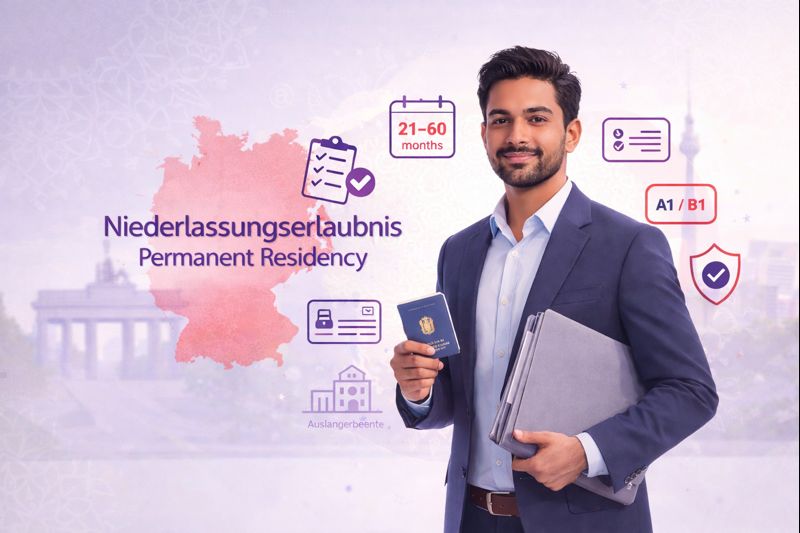
Indians or any Expat can obtain Germany permanent residence (Niederlassungserlaubnis) in Germany through multiple pathways, with timelines ranging from 21 months to 5 years depending on your visa type, German language skills, and employment status. The fastest route is via the EU Blue Card with B1 German (21 months), while the standard pathway requires 5 years of residence.
| Pathway | Timeline | German Required | Pension Contributions | Key Requirement |
|---|---|---|---|---|
| EU Blue Card + B1 | 21 months | B1 | 21 months | Blue Card employment |
| EU Blue Card + A1 | 27 months | A1 | 27 months | Blue Card employment |
| EU Blue Card (No Certificate) | 33 months | Basic knowledge | 33 months | Blue Card employment |
| Skilled Worker (German Degree) | 2 years | B1 | 24 months | Work in degree-related field |
| Skilled Worker (Foreign Degree) | 3 years | B1 | 36 months | §18a/§18b/§18d visa |
| Spouse of German Citizen | 3 years | B1 | — | Marriage + living together |
| Spouse of PR Holder | 3-5 years | B1 | 36-60 months | Working ≥20 hrs/week |
| Student → Work → PR | 4+ years | B1 | 24-36 months | Study time counts 50% |
| Self-Employed | 3 years | B1 | — | Profitable business |
| General (All Others) | 5 years | B1 | 60 months | Legal residence |
What is Niederlassungserlaubnis (Settlement Permit)?
The Niederlassungserlaubnis is Germany’s permanent residence permit, allowing you to live and work in Germany indefinitely without visa renewals. Unlike your temporary residence permit (Aufenthaltserlaubnis), PR provides long-term security and freedom.
Key Benefits of German PR
Employment Freedom: Work in any profession, change employers freely, or start your own business without immigration restrictions.
No Renewal Hassles: Your PR doesn’t expire as long as you remain in Germany. You only need to renew the physical card every 10 years.
Family Security: Simplified family reunification for spouses and children, with easier paths to their own PR.
Better Financial Access: Banks treat PR holders almost like German citizens for mortgages and loans—more on this below.
Path to Citizenship: PR is typically a stepping stone to German citizenship, though you can hold PR indefinitely without naturalizing.
Social Security Access: Full access to unemployment benefits, healthcare, and pension rights equivalent to German citizens.
What PR Does NOT Give You
PR is not citizenship. You cannot vote in federal elections, hold a German passport, or enjoy diplomatic protection as a German citizen. For these rights, you’d need to pursue naturalization (Einbürgerung).
Niederlassungserlaubnis vs. Daueraufenthalt-EU: Which Should You Choose?
Germany offers two types of permanent residence permits. Understanding the difference matters, especially if you might want EU mobility later.
| Feature | Niederlassungserlaubnis | Daueraufenthalt-EU |
|---|---|---|
| Validity | Indefinite in Germany | Indefinite in Germany + EU mobility |
| Expires if abroad | 6 months outside Germany | 12 months outside EU (24 months for ex-Blue Card holders)* |
| EU Work Rights | None (only 90-day Schengen visits) | Can apply for residence in other EU countries |
| Minimum Residence | Varies by pathway (21 months to 5 years) | 5 years minimum |
| Application Fee | €113 | €109 |
| Restrictions | N/A | Not valid in Denmark or Ireland |
*Exact expiry rules depend on your permit history and conditions (Nebenbestimmungen)—confirm with your Ausländerbehörde.
Recommendation: If you plan to stay only in Germany, the standard Niederlassungserlaubnis is sufficient. However, if you might relocate within the EU later—say, to the Netherlands or France—request the Daueraufenthalt-EU specifically when applying. It’s not automatic; you must ask for it. You can hold both permits simultaneously.
Pathway 1: EU Blue Card to PR (Fastest Route)
The EU Blue Card offers the fastest path to permanent residence in Germany, making it the preferred route for skilled Indian professionals.
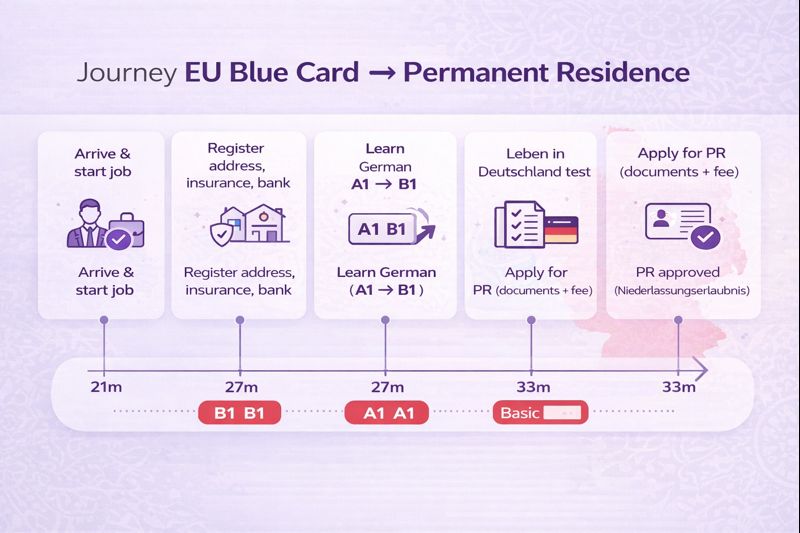
Timeline Options
21 Months: With B1 German certificate + 21 months pension contributions + continuous Blue Card employment
27 Months: With A1 German certificate + 27 months pension contributions + continuous Blue Card employment
33 Months: Without any formal German certificate (basic knowledge sufficient) + 33 months pension contributions + continuous Blue Card employment
Requirements Checklist
✅ Currently holding EU Blue Card (§18g AufenthG)
✅ Employed in a job meeting Blue Card salary thresholds (€50,700 standard / €45,934.20 for shortage occupations in 2026)
✅ Pension contributions matching your employment period (automatic for employees)
✅ German language certificate (B1 for 21 months, A1 for 27 months, or basic knowledge for 33 months)
✅ Passed “Leben in Deutschland” test (15/33 correct)
✅ Secure livelihood (no social benefits dependency)
✅ Valid health insurance (statutory or private)
✅ Adequate housing
✅ No criminal record
Real-World Timeline: Blue Card to PR
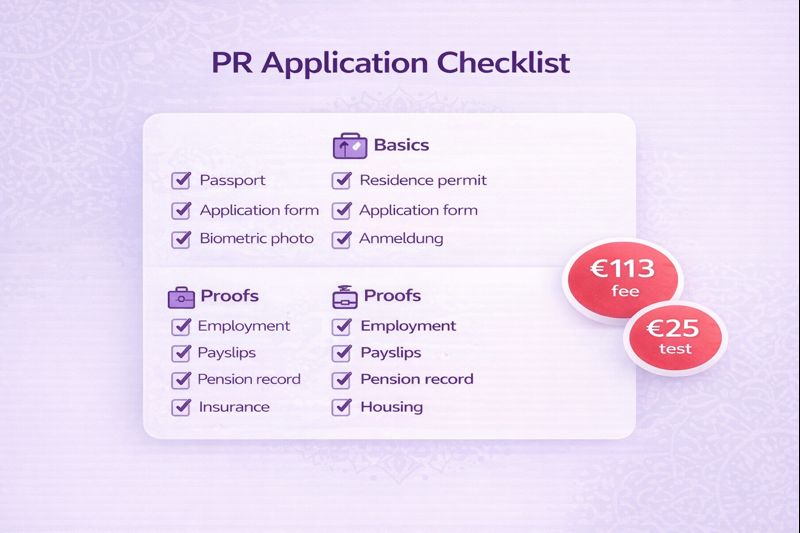
Here’s what a typical journey looks like for an Indian IT professional:
Month 0: Arrive in Germany with Blue Card, start employment
Month 1-6: Settle in, open bank account, register address, get health insurance
Month 6-12: Begin German language course (evening classes or weekend intensive)
Month 12-18: Achieve B1 German, book “Leben in Deutschland” test
Month 18-21: Pass test, gather documents, apply for PR
Month 21-24: PR application processing Month 24: Receive Niederlassungserlaubnis
Pathway 2: Skilled Worker Visa to PR
If you hold a skilled worker visa (§18a, §18b, or §18d AufenthG) rather than a Blue Card, your path to PR has different timelines.
German University Graduates: 2 Years
If you graduated from a German university and work in a field related to your degree:
- 2 years of employment in Germany
- 24 months of pension contributions
- B1 German language certificate
- Passed “Leben in Deutschland” test
- Work in a qualification-appropriate role
Foreign Degree Holders: 3 Years
If you hold a recognized foreign degree:
- 3 years of employment in Germany
- 36 months of pension contributions
- B1 German language certificate
- Passed “Leben in Deutschland” test
- Recognized degree + employment in related field
Important Distinction
The skilled worker pathway requires your job to be “qualification-appropriate”—meaning it must relate to your degree or professional training. A software engineer working as a restaurant manager wouldn’t qualify, even with 3 years of residence.
Pathway 3: Student to PR
Many Indians arrive in Germany on student visas. Here’s how the path to PR works:
How Student Time Counts
Student visa time counts at 50% toward the general 5-year PR requirement. So 4 years of study = 2 years credited toward PR.
However, there’s a crucial distinction:
For Blue Card fast-track (21/27/33 months): Your student years do NOT count. The clock starts only when you begin Blue Card employment after graduation.
For skilled worker fast-track (2-3 years): The clock starts when you begin qualified employment after graduation.
Practical Example
Ravi’s Journey:
- 2019-2023: Master’s degree in Germany (4 years)
- 2023-2025: Blue Card employment (2 years)
For general PR (5-year path): Ravi has 2 years (student) + 2 years (work) = 4 years. Needs 1 more year.
For German graduate fast-track: Ravi has 2 years of work = eligible for PR with B1 German.
For Blue Card fast-track: Ravi has 24 months of Blue Card employment. With B1 German, he was eligible at 21 months.
Student Work and Pension Contributions
As a student, you can work up to 20 hours/week (40 hours during breaks) or 140 full days/280 half-days per year. These jobs typically require pension contributions.
Critical Point: While you earn pension contributions as a working student, this work experience does NOT count toward Blue Card fast-track timelines. You must first transition to a proper work visa or Blue Card, then accumulate the required months.
Pathway 4: Family/Spouse to PR
Spouse of German Citizen
Timeline: 3 years of residence + living in marital partnership
Requirements:
- B1 German language certificate
- Passed “Leben in Deutschland” test
- Held residence permit for family reasons for 3+ years
- Living together as married couple in Germany
- Secure livelihood (income can be combined with spouse’s)
Spouse of PR Holder (Skilled Worker)
Timeline:
- 3 years if working at least 20 hours/week
- 5 years otherwise
Requirements:
- Your spouse must hold Niederlassungserlaubnis under §18c AufenthG (skilled worker PR)
- Living together as married couple
- B1 German + Leben in Deutschland test
- 36-60 months pension contributions (depending on timeline)
- Your own residence permit was not issued for humanitarian reasons
Children
Minor children can obtain PR together with their parents if they meet age-appropriate integration requirements. Children under 16 generally don’t need specific language certificates.
Pathway 5: Opportunity Card (Chancenkarte) Holders
How It Works
- Enter Germany on Opportunity Card (1 year validity)
- Search for qualified employment
- Transition to work visa or Blue Card once employed
- PR clock starts only after transitioning
Work done during the Opportunity Card period (up to 20 hours/week or trial employment) does NOT count toward PR pension requirements. The qualifying employment begins only after you receive a proper work permit.
Bottom Line: The Opportunity Card is a bridge to employment, not a PR pathway itself. Plan for the full PR timeline (21 months to 5 years) to begin only after securing a proper work visa.
Pathway 6: Self-Employment to PR
Self-employed individuals (§21 AufenthG) can apply for PR after 3 years if:
- Business is successful, profitable, and sustainable
- Livelihood is secured through business income
- B1 German language certificate
- Passed “Leben in Deutschland” test
The “successful business” determination is at your case worker’s discretion. Prepare a strong case with tax returns, profit statements, and evidence of ongoing contracts.
The Leben in Deutschland Test: What You Need to Know
All PR applicants must demonstrate “basic knowledge of the German legal and social order and living conditions.” The standard proof is passing the “Leben in Deutschland” test.
Test Structure
- 33 questions (multiple choice, 4 options each)
- 30 general questions + 3 state-specific questions (based on where you live)
- 60 minutes duration
- Pass mark: 15/33 correct (45%) for PR; 17/33 for citizenship
- Fee: €25
Content Areas
The test covers German political structure (Bundestag, Bundesrat, electoral system), history, legal system, civil rights, religious diversity, gender equality, and general living conditions.
How to Register
Register through your local Volkshochschule (VHS) or approved private language schools. You can take the test without completing an integration course, though availability varies by location.
Results: Arrive by post in 4-6 weeks (centrally processed by BAMF). The certificate does not expire.
Preparation Resources
- Official question bank: 310 questions total (300 general + 10 per state) available at bamf.de
- Free practice tests: Multiple websites offer online practice with instant feedback
- Mobile apps: Available with English translations of questions—search “Einbürgerungstest” or “Leben in Deutschland” on app stores
- Integration course: Includes an orientation course as preparation
- YouTube channels: Several German channels explain test concepts with visual aids
Language Level Needed: Questions are in formal, bureaucratic German. A2-B1 level is typically needed to understand the questions, though some apps provide translations.
Sample Questions
To give you an idea of what to expect:
Political System: “What is the Bundestag?” (Answer: Germany’s parliament)
History: “When did the Berlin Wall fall?” (Answer: 1989)
Rights: “Who can start a political party in Germany?” (Answer: Every German citizen)
State-Specific (Bavaria): “What is the capital of Bavaria?” (Answer: Munich)
The questions test factual knowledge rather than opinion. Most Indians find the test manageable with 2-4 weeks of dedicated preparation using practice apps.
Test Day Tips
Arrive 15 minutes early with your ID and payment receipt. The test center provides all materials—no notes or phones allowed. You’ll receive your results by post in 4-6 weeks. If you fail (rare, with preparation), you can retake the test after paying the €25 fee again.
Who’s Exempt?
- German high school or university graduates
- Those who’ve completed an integration course with Leben in Deutschland test
- Individuals with intellectual/physical disabilities (medical verification required)
- Special age-related exemptions (case-by-case)
Complete Cost Breakdown: PR Application
| Item | Cost (EUR) | Cost (INR @ ₹105) |
|---|---|---|
| PR Application Fee | €113 | ₹11,865 |
| PR Application (minors) | €55-57 | ₹5,775-5,985 |
| PR Application (self-employed) | €124 | ₹13,020 |
| PR Application (highly qualified) | €147 | ₹15,435 |
| Residence Permit Card (eAT) | €67 | ₹7,035 |
| Leben in Deutschland Test | €25 | ₹2,625 |
| German Language Course (B1) | €1,500-3,000 | ₹1,57,500-3,15,000 |
| B1 Exam (Goethe/telc) | €150-250 | ₹15,750-26,250 |
| Integration Course (if required) | €220 (subsidized) | ₹23,100 |
| Document Translation (per doc) | €20-50 | ₹2,100-5,250 |
| Apostille Services (per doc) | €25-50 | ₹2,625-5,250 |
| Certificate of Good Conduct | €13 | ₹1,365 |
| Total Estimated Range | €2,000-4,000 | ₹2,10,000-4,20,000 |
City-Specific Processing Times
Processing times vary significantly across German cities. Here’s what to expect:
Tip: Smaller cities often process applications faster. If you have flexibility in where to live, consider this when planning your PR timeline.
Financial Benefits: Why PR Matters for Loans and Mortgages
One of the most significant practical benefits of PR is dramatically improved access to financing.
Mortgage/Home Loan Advantages
| Status | Typical Down Payment | Typical Max LTV | Notes |
|---|---|---|---|
| Temporary Permit | 30-40% | 55-70% | Many banks reluctant to lend |
| EU Blue Card | 10-20% | 80-90% | Better access than general permits |
| Permanent Residence | Lower | Higher | Treated similarly to citizens |
| German Citizen | Lowest | Highest | Best terms available |
Note: These are illustrative ranges. Actual approval, down payment requirements, and interest rates depend heavily on your income, SCHUFA score, property type, bank policy, and individual circumstances. PR improves your profile but doesn’t guarantee specific terms.
Key Differences:
Temporary Permit Holders: Many banks are reluctant to lend. When they do, expect higher down payment requirements, with loans sometimes structured to be repaid within your visa validity period.
Blue Card Holders: Better access than general temporary permits. Banks recognize the stability, but terms vary significantly by bank and applicant profile.
PR Holders: Generally treated more favorably—closer to German citizens. Banks have more confidence in long-term repayment capacity. Exact terms still depend on income, SCHUFA, and property.
Personal Loans and Credit
PR also improves access to personal loans, credit cards, and other financial products. With temporary permits, many banks decline applications outright or offer unfavorable terms.
Rental Advantages
While less quantifiable, PR holders often find it easier to secure rental apartments in Germany’s competitive housing market. Landlords prefer tenants with stable, long-term residence status.
In cities like Munich, Frankfurt, and Berlin where apartment hunting is notoriously difficult, PR can be the difference between getting an apartment and being passed over. Some landlords explicitly require permanent residence or German citizenship, especially for longer lease terms.
Starting a Business
With PR, you can start any type of business without restrictions. Temporary permit holders often face limitations—Blue Card holders, for instance, must apply for a permit change if they want to leave employment for self-employment. PR removes these barriers entirely.
Insurance and Financial Products
Many financial products become accessible or more affordable with PR:
- Life insurance: Easier qualification with better rates
- Private pension products: Full access to Riester-Rente and other government-subsidized retirement savings
- Investment accounts: Some brokers have simpler onboarding for PR holders
German Language: The Reality Check
Let’s be honest about German language requirements, because this is where many Indians struggle.
What B1 Actually Means
B1 (CEFR) means “intermediate” German—you can handle most everyday situations, understand the main points of clear standard input, and produce simple connected text on familiar topics. In practical terms:
- Understanding a doctor’s appointment (mostly)
- Following news broadcasts (with difficulty)
- Writing emails to your landlord
- Having basic conversations with colleagues
How Long Does B1 Take?
The honest answer: 400-600 hours of structured learning for most Indians, assuming you have no prior German exposure.
Realistic timelines:
- Intensive course (20+ hours/week): 6-9 months
- Evening classes (6 hours/week): 12-18 months
- Self-study with apps only: Often insufficient for B1 certification
The 80-90% Reality
Here’s an uncomfortable truth many immigration guides don’t mention: despite Germany’s push for “English-friendly” workplaces, 80-90% of jobs in Germany—including in “international” companies—require German proficiency for day-to-day work and career advancement.
Even in English-speaking IT teams, internal communications, company policies, HR processes, and interactions outside your immediate team typically happen in German. PR doesn’t require German fluency for approval, but your quality of life and career prospects in Germany improve dramatically with strong German skills.
Our recommendation: Don’t view B1 as the finish line. Continue learning toward B2 and beyond. Your integration—professionally and socially—depends on it.
Language Learning Tips from Indians in Germany
What works:
- German-speaking office environments (even if English is possible)
- Tandem partners (language exchange with Germans learning Hindi/English)
- Immersive courses in Germany rather than online-only options
- German TV shows with German subtitles (not English!)
- Speaking German at every opportunity, even when embarrassing
What doesn’t work:
- Relying solely on apps like Duolingo (good supplement, not sufficient alone)
- Living in English bubbles (Indian friend circles only, English-only workplace)
- Cramming before the exam without consistent daily practice
Understanding Pension Contributions (Rentenversicherung)
Pension contributions are a crucial PR requirement that trips up many applicants. Here’s what you need to know.
How German Pension Works
As an employee in Germany, you automatically contribute 18.6% of your gross salary to the statutory pension system—half from your paycheck (9.3%), half from your employer (9.3%). This happens automatically; you don’t need to do anything.
Checking Your Contribution Record
Request your Rentenversicherungsverlauf (pension contribution history) from Deutsche Rentenversicherung:
- Online: Through their web portal at deutsche-rentenversicherung.de (requires registration)
- By post: Fill out form V0100 and mail it
- In person: Visit any DRV service center
Processing time: 2-4 weeks by post, faster online. Request this BEFORE starting your PR application to verify your months align with requirements.
Common Issues
Gap months: If you had unemployment gaps or were between jobs, those months may not show contributions. Even small gaps can disqualify you if you’re aiming for a specific timeline (e.g., 21 months for Blue Card fast-track).
Minijob periods: 450€-jobs (Minijobs) often have reduced or no pension contributions. Time working in Minijobs may not count toward your PR pension requirement.
Freelance gaps: Self-employed individuals are often exempt from mandatory pension insurance. If you had freelance periods, verify whether you made voluntary contributions.
Student employment: Working students make pension contributions, but verify the amount—part-time and student jobs may have lower contribution rates.
What the Ausländerbehörde Checks
Your pension contribution months must match your required timeline:
- Blue Card 21-month pathway: 21 months of contributions
- Blue Card 27-month pathway: 27 months of contributions
- Skilled worker 3-year pathway: 36 months of contributions
- Standard 5-year pathway: 60 months of contributions
The Ausländerbehörde will request your pension record directly from DRV during application processing, but having your own copy helps you identify issues early.
If you leave Germany before obtaining PR, you may be eligible to claim a refund of your pension contributions.
Key Points
Eligibility: Non-EU citizens who leave Germany permanently and are no longer subject to mandatory pension contributions can claim their employee contributions (9.3% of gross salary) back after 24 months of leaving.
What You Get: Only YOUR portion (9.3%)—not the employer’s matching 9.3%.
Who Cannot Claim: Anyone with Niederlassungserlaubnis or Daueraufenthalt-EU. Once you have PR, you cannot claim a refund and must wait until German retirement age (currently 67) to receive pension benefits.
The Trade-off:
Example: Priya worked 30 months in Germany, contributing €400/month to pension.
- If she leaves before PR: Can claim €12,000 (employee portion only) after 24-month wait
- If she gets PR and stays until retirement: Receives €24,000+ (both portions plus interest/growth)
Contracting States: India has a social security agreement with Germany. The specific refund eligibility depends on your contribution period and the bilateral agreement terms. Generally, with less than 60 months of contributions, refunds are possible.
This isn’t a warning against getting PR—it’s simply information for those who may be uncertain about their long-term plans. If you’re committed to Germany, PR is overwhelmingly the better choice.
Document Checklist for PR Application
Standard Documents (All Pathways)
Employment-Related Documents
Self-Employment Documents
Family Pathway Additional Documents
Application Process: Step by Step
Step 1: Verify Eligibility
Use your local Ausländerbehörde’s Quick-Check tools (available on city websites) to confirm you meet all requirements before starting the formal application.
Step 2: Gather Documents
Collect all required documents. Order your Rentenversicherungsverlauf (pension history) from Deutsche Rentenversicherung—this can take 2-4 weeks.
Step 3: Book Language Test and Leben in Deutschland Test
If you haven’t already, book and pass your B1/A1 German exam and the Leben in Deutschland test. Results can take 4-6 weeks.
Step 4: Submit Online Application
Most cities now require online applications. Berlin, Munich, Frankfurt, and other major cities have digital portals. Upload all documents in PDF format (total size limit typically 100MB, individual files max 7MB).
Step 5: Pay Initial Fee
The fee (typically €56.50 upfront, €56.50 upon approval in Berlin, or full €113 in other cities) must be paid online via card or PayPal before submission.
Step 6: Receive Confirmation (Fiktionsbescheinigung)
After submission, you receive a PDF confirming your application. This document extends your current residence title’s validity until a decision is made.
Step 7: Attend In-Person Appointment
You’ll be scheduled for biometrics and document verification. Bring originals of all uploaded documents. Expect a brief interview in German about your application.
What to Expect at the Interview:
The interview is typically short (15-30 minutes) and conducted in German—this is partly to verify your language skills. Common questions include:
- Why do you want permanent residence?
- How long have you been in Germany?
- What do you do for work?
- Where do you live? (Verify your registration)
- What are your plans in Germany?
The interviewer may ask about details in your documents (employment dates, address history) to verify accuracy. Stay calm, answer honestly, and don’t worry if your German isn’t perfect—B1 level is sufficient.
Documents to bring (originals):
- Passport
- Current residence permit
- All uploaded documents
- Appointment confirmation
Step 8: Receive Decision
Processing takes 6-8 weeks after your appointment in most cases, though backlogs can extend this. Once approved, you’ll be notified to collect your new residence permit card.
Common Mistakes to Avoid
Starting too late: Begin your PR application 3-6 months before you become eligible. Appointment wait times can be significant.
Underestimating German learning: B1 German typically takes 6-12 months of serious study. Don’t assume you’ll learn “on the job.”
Ignoring the Leben in Deutschland test: It’s not difficult, but you do need to prepare. Don’t leave it to the last minute when test slots may be unavailable.
Incomplete pension records: Your pension contributions must match your employment period exactly. Request your Rentenversicherungsverlauf early and verify the numbers.
Document expiration: Many documents must be less than 3 months old. Coordinate your document gathering carefully.
Not applying online first (in digital-first cities): In Berlin and other cities, showing up without an online application will get you turned away.
Assuming Blue Card time counts automatically: The pension requirement isn’t just “time in Germany”—it’s specifically pension contributions during qualifying employment.
Success Story: From EU Blue Card to PR in Frankfurt
Ananya’s Timeline (IT Professional)
October 2023: Arrived in Frankfurt with EU Blue Card (€58,000 salary at tech company)
November 2023: Registered address, opened bank account, enrolled in German evening classes (A1-A2)
March 2024: Completed A2 German
August 2024: Achieved B1 German certificate (Goethe-Institut)
September 2024: Passed Leben in Deutschland test (scored 22/33)
October 2024: Submitted online PR application via Frankfurt Ausländerbehörde portal
December 2024: Received appointment for document verification and biometrics
February 2025: Received Niederlassungserlaubnis (21 months after Blue Card)
Total Time: 16 months from arrival to PR approval
Ananya’s Tips:
- “Start German immediately—I took 3 hours/week evening classes plus daily Duolingo”
- “The B1 exam was harder than I expected. Take a prep course before the test.”
- “Keep a folder with all your documents updated. When I applied, I had everything ready in 2 days.”
- “Frankfurt processes quickly once you submit. The wait was mostly for the appointment.”
Frequently Asked Questions
Can I apply for PR while on probation at my job?
Technically yes, but it’s risky. You need to demonstrate stable employment. If you’re in probation and get rejected, you’d need to reapply. Most advisors recommend waiting until probation ends.
Does time with a previous employer count toward my Blue Card months?
Yes, as long as you held a Blue Card throughout. Job changes don’t reset your clock, but you must have been employed in Blue Card-qualifying roles the entire time.
Can my spouse apply for PR at the same time as me?
Spouses must meet their own eligibility requirements. If you both qualify (e.g., both have Blue Cards), you can apply simultaneously. If your spouse is on a family reunion visa, their timeline may differ.
What happens if I’m unemployed when applying?
Your application will likely be rejected. PR requires demonstrating secure livelihood, which typically means current employment. Wait until you’re employed again.
Can I leave Germany while my PR application is processing?
Short trips (vacation) are fine. Extended absences may raise questions about your intention to settle in Germany. The Fiktionsbescheinigung keeps your status valid during processing.
Does freelance work count toward pension contributions?
If you’re enrolled in the statutory pension system (pflichtversichert) as a freelancer, yes. However, many freelancers are exempt from mandatory pension insurance, which complicates PR applications under pension-requiring pathways.
I have PR but want to work in another EU country. What are my options?
Your Niederlassungserlaubnis alone doesn’t give EU work rights. You’d need to apply for the Daueraufenthalt-EU (after 5 years residence) or apply for a separate residence permit in the target country.
What if my employer doesn’t provide a confirmation letter within 14 days?
Explain to HR that this is an immigration requirement and the letter must be dated within 14 days of your application submission. Most HR departments are familiar with this. If they refuse, escalate through management—it’s a standard document that costs them nothing to provide.
Can I apply for PR if I’m planning to switch jobs soon?
It’s better to apply while you have stable current employment. If you’re switching jobs, consider either applying before you leave (while still employed) or waiting until you’ve completed probation at the new job.
How is “adequate housing” determined?
Generally, 12 square meters per person over age 6, and 10 square meters for children under 6. Babies under 2 aren’t counted. In practice, most apartments meet this requirement for typical family sizes. You’ll need to provide your rental contract showing apartment size and number of occupants.
Do I need a lawyer for PR application?
For straightforward cases (clear eligibility, complete documents), a lawyer isn’t necessary. The application process, while bureaucratic, is manageable independently. However, if your situation is complex (gaps in employment, unclear degree recognition, previous visa issues), consulting an immigration lawyer (€500-2,000) can prevent costly mistakes.
What if my PR application is rejected?
You receive a written rejection (Bescheid) explaining the reasons. You have one month to file an objection (Widerspruch). If the objection fails, you can pursue legal action (Klage) in administrative court. Most rejections stem from incomplete documents or unmet requirements—addressing these and reapplying is often simpler than legal challenges.
Can I apply for PR from outside Germany?
No. You must be physically present in Germany with a valid residence permit to apply. PR applications are submitted to your local Ausländerbehörde, not embassies abroad.
Does parental leave affect my PR eligibility?
Parental leave (Elternzeit) doesn’t automatically disqualify you, but it may affect your pension contributions if you’re not receiving Elterngeld or if contributions stop. Clarify your specific situation with Deutsche Rentenversicherung and your local Ausländerbehörde before applying.
Maintaining Your PR After Approval
Congratulations—you’ve received your Niederlassungserlaubnis! But there are important rules for keeping it.
The 6-Month Rule
Your PR expires automatically if you leave Germany for more than 6 consecutive months. This catches many Indians off guard—extended home visits, caring for family in India, or international job assignments can accidentally void your hard-earned PR.
Critical: You can apply for prior permission from your Ausländerbehörde BEFORE leaving if you know you’ll be abroad longer than 6 months. This must be done before departure—you cannot apply retroactively.
Exceptions:
- Prior approval from Ausländerbehörde for longer absence (apply BEFORE leaving)
- Certain circumstances like serious illness (documented)
- Employment-related reasons (requires prior authorization)
- If you’ve lived in Germany 15+ years, different rules may apply
Renewal vs. New Card
Your PR status doesn’t expire, but the physical card (eAT) expires every 10 years. Renewing the card is straightforward—just biometric update, photo, and payment. You’re not re-applying for PR; you’re just getting a new card.
Circumstances That Can Revoke PR
While rare, PR can be revoked if:
- You obtained it through fraud or misrepresentation
- You pose a threat to public safety (serious criminal convictions)
- You’re deported due to criminal activity
- You claim social benefits for extended periods without justification
- You obtain PR in another EU country (Daueraufenthalt-EU exception exists)
Normal use of social benefits during temporary unemployment doesn’t typically trigger revocation, but prolonged dependency can raise questions.
What’s Next After PR?
German Citizenship
With PR secured, you can pursue German citizenship (Einbürgerung) if desired. This unlocks voting rights, the German passport, and full EU mobility. We cover the complete process, requirements, and implications for Indians in our dedicated guide.
→ Germany PR to Citizenship: Complete Guide for Indians (coming soon)
Staying with PR Indefinitely
You can hold PR forever without pursuing citizenship. Many Indians prefer this option to retain their Indian citizenship while enjoying full residence and work rights in Germany.
Bringing Family
PR makes family reunification significantly easier. Your spouse won’t face the usual A1 German requirement in some cases, and your children can join you with simplified procedures.
Blue Card vs. PR vs. Citizenship: Quick Comparison
| Benefit | EU Blue Card | Niederlassungserlaubnis (PR) | German Citizenship |
|---|---|---|---|
| Work freely in Germany | Yes (with conditions) | Yes (unrestricted) | Yes (unrestricted) |
| Change employers | After 12 months freely | Freely | Freely |
| Start a business | Restricted | Freely | Freely |
| Stay during unemployment | 3-6 months | Indefinite (with caveats) | Indefinite |
| Absence allowed | 12 months outside EU | 6 months outside Germany | No limit |
| Vote in elections | No | No | Yes |
| German passport | No | No | Yes |
| Keep Indian citizenship | Yes | Yes | No* |
*India does not allow dual citizenship. See our PR to Citizenship guide for detailed implications for Indians.
Bottom Line: PR provides significantly more security and freedom than a Blue Card while letting you keep Indian citizenship.
Conclusion
Germany’s permanent residence pathways are well-defined and achievable for Indians who plan ahead. Whether you’re fast-tracking through a Blue Card in 21 months or building toward the standard 5-year timeline, the key is starting early—especially with German language learning and pension contribution verification.
The investment in PR pays dividends: employment freedom, financial access, family security, and long-term stability in one of Europe’s strongest economies.
Your Next Steps:
- Identify which pathway applies to you
- Check your pension contribution record today
- Enroll in German language classes if you haven’t already
- Book your Leben in Deutschland test well in advance
- Start gathering documents 3-6 months before eligibility
🏡 Making Germany Your Permanent Home?
PR means you’re here to stay. Build your roots with the right community.
Brizz.me connects settled Indians with:
- 🎉 Family-friendly community events — Kids’ Diwali, cultural programs, weekend meetups, festival celebrations
- ✅ Services for long-term residents — Insurance & investment consulting, tax advisors, house help (cleaning, nanny, cooking), kids’ classes (chess, music, dance), Indian ethnic wear, and more
- 🏠 Find your forever home — Apartments and houses for families putting down roots
📍 You’ve earned your place in Germany. Find your community on Brizz.me.
Disclaimer
This guide is for informational purposes only and does not constitute legal or immigration advice. German regulations change frequently — always verify current requirements with official sources (make-it-in-germany.com, BAMF, your local Ausländerbehörde) before making decisions. Information accurate as of January 2026.