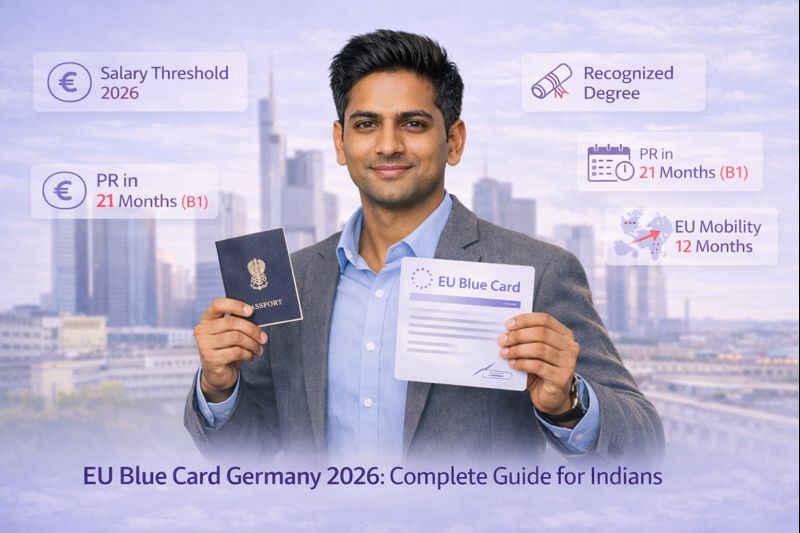
The EU Blue Card is Germany’s premium work permit for highly qualified professionals. From January 2026, you need a recognized degree + job offer with minimum €50,700 salary (€45,934.20 for shortage occupations). The biggest advantage? Permanent residency in just 21 months with B1 German – the fastest PR pathway in Germany.
| Aspect | Details |
|---|---|
| What is it? | Premium residence permit for highly qualified non-EU professionals |
| 2026 Salary (General) | €50,700/year (~₹53.2 lakhs) |
| 2026 Salary (Shortage/Graduates/IT) | €45,934.20/year (~₹48.2 lakhs) |
| Degree Required | Recognized university degree or equivalent |
| Job Contract | Minimum 6 months, matching your qualification |
| German Language | NOT required for application |
| Validity | Up to 4 years (contract duration + 3 months) |
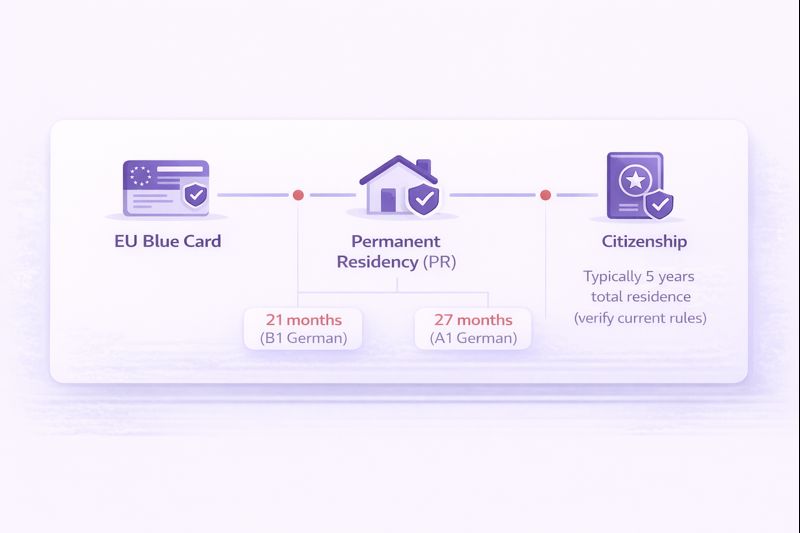
| PR Pathway | 21 months (B1 German) or 27 months (A1 German) |
| Citizenship | 5 years minimum residence (verify current rules when applying) |
| Family Reunification | Yes – spouse can work immediately, no German required |
| EU Mobility | Move to another EU country after 12 months |
Currency note: All INR values approximate, calculated at 1 EUR ≈ ₹105. Exchange rates fluctuate daily.
Where Are You in Your Germany Journey?
Before diving into details, identify your current situation:
| Your Situation | Your Pathway | Time to PR |
|---|---|---|
| In India with job offer | Apply for EU Blue Card visa | 21-27 months |
| Student in Germany (graduating) | Switch to Blue Card after job offer | 21-27 months |
| On Opportunity Card (job searching) | Convert to Blue Card when hired | 21-27 months |
| On regular work permit (§18a/§18b) | May switch to Blue Card if eligible | Check eligibility |
| Already have Blue Card | Focus on German language for faster PR | Depends on German level |
| Have PR (Niederlassungserlaubnis) | Apply for citizenship | 5 years total residence |
This guide covers the complete journey. Jump to the section relevant to you, or read through for the full picture.
What is the EU Blue Card?
The EU Blue Card (Blaue Karte EU) is a residence and work permit designed specifically for highly qualified professionals from non-EU countries. Think of it as Germany’s answer to the US Green Card – but with faster paths to permanent residency.
Governed by Section 18g of the German Residence Act (Aufenthaltsgesetz), the Blue Card was created to help EU countries attract top global talent to address skill shortages.
Why the Blue Card Matters for Indians
India is one of the top source countries for EU Blue Card holders in Germany. The combination of strong IT/engineering talent, English proficiency, and Germany’s massive tech sector shortage creates a natural fit. In 2023 alone, Germany issued over 41,000 Blue Cards – and Indians represent a significant portion.
EU Blue Card vs. Regular Work Permit: Which is Better?
Many Indians don’t realize they can choose between different work permits. Here’s why the Blue Card usually wins:
| Feature | EU Blue Card (§18g) | Regular Work Permit (§18a/§18b) |
|---|---|---|
| Salary Requirement | €50,700 (general) / €45,934.20 (shortage) | No fixed minimum |
| Degree Required | Yes (recognized) | Yes, but more flexibility |
| Path to PR | 21-27 months | 36-48 months |
| Job Change (first 12 months) | Notify authorities | May need approval |
| Job Change (after 12 months) | Freely, no notification | May still need notification |
| EU Mobility | Yes, after 12 months | No |
| Family Reunification | Simplified (spouse works immediately) | Usually allowed – check residence permit |
| Time Outside EU | Up to 12 months allowed | Up to 6 months |
| German Language Required | No | No |
Bottom Line: If you qualify for the Blue Card, always choose it over a regular work permit. The faster PR pathway alone makes it worth the higher salary requirement.
When Regular Work Permit Makes Sense
- Your salary is below Blue Card threshold but still adequate
- Your degree isn’t recognized at the required level
- You’re in a non-academic profession (vocational qualification)
- You want flexibility in job types
EU Blue Card Eligibility Requirements (2026)
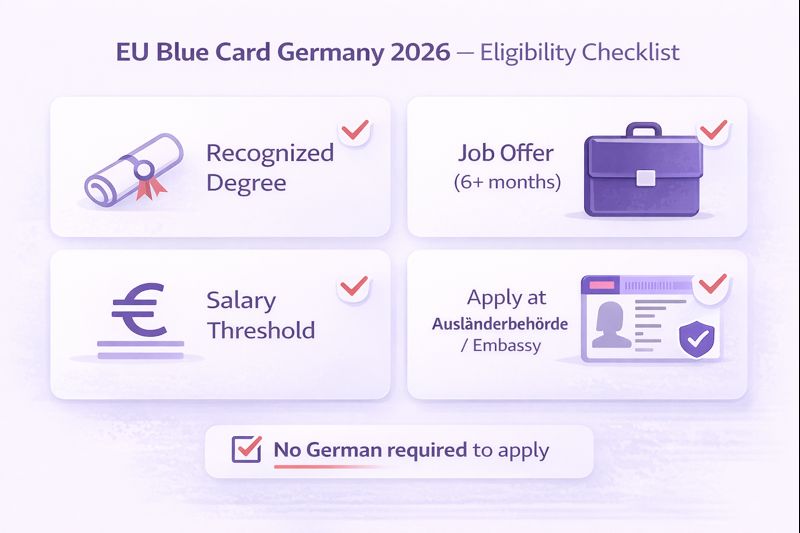
Recognized University Degree
Your degree must be:
- A German university degree, OR
- A foreign degree recognized as equivalent to a German degree
How to Check Your Degree:
- Anabin Database (anabin.kmk.org) – Search for your university and degree
- ZAB Recognition – If not in Anabin, apply for individual assessment
Do I Need Degree Recognition If I Have a Job Offer from a German Company?
Yes, degree recognition is still required even with a confirmed job offer. The German company’s willingness to hire you doesn’t bypass immigration requirements. Here’s what happens:
- The embassy/consulate will verify your degree is recognized before issuing the visa
- Some employers help with the recognition process, but the responsibility is ultimately yours
- If your degree isn’t in Anabin as “recognized,” you’ll need ZAB assessment regardless of your job offer
- Processing continues only after degree recognition is confirmed
Job Offer Meeting Salary Thresholds
2026 Salary Thresholds (Effective January 1, 2026):
| Category | Minimum Gross Annual Salary | Monthly (~) | INR Equivalent |
|---|---|---|---|
| General Occupations | €50,700 | €4,225 | ~₹53.2 lakhs/year |
| Shortage Occupations | €45,934.20 | €3,828 | ~₹48.2 lakhs/year |
| Recent Graduates (within 3 years) | €45,934.20 | €3,828 | ~₹48.2 lakhs/year |
| IT Specialists (no degree, 3+ years experience) | €45,934.20 | €3,828 | ~₹48.2 lakhs/year |
Shortage Occupations (Engpassberufe)
You qualify for the lower salary threshold if your job falls under these categories:
| Shortage Occupation Category | Examples |
|---|---|
| STEM Professionals | Engineers, scientists, mathematicians |
| IT & Communications | Software developers, data scientists, IT managers |
| Healthcare | Doctors, pharmacists, nurses |
| Manufacturing/Construction Managers | Production managers, site managers |
| Education | Teachers, education managers |
| Professional Services Managers | Healthcare managers, childcare managers |
Contract Duration
Your employment contract must be for at least 6 months. The Blue Card is issued for the contract duration plus 3 months, up to a maximum of 4 years.
No German Language Required
Unlike many other permits, you do NOT need to prove German language skills to get the Blue Card. However, learning German is crucial for:
- Faster PR (21 months with B1 vs. 27 months with A1)
- Better career opportunities
- Daily life in Germany
Special Category: IT Specialists Without Degree
Since November 2023, Germany allows experienced IT professionals to get the Blue Card even without a university degree.
Requirements:
- Minimum 3 years of IT work experience in the past 7 years
- Experience must be at university graduate level
- Job offer in IT sector in Germany
- Salary meeting the shortage occupation threshold (€45,934.20 in 2026)
- Federal Employment Agency approval required
Real-World Scenario: Rahul, 28, from Bangalore worked as a senior developer at TCS for 5 years after his diploma. Without a university degree, he still qualified for the Blue Card through his IT experience. His new Berlin employer offered €52,000 – well above the threshold.
Application Process: Step-by-Step
From India (New Applicants)
Step 1: Secure Job Offer
- Use job portals: LinkedIn, StepStone, Indeed Germany, XING
- Ensure salary meets Blue Card threshold
- Get written employment contract
Step 2: Degree Recognition
- Check Anabin database
- If needed, apply for ZAB assessment (3-4 months)
Step 3: Book Visa Appointment
- Apply through German Embassy/Consulate in India
- VFS Global handles appointments in most Indian cities
- Current wait times: 4-12 weeks (varies by location)
Step 4: Submit Documents
| Document | Details |
|---|---|
| Visa application form | Completed and signed |
| Passport | Valid for 6+ months |
| Photos | 2 biometric photos (35x45mm) |
| Employment contract | Original, signed by employer |
| Degree certificate | Original + German translation |
| Degree recognition | Anabin printout or ZAB assessment |
| CV | Detailed, covering education and work |
| Health insurance | Travel insurance for entry |
| Proof of accommodation | If available |
Step 5: Visa Processing
- Processing time: 2-12 weeks (varies)
- You’ll receive a National Visa (Type D) valid for 90 days
Step 6: Enter Germany & Register
- Register at local Bürgeramt within 14 days of arrival
- Get health insurance (public or private)
- Open German bank account
Step 7: Apply for Blue Card
- Visit local Ausländerbehörde (Foreigners Office)
- Submit documents + biometrics
- Receive electronic residence permit (eAT) card in 4-6 weeks
From Within Germany (Students/Opportunity Card Holders)
If you’re already in Germany on a student visa or Opportunity Card:
- Secure qualifying job offer
- Book appointment at Ausländerbehörde
- Submit change of status application
- Receive Fiktionsbescheinigung (allows work while processing)
- Collect Blue Card when ready
Job Change Rules & Restrictions
First 12 Months: Restricted Period
During your first year with the Blue Card:
- You CAN change employers
- You MUST inform the Ausländerbehörde when you change jobs
- The authority has up to 30 days to review your new employment
- They will verify the new job still meets Blue Card requirements (salary threshold, qualification match)
- New job must meet salary threshold (€50,700 general or €45,934.20 shortage in 2026)
- If requirements aren’t met, the authority can suspend your employment authorization
- If new job doesn’t qualify, you may need to apply for a different permit type
After 12 Months: Free Movement
After 12 months of Blue Card employment:
- Change employers freely within Germany
- No prior approval needed
- No notification required to Ausländerbehörde
- Simply update your registration (Anmeldung) if you move cities
If You Lose Your Job
If you become unemployed:
- Blue Card remains valid for 3 months
- You must inform authorities immediately
- Use this time to find new qualifying employment
- If unsuccessful, explore other permit options (job seeker visa, etc.)
Self-Employment & Side Business: The Reality Check
The Hard Truth: The EU Blue Card is for employment only. Self-employment is NOT permitted by default.
What’s Written on Your Card Matters
Your Blue Card will typically state:
- “Beschäftigung bei [Company Name] als [Position] gestattet” (Employment at X as Y permitted)
- “Selbständige Erwerbstätigkeit nicht erlaubt” (Self-employment not permitted)
Can You Have a Side Business?
Officially: No – unless you get additional permission.
Berlin Exception: Berlin’s immigration office often writes “Erwerbstätigkeit gestattet” (gainful employment permitted) on Blue Cards, which some interpret as allowing self-employment. This is legally questionable but practiced.
Other Cities: Munich, Hamburg, Frankfurt – you typically need separate permission under §21(6) AufenthG to do any self-employment alongside your Blue Card job.
Workarounds Some People Use
- Wait for Niederlassungserlaubnis (PR) – Once you have permanent residency, all employment types are permitted
- UG with Spouse as Managing Director – Technically possible but legally risky
- Request Additional Permission – Apply at Ausländerbehörde for self-employment alongside employment
What About Kleingewerbe (Small Business)?
Even registering a small trade business (under €22,000/year) requires self-employment permission. The revenue threshold doesn’t exempt you from residence permit restrictions.
Family Reunification: Bringing Your Family
One of the Blue Card’s biggest advantages is simplified family reunification.
For Your Spouse
| Benefit | Blue Card Holder’s Spouse | Regular Work Permit Holder’s Spouse |
|---|---|---|
| German language required | No | Usually A1 required |
| Work permission | Yes, immediately, unrestricted | Usually allowed – always check the “Nebenbestimmungen” (conditions) on the residence permit |
| Processing time | Faster | Standard |
| Living space proof | Relaxed requirements | Strict requirements |
For Your Children
- Minor children (under 18) can join you
- Access to German public schools (free)
- Children’s permit validity matches yours
For Your Parents (New Since March 2024)
If your Blue Card was issued after March 1, 2024:
- You can bring your parents OR your spouse’s parents to Germany
- Must prove financial capacity to support them
- They won’t automatically get work permission
Required Documents for Family Reunification
| Document | For Spouse | For Children |
|---|---|---|
| Passport | ✓ | ✓ |
| Marriage certificate | ✓ | – |
| Birth certificate | – | ✓ |
| Proof of Blue Card | ✓ | ✓ |
| Health insurance | ✓ | ✓ |
| Accommodation proof | ✓ | ✓ |
| Financial proof | ✓ | ✓ |
EU Mobility: Moving to Other EU Countries
Short-Term Mobility (Business Travel)
With a German Blue Card, you can:
- Travel to other EU countries for business activities
- Stay up to 90 days within 180-day period
- No additional visa needed for Schengen countries
- Activity must relate to your German employment
Long-Term Mobility (Relocation)
After 12 months with a German Blue Card:
- Move to another EU country (except Denmark, Ireland)
- Apply for that country’s Blue Card within 1 month of arrival
- No need to return to India first
- Simplified process compared to fresh application
Real-World Scenario: Priya worked in Munich for 18 months on a Blue Card. When she got an offer from Amsterdam, she could relocate directly and apply for a Dutch Blue Card – no trip back to India required.
The Golden Path: Blue Card → Permanent Residency → Citizenship
This is the complete journey from Blue Card to German passport:
Stage 1: EU Blue Card (Day 1)
You arrive in Germany with your Blue Card and start working.
Stage 2: Permanent Residency (Niederlassungserlaubnis)
Fast Track – 21 Months:
- German level B1
- 21 months of Blue Card employment
- 21 months of pension contributions
- Pass “Life in Germany” test
- Secure livelihood (no social benefits)
Standard Track – 27 Months:
- German level A1 (basic)
- 27 months of Blue Card employment
- 27 months of pension contributions
- Other requirements same as above
| Requirement | 21-Month Track | 27-Month Track |
|---|---|---|
| German Level | B1 | A1 |
| Employment Period | 21 months | 27 months |
| Pension Contributions | 21 months | 27 months |
| Integration Test | “Life in Germany” | “Life in Germany” |
| Application Fee | €113-147 | €113-147 |
Stage 3: German Citizenship (Einbürgerung)
Standard Path – 5 Years:
- 5 years total legal residence in Germany
- Permanent right of residence (PR)
- German level B1
- Pass naturalization test (33 questions, need 17 correct)
- Financial self-sufficiency
- Clean criminal record
- Commitment to democratic values
- Fee: €255 per adult, €51 for children (with parents)
Dual Citizenship: Since 2024, Germany allows dual citizenship. You do NOT need to give up your Indian passport to become German. This means you can enjoy benefits of both nationalities.
Complete Timeline Example
| Milestone | Timeline | Cumulative Time |
|---|---|---|
| Arrive with Blue Card | Month 0 | 0 months |
| Reach B1 German | Month 12 | 12 months |
| Apply for PR | Month 21 | 21 months |
| Receive PR | Month 23 | ~2 years |
| Apply for Citizenship | Month 60 | 5 years |
| Receive German Passport | Month 72-84 | 6-7 years |
Pathways to the Blue Card
Pathway 1: From India with Job Offer
The most direct route:
- Search jobs from India (LinkedIn, StepStone, company websites)
- Secure offer meeting Blue Card requirements
- Apply for Blue Card visa at German Embassy
- Relocate and start work
Timeline: 3-6 months from job offer to arrival
Pathway 2: Student → Blue Card
If you’re studying in Germany:
- Complete your degree
- Apply for 18-month job seeker permit (§20 AufenthG)
- Search for qualifying employment
- Switch to Blue Card when hired
Pathway 3: Opportunity Card → Blue Card
If you arrived on Germany’s Opportunity Card (Chancenkarte):
- Use your 12-month search period
- Work part-time (up to 20 hours) while searching
- Secure qualifying full-time offer
- Convert to Blue Card
Pathway 4: Regular Work Permit → Blue Card
If you’re already on §18a or §18b work permit:
- Check if your current job meets Blue Card salary threshold
- If yes, apply for status change at Ausländerbehörde
- If no, negotiate raise OR find new qualifying job
Why Switch? Blue Card offers faster PR (21-27 months vs. 36+ months).
Common Mistakes Indians Make
Mistake 1: Not Checking Degree Recognition Early
Problem: Discovering your degree isn’t recognized after receiving job offer, delaying everything by months.
Solution: Check Anabin or apply for ZAB assessment before intensive job searching.
Mistake 2: Accepting Below-Threshold Salary
Problem: Taking a €44,000 offer when Blue Card requires €45,934.20 (shortage) or €50,700 (general) in 2026.
Solution: Negotiate. Explain to employer you need Blue Card threshold. The €2,000-6,000 difference is small for them but critical for you.
Mistake 3: Ignoring German Language
Problem: Planning to “learn later” and ending up waiting 27 months for PR instead of 21.
Solution: Start German classes before arrival. A2/B1 courses are widely available online (Goethe Institut, Deutsche Welle).
Mistake 4: Not Understanding Restrictions
Problem: Starting a freelance side gig without permission and risking visa status.
Solution: Read your permit carefully. When in doubt, ask the Ausländerbehörde in writing.
Mistake 5: Missing PR Application Window
Problem: Forgetting to apply for PR at 21/27 months and remaining on temporary status.
Solution: Set calendar reminders. Prepare documents early. Book Ausländerbehörde appointment in advance.
Costs Summary: Blue Card Journey
| Cost Item | Amount (EUR) | Amount (INR ~) |
|---|---|---|
| ZAB degree recognition | €200 | ₹21,000 |
| Visa fee (India) | €75 | ₹7,875 |
| Translation/apostille | €100-300 | ₹10,500-31,500 |
| Flight to Germany | €500-800 | ₹52,500-84,000 |
| Blue Card issuance | €100-147 | ₹10,500-15,435 |
| Health insurance (first month) | €100-200 | ₹10,500-21,000 |
| First month expenses | €2,000-3,000 | ₹2.1-3.15 lakhs |
| Total Initial Investment | €3,075-4,722 | ₹3.2-5.0 lakhs |
Complete Document Checklist
Having the right documents ready is half the battle. Here’s your comprehensive checklist:
For Visa Application from India
| Document | Specifications | Pro Tips |
|---|---|---|
| Passport | Valid 6+ months beyond intended stay, 2 blank pages | Keep old passports too – they show travel history |
| Visa Application Form | Signed, all fields completed | Fill online, print, then sign in blue ink |
| Photos | 2 biometric (35x45mm), white background, recent | Get extras for Ausländerbehörde later |
| Employment Contract | Original, signed by both parties | Must state salary, position, start date, duration |
| Employer Declaration | “Erklärung zum Beschäftigungsverhältnis” form | Employer fills this describing the job |
| Degree Certificate | Original + certified German translation | Apostille from MEA if required |
| Transcripts | Original + certified German translation | Some embassies require, others don’t – check |
| Degree Recognition | Anabin printout OR ZAB assessment | Start this process EARLY |
| CV/Resume | Detailed, chronological, no gaps | German format preferred (europass) |
| Health Insurance | Travel insurance for entry (min €30,000) | Long-term insurance sorted after arrival |
| Proof of Accommodation | Hotel booking or rental contract | Even temporary booking acceptable |
| Cover Letter | Explaining your plans in Germany | Brief, professional, stating purpose |
| Bank Statements | Last 3-6 months | Shows financial stability |
For Blue Card at Ausländerbehörde (After Arrival)
| Document | Purpose |
|---|---|
| Anmeldung confirmation | Proves registered address |
| German health insurance | Public (TK, AOK, etc.) or private |
| Employment contract | Original or certified copy |
| Degree recognition | Updated if needed |
| Passport with visa | Entry stamp proves legal arrival |
| Biometric photo | May be taken on-site in some cities |
| Application fee | €100-147 (card payment or cash) |
Translation Requirements
Documents requiring certified German translation:
- Degree certificate
- Transcripts (if requested)
- Marriage certificate (for family reunification)
- Birth certificates (for children)
Certified Translators: Use translators certified by German courts (beeidigte Übersetzer). Many offer online services for documents from India.
Pro Tips from Indians Who’ve Done It
Before You Apply
Tip 1: Start Degree Recognition Immediately “I wasted 3 months because my Tier-2 college wasn’t in Anabin. ZAB assessment took another 3 months. Start this before you even have a job offer.” – Sneha, Data Scientist, Frankfurt
Tip 2: Negotiate Beyond the Threshold “I asked for €50,000 instead of accepting €44,000. Explained I needed buffer above Blue Card minimum. Company agreed – it’s a small increase for them but peace of mind for me.” – Vikram, DevOps Engineer, Berlin
Tip 3: Get Everything in Writing “My offer letter said ‘competitive salary’ without exact figures. Embassy almost rejected my visa. Always get exact annual gross salary mentioned.” – Ananya, Product Manager, Munich
After Arrival
Tip 4: Anmeldung First, Everything Else Follows “Without Anmeldung, you can’t open bank account, get tax ID, or apply for Blue Card. Do it within 2-3 days of arrival, not 14.” – Rohan, Software Architect, Hamburg
Tip 5: Join Local German Classes “Volkshochschule (VHS) German courses are incredibly cheap (~€200 for a full level). Quality varies by teacher, but can’t beat the price.” – Kavitha, Business Analyst, Düsseldorf
Tip 6: Document Everything “Keep copies of every document, every payment, every communication with Ausländerbehörde. Germans love paper trails. I got PR smoothly because I had everything organized.” – Arjun, Engineering Manager, Stuttgart
For Family Reunification
Tip 7: Apply Together When Possible “We applied for spouse visa same time as my Blue Card visa. Both appointments at embassy together. Both arrived in Germany together. Much less stressful than doing it separately.” – Deepak, Senior Developer, Cologne
Tip 8: Spouse Job Search is Different “My wife has full work permission but no German skills made job search hard. She eventually found an international company. English-only jobs exist but competition is fierce.” – Manish, Tech Lead, Berlin
For PR Application
Tip 9: Book Ausländerbehörde Early “In Berlin, appointment wait times are 2-3 months. I booked my PR appointment at Month 18, so it landed perfectly at Month 21.” – Priya, UX Designer, Berlin
Tip 10: Pension Contributions Are Automatic “I worried about pension contributions. But if you’re employed, they’re deducted automatically from salary. Just get ‘Versicherungsverlauf’ from Deutsche Rentenversicherung as proof.” – Ajay, System Administrator, Frankfurt
Understanding German Bureaucracy: A Survival Guide
The Ausländerbehörde Experience
Every foreigner’s least favorite office, but understanding it helps:
Appointment System:
- Most cities require online appointments
- Berlin, Munich notoriously difficult to get slots
- Some cities have walk-in hours (arrive early)
- Use automated booking tools (legal browser extensions)
What to Expect:
- Bring ALL documents (originals + copies)
- Processing officer may not speak English
- Decision often not given same day
- Fiktionsbescheinigung issued if processing takes longer
City Variations:
The German “Paper Trail” Culture
Germans document everything. Embrace it:
- Get receipts for everything
- Request confirmation emails
- Keep all appointment letters
- Never throw away official documents
- Create folders (physical and digital) by year
Salary Negotiation for Blue Card Threshold
How to Discuss Salary with German Employers
German employers often post salary ranges in job listings. Here’s how to ensure you meet Blue Card requirements:
In the Application: “As a non-EU citizen requiring an EU Blue Card, I would need a minimum gross annual salary of €50,700 (or €45,934.20 for shortage occupations) to qualify. I’m targeting [your range] based on my experience.”
In Negotiations: “The Blue Card salary threshold is €50,700 for 2026. Given my qualifications, I believe €54,000-58,000 reflects market rate while providing the necessary immigration buffer.”
Why Employers Usually Agree:
- They’ve already decided to hire you
- The difference (€3,000-5,000 extra) is minimal vs. recruitment costs
- They want immigration process smooth too
- Losing you after visa rejection means starting over
What If Salary Falls Short?
Option 1: Negotiate Most effective approach – explain Blue Card requirements clearly.
Option 2: Request Signing Bonus Won’t affect annual salary calculation but helps financially.
Option 3: Ask About Timeline Some companies can raise salary after probation. Get it in writing with specific date.
Option 4: Consider Regular Work Permit If employer can’t meet threshold, regular work permit (§18a/§18b) is fallback. You’ll still work, just with longer PR path.
Frequently Asked Questions
Is German language required for the Blue Card?
No. You don’t need any German language certification to apply for or receive the Blue Card. However, German is required for permanent residency (A1 for 27-month track, B1 for 21-month track).
Can I bring my family with the Blue Card?
Yes. Your spouse and children under 18 can join you with simplified family reunification. Your spouse can work immediately without restrictions and doesn’t need German language skills for their residence permit.
What happens if I lose my job?
Your Blue Card remains valid for 3 months after job loss. You must inform authorities immediately and use this time to find new qualifying employment.
Can I work freelance or start a business with the Blue Card?
No, the Blue Card is for employment only. Self-employment requires separate permission or a different permit type. Once you have permanent residency, all work types are permitted.
How long until I can get permanent residency?
With B1 German: 21 months. With A1 German: 27 months. You also need pension contributions for the same period and must pass the “Life in Germany” test.
Can I change employers with the Blue Card?
Yes. During the first 12 months, you must notify authorities before changing. After 12 months, you can change freely without notification.
What’s the difference between Blue Card and regular work permit?
The main differences are: Blue Card requires higher salary but offers faster PR (21-27 months vs. 36 months), simplified family reunification, and EU mobility after 12 months.
Can I apply for the Blue Card without a university degree?
IT specialists with 3+ years of relevant experience can qualify without a degree. For all other professions, a recognized degree is required.
How long can I stay outside Germany with the Blue Card?
Up to 12 consecutive months without losing your Blue Card status (vs. 6 months for regular work permits).
What if my employer offers less than the threshold?
Negotiate. Explain you need Blue Card threshold (€50,700 general or €45,934.20 for shortage occupations in 2026). If they can’t meet it, you might qualify for a regular work permit (§18a/§18b), but with a longer path to PR.
Is the Blue Card valid EU-wide?
The card is issued by Germany but provides EU mobility. After 12 months, you can relocate to another EU country and apply for their Blue Card without returning to India.
What’s the processing time for the Blue Card visa?
From India: typically 4-12 weeks after submitting complete documents. Within Germany (status change): 4-8 weeks with Fiktionsbescheinigung allowing work during processing.
Real-World Success Story
Amit’s Journey: From Pune to Berlin to German Passport
2019: Amit, a software developer from Pune with 4 years experience, received a job offer from a Berlin startup – €55,000/year.
2019 (Month 3): Arrived in Germany with Blue Card. Started German classes immediately (A1 course).
2020 (Month 12): Passed B1 German exam while continuing to work.
2021 (Month 21): Applied for Niederlassungserlaubnis (PR). Approved within 6 weeks.
2021 (Month 24): Wife joined him under family reunification. She started working within 2 weeks.
2024 (Month 60): Applied for German citizenship. Passed naturalization test (29/33 correct).
2025 (Month 72): Received German passport. Kept Indian passport too (dual citizenship).
Key Takeaways from Amit:
- “Start German immediately – don’t wait”
- “The Blue Card bureaucracy is actually straightforward if you prepare documents properly”
- “21-month PR is real – I know many who did it”
- “Dual citizenship changed everything – best of both worlds”
Conclusion
The EU Blue Card represents Germany’s welcome mat for skilled professionals. For Indians with the right qualifications and a job offer meeting salary thresholds, it’s the fastest path to building a permanent life in Europe’s largest economy.
Key Takeaways:
- Eligibility is straightforward: Recognized degree + qualifying job offer + salary threshold
- 21 months to PR is achievable: Start German classes Day 1
- Family benefits are significant: Spouse works immediately, no language requirement for them
- Dual citizenship is now allowed: Keep your Indian passport alongside your new German one
- The investment pays off: Higher salary threshold means higher earning, which funds the journey
Your Germany journey doesn’t end with the Blue Card – it begins there.
💼 Got Your Blue Card? Now Build Your Life Here
The Blue Card opens doors. Brizz.me helps you walk through them.
For Indian professionals in Germany:
- 🎉 Network at professional meetups — Connect with Indians in tech, finance, healthcare, and beyond
- ✅ Find expert services — German tax consultants, insurance advisors, investment consulting (Germany & India), loan guidance, and immigration support
- 🏠 Upgrade your accommodation — Move from temporary housing to your own apartment
📍 Settled professionally? Now settle personally. Join thousands of Indian professionals on Brizz.me.
Disclaimer
This guide is for informational purposes only and does not constitute legal advice. Immigration laws change frequently. Always verify current requirements with official sources (German Embassy, Make-it-in-Germany.com, Ausländerbehörde) or consult an immigration lawyer for your specific situation. Information accurate as of January 2026.
Last Updated: January 2026
Author: Brizz.me Editorial Team
Keywords: EU Blue Card Germany 2026, Blue Card salary threshold, Germany work visa Indians, Blue Card permanent residence, Blue Card vs work permit Germany, Indian professionals Germany, Blue Card family reunification, Germany citizenship Blue Card, Blue Card job change rules, Blue Card self-employment