| Factor | Reality |
|---|---|
| Visa Duration | 12 months (no extension without job offer) |
| Work Rights | Any job, any hours, any salary |
| Financial Proof Required | €13,092/year (~₹13.7 lakhs) |
| Monthly Burn Rate | €1,100-1,500 depending on city |
| Realistic Runway | 8-12 months depending on location |
| Average Applications to Interview | 50-100 applications → 3-5 responses |
| Part-Time Earnings Potential | €400-800/month (20 hrs/week) |
| Blue Card Threshold (2026) | €50,700 standard / €45,934 shortage occupations |
| §18b Threshold (Under 45) | No minimum salary |
| Extension Requirement | Job offer for qualified employment |
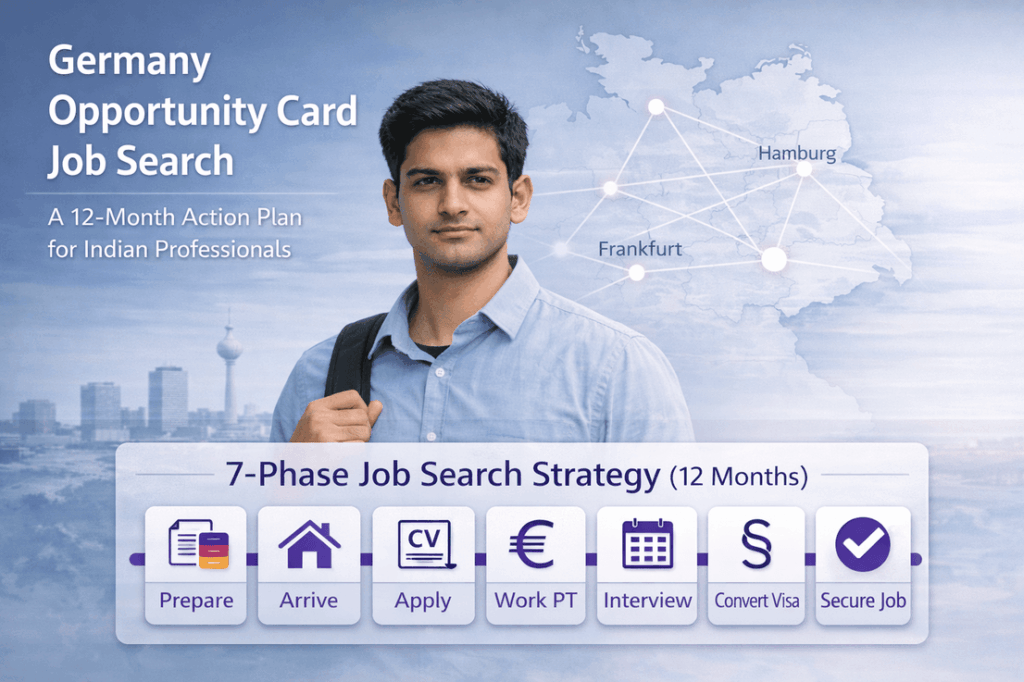
| Part | Phase | Timeline | What You’ll Learn |
|---|---|---|---|
| 1 | Pre-Arrival | 4 months to 0 | German learning, city selection, documents, housing research |
| 2 | Setup Phase | Month 1 | Anmeldung, bank account, part-time jobs, job search launch |
| 3 | Job Search Strategy | Ongoing | Dual-track approach, German video, application tactics |
| 4 | The Grind | Months 2-6 | Application rhythm, German progress, networking cadence |
| 5 | Acceleration | Months 7-9 | Salary pivots, recruiter blitz, expanding geography |
| 6 | Final Push | Months 10-12 | Crisis mode, backup plans, extension rules |
| 7 | Community & Support | Throughout | Mental health, support system, weekly non-negotiables |
Part 1: Pre-Arrival (4 Months to Arrival)
You’re waiting for your visa. Don’t waste this time. What you do in these months can make the difference between struggling and thriving.
German Language (Start Immediately — Month -4)
This is the single most important thing you can do before landing. Even basic German changes how employers perceive you AND unlocks part-time job opportunities that pay better.
Your German Timeline:
| Phase | Target | What to Do |
|---|---|---|
| Months -4 to -3 | A1 | Intensive course (online or Goethe Institut), daily practice |
| Month -2 | A1 → A2 | Take Goethe/telc A1 exam, start A2 course |
| Month -1 | A2 in progress | Continue A2, conversational practice, German content |
| Month 1 in Germany | A2 (ongoing) | Setup phase (Anmeldung, bank, settling). If your A2 course is ongoing, continue. |
| Months 2-3 | Complete A2, start B1 | Enroll in VHS or in-person B1 course + part-time job exposure |
| Month 6 | B1 Certificate | Complete B1, attend VHS interview prep courses |
Learning Resources:
- Apps: Duolingo (daily streaks), Deutsche Welle (free courses), Anki (flashcards)
- Exams: Goethe Institut, telc, or ÖSD certificates are recognized everywhere
- Why it matters: Saying “Ich lerne Deutsch” in interviews signals commitment
For a complete German learning roadmap, see our Learn German for Germany: A1 to B2 Guide.
Choose Your City Wisely (Research Early, Decide by Month -2)
This decision affects everything—your runway, job opportunities, and quality of life. Start researching cities while you’re learning German, and finalize your decision at least 2 months before departure. Most Indians default to Munich or Frankfurt because they’re famous. This is often a mistake for Opportunity Card holders.
The Financial Reality:
| City | Monthly Cost (WG + Living) | Your Runway |
|---|---|---|
| Munich/Frankfurt | €1,400-1,600 | 8-9 months |
| Berlin/Hamburg | €1,200-1,400 | 9-11 months |
| Satellite Cities | €900-1,100 | 11-14 months |
If you’re in Munich spending €1,500/month, you have 8-9 months before you’re out of money—not 12. That’s a big difference.
The Satellite City Strategy
Living in a smaller city near a major hub gives you the same job market access with 3-4 extra months of runway.
Frankfurt Cluster (Finance, Consulting, Tech):
| City | Distance | Rent Savings | Why It Works |
|---|---|---|---|
| Darmstadt ⭐ | 15 min S-Bahn | €250-300/month | TU Darmstadt tech ecosystem, Software AG, startups |
| Mainz | 25 min | €200-250/month | Cross-Rhine access, smaller but growing |
| Offenbach | 10 min | €200-250/month | Affordable, improving rapidly |
Munich Cluster (Automotive, Engineering, Tech):
| City | Distance | Rent Savings | Why It Works |
|---|---|---|---|
| Augsburg ⭐ | 30 min train | €300-400/month | MAN, KUKA, Premium AEROTEC, solid Indian community |
| Ingolstadt | 45 min | €250-300/month | Audi headquarters, automotive ecosystem |
| Freising | 25 min | €200-300/month | Airport proximity, growing tech |
Stuttgart Cluster (Automotive, Manufacturing):
| City | Distance | Rent Savings | Why It Works |
|---|---|---|---|
| Böblingen ⭐ | 20 min S-Bahn | €200-250/month | IBM, HP, Philips — IT hub |
| Sindelfingen | 20 min | €200-250/month | Mercedes-Benz HQ |
| Esslingen | 15 min | €150-200/month | Engineering firms, university town |
Berlin: Already cheaper than Munich/Frankfurt. Startup ecosystem is flexible on visas. Strong Indian community. Stay in Berlin itself.
Hamburg: Overlooked by Indians. Strong logistics, engineering, renewable energy. Less competition.
The math: Living in Augsburg instead of Munich saves €300-400/month. Over 12 months = €3,600-4,800. That’s 3-4 extra months of runway. Same jobs (via commute), way less financial stress.
Documents to Prepare (Month -2)
Get these ready before you leave India:
Housing Research (Month -1 Only)
Start housing research 1 month before arrival—not earlier. Listings move fast in Germany, and anything you see 3 months before will be long gone.
What to do in Month -1:
- Join WG-Gesucht, eBay Kleinanzeigen groups for your target city
- Identify 3-5 target neighborhoods (check commute times to business districts)
- Understand price ranges so you don’t overpay when you arrive
- Book 2-3 weeks of temporary accommodation (hostel/Airbnb) for arrival
For a complete breakdown of WG rooms, studios, and how German rentals work, see our Rental Houses in Germany Guide.
Part 2: Month 1 — The Setup Phase
For a complete breakdown of everything you need to do when you first arrive, see our Moving to Germany Guide.
Week 1: Survival Mode
| Day | Priority Task |
|---|---|
| 1-2 | Recover from travel, settle into temporary accommodation |
| 3 | Register address (Anmeldung) — non-negotiable |
| 4 | Open German bank account (N26/Commerzbank) — see our Banking Guide |
| 5 | Get German SIM card (Aldi Talk, Lebara) |
| 6-7 | Grocery run, explore neighborhood, rest |
Anmeldung is your first priority. Without it, you can’t open a bank account, sign a rental contract, or do anything official. For step-by-step instructions, see our Anmeldung in Germany Guide.
Week 2: Part-Time Job Hunt Begins
Don’t wait until savings run low. Start Week 2. Part-time income isn’t optional—it’s what extends your runway from 8 months to 12.
Part-Time Job Options for Indians:
| Category | Pay Rate | German Needed | How to Find |
|---|---|---|---|
| Food Delivery | €13.90-16/hr | None | Lieferando, Wolt, Uber Eats apps |
| Indian Restaurants | €13.90-15/hr | None | Walk in directly, ask owner |
| Warehouse/Logistics | €13.90-16/hr | Basic | Randstad, Adecco, Amazon jobs |
| Tutoring | €15-25/hr | None | Superprof, Preply, Brizz Services |
| Ethnic Retail | €13.90-15/hr | Basic | Indian grocery stores, walk in |
| Cleaning | €13.90-16/hr | None | Helpling, Book A Tiger, word of mouth |
| Event Staff | €13.90-18/hr | Basic | Messepersonal, Promotion-Jobs |
Target: €400-800/month from part-time work. This extends your runway by 3-5 months.
Weeks 3-4: Full-Time Job Search Launches
Your daily schedule should look like this:
| Time | Activity |
|---|---|
| 8:00-9:00 | German study (Duolingo, vocabulary) |
| 9:00-12:00 | Job applications (Tier 1 quality applications) |
| 12:00-13:00 | Lunch break |
| 13:00-15:00 | LinkedIn networking, company research |
| 15:00-17:00 | Part-time job shift OR more applications |
| 17:00-18:00 | German practice (speaking, listening) |
| Evening | Community events, rest, or part-time work |
Week 3 Targets:
- 15-20 quality applications sent
- 10 LinkedIn connection requests to people at target companies
- 1-2 German learning sessions with tutor or tandem partner
Week 4 Targets:
- 25-30 total applications
- Part-time job secured (or solid leads)
- First networking event attended
Part 3: Full-Time Job Search — The Dual-Track Strategy
The Four Employment Pathways
This is critical. Most guides only mention Blue Card. There are actually four ways to convert your Opportunity Card to a work permit:
| Pathway | Legal Basis | Salary Requirement (2026) | Best For |
|---|---|---|---|
| EU Blue Card | §18g AufenthG | €50,700 (standard) / €45,934 (shortage) | High earners, IT, engineering |
| Skilled Worker (Academic) | §18b AufenthG | No minimum (if under 45) | Mid-level roles, any salary |
| Skilled Worker (Vocational) | §18a AufenthG | No minimum (if under 45) | Recognized vocational training |
| Professional Experience | §19c Abs. 2 AufenthG | ~€45,630 | 3+ years experience, IT specialists |
Strategic Implication: Apply for BOTH Blue Card-qualifying jobs (€50,700+) AND lower-paying qualified employment jobs (€35,000-50,000) simultaneously. Don’t limit yourself to just Blue Card roles.
Your CV — The German Way
Your CV is your first impression. German CVs are different from American or Indian resumes. Get this wrong, and you’re filtered out before a human ever sees your application.
German CV vs. English CV — When to Use Which
This is critical. Most Indians get this wrong:
| Job Posting Language | German Mentioned? | Which CV to Send |
|---|---|---|
| German | — | German CV only |
| English | “German required” or “German B2” | German CV |
| English | “German nice to have” | German CV (shows effort) |
| English | No German mentioned at all | English CV acceptable |
Why? A German CV signals: “I’m serious about integrating. I’m not just mass-applying from abroad.” It immediately differentiates you from 200 other Indian applicants sending English CVs.
German CV Format — What’s Different
| Element | Indian/US Resume | German CV (Lebenslauf) |
|---|---|---|
| Photo | Not included | Required — professional headshot, neutral background |
| Personal details | Minimal | Date of birth, nationality, marital status (optional but common) |
| Length | 1 page strictly | 2 pages is standard and acceptable |
| Format | Flexible | Reverse chronological, structured |
| Section headers | English | German (see below) |
| Signature | Not needed | Sometimes included at bottom with date |
German Section Headers
Use these exact headers:
| English | German |
|---|---|
| Personal Information | Persönliche Daten |
| Work Experience | Berufserfahrung |
| Education | Ausbildung |
| Skills | Kenntnisse |
| Languages | Sprachkenntnisse |
| Certifications | Zertifikate |
| Interests/Hobbies | Interessen / Hobbys |
The Must-Have Elements
1. German Phone Number (+49)
| What You Write | What HR Thinks |
|---|---|
| +91 98765 43210 | “Still in India, not serious, hassle to coordinate” |
| +49 176 1234 5678 | “Already here, can start quickly, easy to reach” |
Get a German SIM immediately. Use that number on ALL applications.
2. German Address
Same logic. A German address signals you’re already on the ground, ready to work.
Max-Mustermann-Straße 42
60329 Frankfurt am Main
If you’re in temporary housing, that’s fine. Use whatever address you have.
3. Visa Status Line
Add this in your header or personal details section:
Aufenthaltsstatus: Chancenkarte (§20a AufenthG) — volle Arbeitserlaubnis
Or in English CV:
Visa Status: Opportunity Card — Full work authorization in Germany
This immediately answers HR’s first question: “Can this person work legally?”
4. Professional Photo
- Passport-style but friendlier (slight smile is okay)
- Neutral background (white, light gray, light blue)
- Business attire (shirt/blouse, blazer optional)
- Good lighting, high resolution
- No selfies, no vacation photos, no cropped group photos
- Size: approximately 4.5 x 6 cm
5. Language Section — Be Honest
German employers will test your language claims. Don’t exaggerate.
| Your Level | How to Write It |
|---|---|
| A1 (beginner) | Deutsch: Grundkenntnisse (A1) |
| A2 | Deutsch: Grundkenntnisse (A2) |
| B1 | Deutsch: Gute Kenntnisse (B1) |
| B2 | Deutsch: Fließend (B2) |
| C1+ | Deutsch: Verhandlungssicher (C1) |
| Native | Muttersprache |
For English:
Englisch: Verhandlungssicher / Fließend
6. Quantified Achievements
German employers respect precision. Replace vague statements with numbers:
| ❌ Weak | ✅ Strong |
|---|---|
| “Improved system performance” | “Reduced API response time by 40% (800ms → 480ms)” |
| “Led a team” | “Led team of 6 engineers across 3 time zones” |
| “Worked on customer projects” | “Delivered 12 client projects totaling €2.4M revenue” |
| “Responsible for testing” | “Automated 200+ test cases, reducing QA time by 60%” |
ATS Optimization
Large German companies (Siemens, SAP, Deutsche Bank, BMW) use Applicant Tracking Systems that auto-filter CVs before humans see them.
ATS Survival Rules:
Keyword Matching:
If job posting says: “Experience with Python, AWS, and CI/CD pipelines”
Your CV should include those exact terms:
• Python (4 years) — Django, Flask, FastAPI
• AWS — EC2, S3, Lambda, RDS
• CI/CD — Jenkins, GitLab CI, GitHub Actions
Don’t write “cloud computing” when they said “AWS.” Don’t write “automation” when they said “CI/CD.” Match their language.
CV Template Structure
[PHOTO]                    [Name]
                          [Address]
                          [Phone: +49...]
                          [Email]
                          [LinkedIn URL]
                          [Visa: Chancenkarte — full work authorization]

BERUFSERFAHRUNG (Work Experience)
—————————————————————————————————
[Date range]    [Job Title]
                [Company Name], [City]
                • Achievement with numbers
                • Achievement with numbers
                • Achievement with numbers

[Repeat for each role, reverse chronological]

AUSBILDUNG (Education)
—————————————————————————————————
[Date range]    [Degree]
                [University Name], [City/Country]
                • Relevant coursework or thesis (if recent graduate)

KENNTNISSE (Skills)
—————————————————————————————————
Programming:    Python, Java, JavaScript, SQL
Frameworks:     Django, React, Spring Boot
Tools:          Git, Docker, Kubernetes, Jenkins
Cloud:          AWS (EC2, S3, Lambda), Azure

SPRACHKENNTNISSE (Languages)
—————————————————————————————————
Deutsch:        Grundkenntnisse (A2)
Englisch:       Verhandlungssicher
Hindi:          Muttersprache
[Other Indian languages]: Muttersprache

ZERTIFIKATE (Certifications)
—————————————————————————————————
• AWS Solutions Architect Associate (2024)
• German A2 Certificate — Goethe Institut (2025)
Cover Letter Essentials (Anschreiben)
German employers expect a cover letter. It’s not optional.
When to Write in German vs English
Same rule as CV:
- Job posting in German → German cover letter
- Job posting mentions German requirement → German cover letter
- Job posting fully English, no German mentioned → English acceptable
German Cover Letter Structure
[Your Name]
[Your Address]
[Phone, Email]

[Company Name]
[HR Contact if known]
[Company Address]

[City], [Date]

Betreff: Bewerbung als [Job Title] — [Reference Number if any]

Sehr geehrte Damen und Herren, (or Sehr geehrte Frau [Name], / Sehr geehrter Herr [Name],)

[Paragraph 1: Why this company, why this role — specific, not generic]

[Paragraph 2: Your relevant experience and achievements — match to job requirements]

[Paragraph 3: Why you're in Germany, your commitment, availability]

[Closing: Call to action]

Mit freundlichen Grüßen,

[Your Name]

Anlagen:
- Lebenslauf
- Zeugnisse
Cover Letter Tips
Paragraph 1 — Hook: Don’t write: “I am writing to apply for the position of…” Write: “Als [your background] mit [X] Jahren Erfahrung in [field] hat mich Ihre Stellenausschreibung für [role] bei [company] besonders angesprochen, weil…”
Paragraph 2 — Match: Take 2-3 requirements from the job posting. Show how you meet each:
- They want: “Experience with microservices”
- You write: “Bei [Previous Company] habe ich eine Microservices-Architektur für [project] entwickelt, die [specific result].”
Paragraph 3 — Your Situation: Address the visa question proactively: “Ich befinde mich derzeit in Deutschland mit einer Chancenkarte und bin sofort verfügbar. Ich freue mich auf die Möglichkeit, meine Erfahrung in Ihr Team einzubringen.”
Length: One page maximum. 3-4 paragraphs.
Where to Find Jobs — German Portals
Don’t just use LinkedIn. German employers post on German platforms.
Primary Job Portals
| Portal | URL | Best For |
|---|---|---|
| LinkedIn Germany | linkedin.com/jobs | International companies, tech, startups |
| StepStone | stepstone.de | Germany’s largest job board, all industries |
| Indeed Germany | de.indeed.com | Aggregates from many sources, volume |
| xing.com/jobs | Traditional German companies, Mittelstand | |
| Arbeitsagentur | arbeitsagentur.de/jobsuche | Government portal, comprehensive, free |
| Glassdoor Germany | glassdoor.de | Company reviews + salary data + jobs |
| Kimeta | kimeta.de | Meta-search across multiple job boards |
| Stellenanzeigen | stellenanzeigen.de | German job aggregator |
Industry-Specific Portals
| Industry | Portal | URL |
|---|---|---|
| Tech/IT | WeAreDevelopers | wearedevelopers.com/jobs |
| Tech/IT | Honeypot | honeypot.io |
| Tech/IT | 4scotty | 4scotty.com |
| Tech/IT | Stack Overflow | stackoverflow.com/jobs |
| Startups | Berlin Startup Jobs | berlinstartupjobs.com |
| Startups | Deutsche Startups | deutsche-startups.de/jobs |
| Engineering | Ingenieur.de | ingenieur.de/jobs |
| Engineering | Get in Engineering | get-in-engineering.de |
| Finance | eFinancialCareers | efinancialcareers.de |
| Automotive | Autojob | autojob.de |
| Academia | Academics | academics.de |
| Data/AI | DataJobs.de | datajobs.de |
Recruiter Platforms (They Find Jobs FOR You)
External recruiters are paid by companies to fill roles. They want to place you — it’s free for candidates.
| Recruiter | URL | Specialization |
|---|---|---|
| Hays Germany | hays.de | IT, Engineering, Finance, Life Sciences |
| Michael Page | michaelpage.de | All industries, mid-senior level |
| Robert Half | roberthalf.de | Finance, IT, Admin |
| Randstad | randstad.de | All levels, including temp/contract |
| Harvey Nash | harveynash.com/germany | IT, Digital, Executive |
| Experis | experis.de | IT specialists, tech |
| Computer Futures | computerfutures.com/de | Tech, Software Engineering |
| Progressive | progressive.de | Engineering, Manufacturing |
| Gulp | gulp.de | IT freelance & permanent |
| Etengo | etengo.de | IT consultants |
How to approach recruiters:
- Register on their portals (upload CV)
- Find individual recruiters on LinkedIn — search “[Company] Recruiter Germany [your field]”
- Send direct message: “I’m a [role] with [X] years experience, currently in Germany on Chancenkarte with full work authorization. Open to opportunities €[X]+. Happy to discuss suitable roles.”
- Follow up if no response in 5 days
Company Career Pages (Direct Applications)
Many companies don’t post on job boards — or post there late. Check career pages directly:
| Industry | Companies & Career Pages |
|---|---|
| Tech | SAP Careers, Siemens Jobs, Bosch Careers, Deutsche Telekom, Infineon |
| Automotive | BMW Careers, Mercedes-Benz Jobs, Volkswagen Careers, Porsche Jobs, Continental |
| Finance | Deutsche Bank Careers, Commerzbank Jobs, Allianz Careers, Munich Re |
| Consulting | Roland Berger, Simon-Kucher, Horváth |
| E-commerce | Zalando Jobs, Otto Group, Delivery Hero |
AI Tools for CV & Applications
Don’t create your CV from scratch. Use tools that help with formatting, ATS optimization, and keyword matching.
AI CV Builders & Templates
| Tool | URL | Best For | Cost |
|---|---|---|---|
| Europass | europa.eu/europass | EU-standard format, free, recognized | Free |
| Lebenslauf.de | lebenslauf.de | German-specific templates | Free + Premium |
| Resume.io | resume.io | Modern templates, ATS-friendly | Free trial |
| Novoresume | novoresume.com | Clean designs, ATS-tested | Free + Premium |
| Kickresume | kickresume.com | AI writer, nice templates | Free + Premium |
| Rezi | rezi.ai | ATS-focused, AI optimization | Free + Premium |
| Enhancv | enhancv.com | Modern, creative layouts | Free trial |
| Canva | canva.com/resumes | Visual CVs (use carefully for ATS) | Free + Premium |
ATS Checkers (Test Your CV Before Sending)
These tools scan your CV against job postings and tell you what’s missing:
| Tool | URL | What It Does | Cost |
|---|---|---|---|
| Jobscan | jobscan.co | Matches CV to job posting, shows keyword gaps | 5 free scans/month |
| Resume Worded | resumeworded.com | AI scoring, line-by-line feedback | Free basic scan |
| SkillSyncer | skillsyncer.com | Extracts keywords from job postings | Free + Premium |
| TopResume | topresume.com/resume-review | Free expert review (upsells services) | Free basic review |
| CVscan | cvscan.uk | Quick ATS compatibility check | Free |
How to use ATS checkers:
- Copy the job posting text
- Upload your CV
- Tool shows match percentage and missing keywords
- Add missing keywords naturally to your CV
- Re-scan until you hit 70%+ match
Keyword Research for Job Applications
Finding the right keywords increases your interview rate dramatically:
| Method | How To |
|---|---|
| Job posting analysis | Copy 10 similar job postings into a document. Highlight repeated skills, tools, certifications. Those are your keywords. |
| LinkedIn Skills | Search people with your target job title → see their “Skills” section → note common ones |
| Jobscan keyword finder | Paste job posting → tool extracts important keywords automatically |
| Google Trends | Compare search volume for skill terms (e.g., “Kubernetes” vs “Docker”) |
| StackOverflow Survey | survey.stackoverflow.co — see trending technologies |
Your Online Presence — Beyond the CV
German HR teams Google you. Make sure they find professional content.
LinkedIn Optimization
Your LinkedIn profile is often checked BEFORE your CV is read.
Must-do optimizations:
LinkedIn URL: Customize at linkedin.com/public-profile/settings → Change to linkedin.com/in/yourname (add to CV header)
GitHub / GitLab (For Tech Roles)
For developers, your GitHub is your portfolio. German tech companies check it.
| Platform | URL | Tips |
|---|---|---|
| GitHub | github.com | Pin 4-6 best repos, write good READMEs |
| GitLab | gitlab.com | Alternative, good for CI/CD showcases |
| Bitbucket | bitbucket.org | Less common but acceptable |
GitHub optimization:
Personal Website / Portfolio
A personal website makes you memorable and shows initiative.
| Platform | URL | Best For | Cost |
|---|---|---|---|
| GitHub Pages | pages.github.com | Developers, free hosting | Free |
| Netlify | netlify.com | Frontend developers | Free tier |
| Vercel | vercel.com | React/Next.js developers | Free tier |
| Carrd | carrd.co | Simple one-page portfolios | Free + $19/year |
| WordPress.com | wordpress.com | Blogs, content portfolios | Free + Premium |
| Wix | wix.com | Non-technical, visual builder | Free + Premium |
| Notion | notion.so | Quick portfolio pages | Free |
What to include:
- About me (brief, professional)
- Projects/Work samples
- Skills/Technologies
- CV download link
- Contact information
- Optional: Blog with technical articles
Other Portfolio Platforms
| Field | Platform | URL |
|---|---|---|
| Design | Behance | behance.net |
| Design | Dribbble | dribbble.com |
| Frontend | CodePen | codepen.io |
| Data Science | Kaggle | kaggle.com |
| Writing/Content | Medium | medium.com |
| Tech Blog | Dev.to | dev.to |
| Academic | Google Scholar | scholar.google.com |
| Academic | ResearchGate | researchgate.net |
Your Secret Weapon: The German Self-Introduction Video
Most Indian applicants send the same thing: CV + Cover Letter in English. HR sees 200 of these daily. They blur together.
A 60-90 second video in German—even at A1/A2 level—destroys the “does he speak German?” objection before they even ask.
What the video shows:
| Signal | Why It Matters |
|---|---|
| “I’m already learning German” | Answers their biggest concern |
| Initiative & effort | 99% of applicants don’t do this |
| Personality | CVs are flat—video shows you’re human |
| Cultural adaptation intent | “This person is serious about integrating” |
| Confidence | Recording yourself is hard. It shows courage. |
Script Template (A1/A2 Level):
"Hallo, mein Name ist [Your Name].
Ich komme aus Indien und ich bin [Software Engineer / Data Analyst / etc.].
Ich habe [X] Jahre Erfahrung in [industry/skill].
Ich lerne Deutsch — jetzt bin ich auf Niveau A2.
Ich suche eine Stelle als [role] in Deutschland.

[Switch to English]
I'd love to bring my experience in [specific skill] to your team.
I'm currently in Germany on an Opportunity Card and can start immediately.
Thank you for your time — Vielen Dank!"
Recording Tips:
- Good lighting (face a window)
- Plain background
- Dress like you would for an interview
- Record 10+ takes until it feels natural
- Upload to YouTube (unlisted)—share link in applications
- Update as German improves: A1 version Month 1, A2 version Month 3, B1 version Month 6
- Add link to LinkedIn summary, email signature, CV header
Advanced Move: Send personalized 30-second videos for dream companies:
“Hallo [Company Name] Team, ich habe Ihre Stellenanzeige für [role] gesehen und ich bin sehr interessiert…”
Takes 5 minutes per application. Response rate: 3-4x higher than standard applications.
Application Quality Framework
Not all applications should get the same effort:
| Tier | Companies | Effort Per Application | Volume |
|---|---|---|---|
| Tier 1 | Dream companies, perfect role match | Custom CV + tailored cover letter + German video | 5-7/week |
| Tier 2 | Good companies, decent role match | Tailored CV, standard cover letter | 10-15/week |
| Tier 3 | Volume applications, any relevant role | One-click apply, generic materials | 5-10/day |
Tier 1 Application Checklist:
The Follow-Up System
| Timeline | Action |
|---|---|
| Day 0 | Submit application |
| Day 3 | LinkedIn connect with recruiter/hiring manager |
| Day 7 | Polite follow-up email: “Wanted to confirm you received my application…” |
| Day 14 | Second follow-up if no response |
| Day 21 | Move on (but keep in pipeline for future roles) |
Only 30-40% of positions are posted publicly. The rest fill through:
- Internal referrals
- Recruiter networks
- LinkedIn direct outreach
- Networking events
- Company career pages (not job boards)
How to Access Hidden Jobs:
- LinkedIn Direct Outreach:
- Message hiring managers: “I noticed [Company] is growing the [Team]. I have [X] years in [skill]. Would you be open to a brief chat?”
- Response rate: 10-15% (much higher than cold applications)
- External Recruiters:
- Hays, Michael Page, Robert Half, Randstad
- They’re paid on placement—they WANT to help you get hired
- Send CV to 5-10 recruiters in your field
- Company Career Pages:
- Apply directly on company websites, not just LinkedIn/StepStone
- Some companies don’t post on job boards
- Networking Events:
- Meetup.com tech events
- Indian community professional meetups
- XING events (still big in Germany)
- LinkedIn Local events
Part 4: Months 2-6 — The Grind
What to Expect
| Month | Applications | Responses | Interviews | Offers |
|---|---|---|---|---|
| 2 | 40-60 | 2-4 | 1-2 | 0 |
| 3 | 60-90 | 4-6 | 2-3 | 0-1 |
| 4 | 90-120 | 5-8 | 3-4 | 0-1 |
| 5 | 120-150 | 7-10 | 4-5 | 1-2 |
| 6 | 150-180 | 10-15 | 5-7 | 1-2 |
This is a numbers game. Low response rates are normal. Don’t take rejection personally.
German Language Progress
| Month | Target Level | How to Achieve |
|---|---|---|
| 1 | A1 complete | Daily Duolingo, vocabulary apps |
| 2-3 | A2 in progress | Tandem partner, VHS evening course |
| 4-5 | A2 complete | Conversation practice, German videos |
| 6 | B1 started | Intensive course if needed |
Networking Cadence
| Activity | Frequency |
|---|---|
| LinkedIn connection requests | 10-15/week |
| LinkedIn direct messages to hiring managers | 5-10/week |
| Coffee chats / informational interviews | 2-3/month |
| Industry meetups/events | 2-3/month |
| Indian community events | 2-4/month |
Monthly Check-In Questions
Ask yourself at the end of each month:
- How many applications did I send?
- How many responses did I get? (Calculate response rate)
- What’s working? What’s not?
- Am I applying to the right roles?
- Is my German improving?
- How is my part-time income?
- How is my mental health?
Part 5: Months 7-9 — The Acceleration Phase
The Salary Pivot
If you’ve had interviews but no offers, Month 7 is time to reassess.
Before Month 7:
- Targeting €50,000+ (Blue Card-qualifying)
- Focused on “perfect fit” roles
- Being selective
After Month 7:
- Include €40,000-50,000 roles (still qualifies under §18b)
- Expand to adjacent roles
- “Good enough” becomes acceptable
Expand Your Categories
| Before Month 7 | After Month 7 |
|---|---|
| Software Engineer only | Software Engineer + QA Engineer + DevOps |
| Frankfurt only | Frankfurt + Darmstadt + Mainz |
| Product companies only | Product + Consulting + Agencies |
| English roles only | English + “German nice to have” |
Recruiter Blitz
Contact every relevant recruiter:
- Hays Germany
- Michael Page
- Robert Half
- Randstad
- Harvey Nash
- Spencer Stuart (executive)
- Kienbaum (German specialist)
- Industry-specific recruiters in your field
Send each your updated CV with a note: “I’m an [X] professional on an Opportunity Card, able to work immediately in Germany. I’m open to roles from €40,000+. Happy to discuss any suitable opportunities.”
Part 6: Months 10-12 — The Final Push
Day 300 Reality Check
You have ~65 days left. This is when it gets real.
Time to widen everything:
| Factor | Before Day 300 | After Day 300 |
|---|---|---|
| Salary floor | €45,000+ | €38,000+ (if qualifies for visa) |
| Location | 2-3 preferred cities | Any city in Germany |
| Role fit | 80%+ match | 60%+ match |
| Company size | Mid-large companies | Any size including startups |
| Industry | Preferred industries | Any relevant industry |
Backup Plans
If no offers by Month 11:
- Intensify applications: 15-20 quality applications per day
- Expand geography: Include smaller cities (Kassel, Chemnitz, Magdeburg)
- Contract roles: Short-term contracts can sometimes convert
- Startup roles: More flexible on visa, faster hiring
- Consulting firms: Always hiring, visa-friendly
Extension Rules (§20a Abs. 5)
The Opportunity Card cannot be extended without meeting these conditions:
You need a job offer for qualified employment matching your qualifications.
This means:
- Any job that qualifies under §18a, §18b, §18g, or §19c works
- Part-time jobs don’t count
- Mini-jobs don’t count
- The job must match your qualification level
What happens at Day 365 without a job offer:
- You must leave Germany
- You can apply for a different visa from abroad if eligible
- Your Opportunity Card cannot be renewed
Part 7: Community & Support
The job search is mentally tough. Don’t do it alone.
Build Your Support System
| Who | Why |
|---|---|
| Indian community friends | Attend Brizz events, join city WhatsApp groups |
| German friends | Tandem partners, VHS classmates, hobby groups |
| Professional peers | LinkedIn connections in similar situations |
| Family back home | Regular calls (but set boundaries on job questions) |
Weekly Non-Negotiables
Even when the job search is intense, protect these:
- One social activity (not networking—actual fun)
- One physical activity (gym, walking, sports)
- One rest day (no applications, no job thoughts)
- Contact with home (video call with family/friends)
Join the Indian Community on Brizz
FAQ
How many applications should I send per week?
25-40 quality applications minimum. Mix Tier 1 (5-7 highly customized), Tier 2 (10-15 tailored), and Tier 3 (10-20 volume). Quality matters more than quantity, but you need volume to generate interviews.
What if I don’t meet the Blue Card salary threshold?
Yes, you can still get a work visa. Under §18b, there’s no minimum salary for workers under 45—the job just needs to match your qualification. A €42,000 role matching your degree qualifies for visa conversion. You don’t need Blue Card—you need any qualified employment.
Should I learn German before coming?
Yes, at least A1. Basic German changes how employers perceive you. Even saying “Ich lerne Deutsch” in interviews signals commitment. Aim for A2 by Month 3, B1 by Month 6.
Which city should I choose?
Satellite cities over major hubs. Darmstadt (Frankfurt cluster), Augsburg (Munich cluster), or Böblingen (Stuttgart cluster) offer €250-400/month savings while maintaining access to the same job market via 30-45 minute commutes. This buys you 3-4 extra months of runway.
What if I haven’t found a job by Month 9?
Widen everything immediately. Lower your salary floor (€38,000+ if it qualifies for visa), expand geography to any German city, include adjacent roles, and contact every recruiter in your field. Consider contract roles and startups—any qualified employment counts.
Can I do part-time work on Opportunity Card?
Yes, with no restrictions. You can work any job, any hours, any salary. Part-time work is essential for extending your financial runway. Target €400-800/month from delivery, tutoring, or restaurant work.
How do I explain my visa to German employers?
Simple: no cost, no hassle for them. Say: “I’m on an Opportunity Card—I can work legally now. Once hired, I convert to a work permit. There’s no sponsorship cost or paperwork for you—just provide a standard contract.”
What happens if I don’t find a job in 12 months?
You must leave Germany. The Opportunity Card cannot be extended without a job offer for qualified employment. If you don’t have an offer by Month 12, you’ll need to return home and potentially apply for a different visa from abroad.
Should I work with recruiters?
Yes, absolutely. External recruiters (Hays, Michael Page, etc.) are paid by companies when they place candidates. They want to help you get hired. Contact 5-10 recruiters in your field.
How important is networking?
Very important—critical, actually. Only 30-40% of jobs are posted publicly. The rest fill through referrals and networks. Attend 2-4 events per month, send 10-15 LinkedIn connection requests per week, and have 2-3 coffee chats monthly.
About This Guide
This Guide #2 is part of Brizz’s Opportunity Card Trilogy — helping Indians navigate Germany’s new points-based immigration pathway.
| # | Guide |
|---|---|
| 1 | Germany Opportunity Card Application Guide |
| 2 | Germany Opportunity Card Job Search: 12-Month Action Plan 📍 |
| 3 | Germany Opportunity Card Extension Guide (Coming Soon) |
Related Guides:
- EU Blue Card Germany — Complete Guide
- Germany Permanent Residence (PR) Guide
- Moving to Germany — Complete Guide
- Anmeldung in Germany — Complete Guide
- German Banking System for Expats
- Rental Houses in Germany (WG, Studio)
- Learn German for Germany: A1 to B2
- Health Insurance in Germany
Legal References
| Permit Type | Legal Basis | Key Requirement |
|---|---|---|
| EU Blue Card | §18g AufenthG | €50,700 standard / €45,934 shortage occupations |
| Skilled Worker (Academic) | §18b AufenthG | Recognized degree, job matching qualification |
| Skilled Worker (Vocational) | §18a AufenthG | Recognized vocational training |
| Professional Experience | §19c Abs. 2 AufenthG | 3+ years IT experience, ~€45,630 salary |
| Opportunity Card | §20a AufenthG | Points-based, 12-month job search |
| Extension Requirement | §20a Abs. 5 AufenthG | Job offer for qualified employment |
⚠️ Disclaimer: This guide is for informational purposes only and does not constitute legal, financial, or immigration advice. German immigration law changes frequently, and individual circumstances vary. Always verify current regulations with official sources (BAMF, Ausländerbehörde, or your local immigration office) or consult an immigration lawyer for your specific situation.